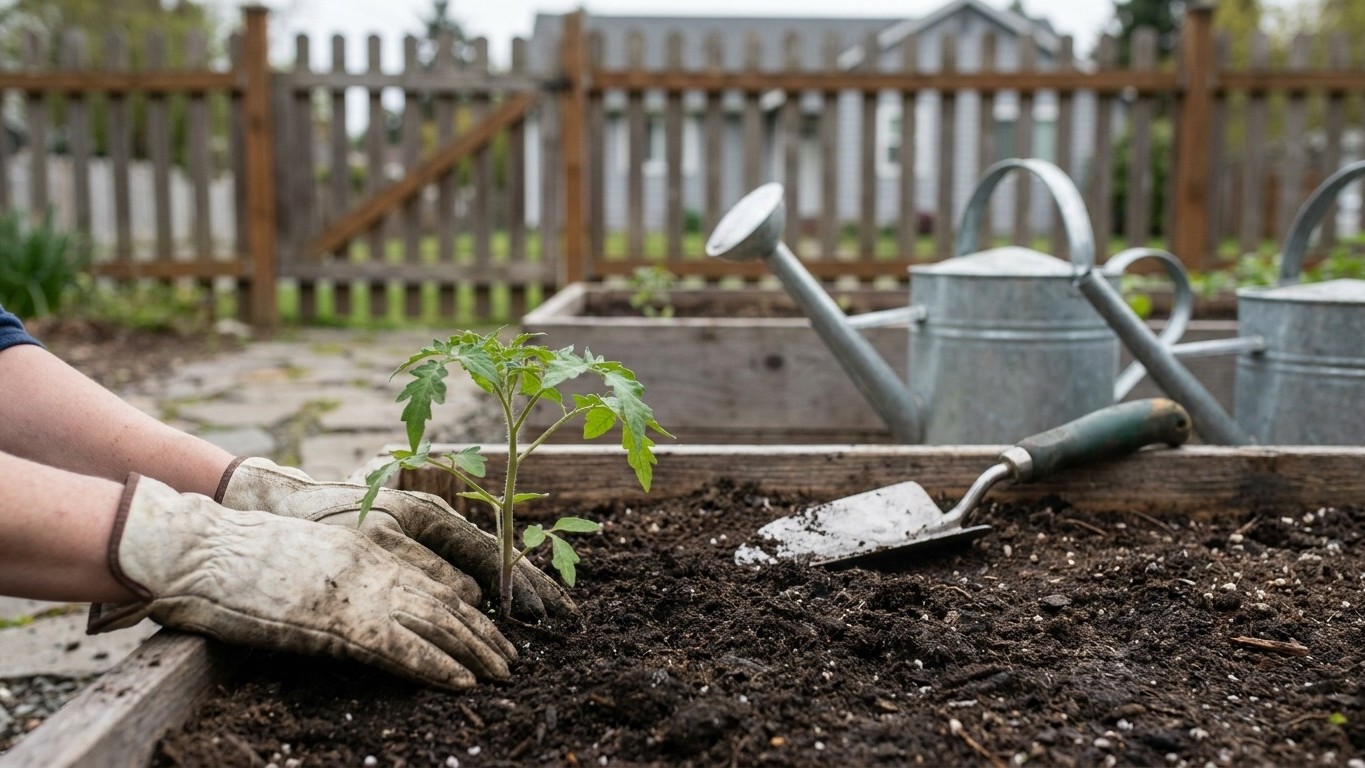

Mid-May, not the last-freeze date, is when tomatoes actually go into the ground on the western side of Washington. The frost-free window near Seattle stretches nearly eight months on paper, last spring freeze in early March, first fall freeze by late November, but cold, wet soil eats weeks off that front end regardless of what the thermometer says. The real math isn’t counting from the freeze date at all; it’s counting back from fall frost by whatever days-to-maturity your variety demands.
What this comes down to in Washington

In western Washington, the whole planting-date question comes down to the length of the frost-free window measured near Seattle. NOAA’s NCEI 1991-2020 normals put the last spring freeze there between February 27 and March 18, and the first fall freeze between November 13 and November 30. Subtract one from the other and the frost-free season looks like roughly eight months on paper. A tomato never actually gets the full eight months, because the soil and the light lag weeks behind the calendar date of the last freeze.
Why the frost window isn’t the planting date
The frost window itself is not the planting signal. It’s the outer boundary the season has to fit inside. West of the Cascades, spring soil stays cold and wet long after the air stops freezing, and short, gray days slow root growth even once the thermometer cooperates. Growers here treat the frost-free window as a budget to spend carefully, not a green light to plant tomatoes the day it opens. The real decision is which cultivar’s days-to-maturity fits inside that budget once you’ve backed off the front end for slow soil warming and the back end for shortening, cooling fall days.
This is also why a single frost date for the whole state is useless here. Eastern Washington, on the far side of the Cascades, is high desert with a much shorter, more sharply bounded season, and a Seattle-area frost window has no bearing on a garden in Spokane or the Columbia Basin. Anyone gardening outside the Puget Sound lowlands needs their own local frost data before doing any of this arithmetic; the section below on regional variation says more about that. For the growing methods you already have in hand, growing tomatoes in Washington covers the basics.
Working it out for your own garden
The method stays the same every year, even when the exact dates shift. Find your cultivar’s days-to-maturity, decide when you can realistically get a transplant into the ground, and check whether the sum lands before your first fall frost window.
Start with the catalog number. Days-to-maturity on a tomato seed packet is counted from the transplant date, not from seed-starting, and it assumes steady warm weather, a figure that shifts by a week or two either way depending on the season. Treat it as a target, not a guarantee.
Two cultivars, two outcomes
Take ‘Stupice‘, an early, cold-tolerant slicer around 55 days to maturity with small red fruit, bred for short seasons. Even accounting for the fact that transplanting happens well after the February 27 to March 18 frost window closes, once soil and night temperatures actually cooperate, 55 days later lands solidly in the middle of summer, with plenty of room before the November 13 to 30 fall frost window near Seattle (NOAA NCEI 1991-2020 normals). This variety has margin to spare.
Now take ‘Cherokee Purple‘, a large pink-red beefsteak around 80 to 85 days to maturity. Run the same arithmetic and the picture changes. Even started at the earliest realistic point in the season, 80 to 85 days later pushes into late summer, and that catalog figure assumes warm, sunny days that maritime Washington’s cooler, cloudier summers don’t always deliver in full. The fall frost window looks like enough room on paper, but the extra ripening time this climate quietly adds isn’t in the seed packet’s count. That’s why long-season slicers here often need the earliest possible transplant date plus a warming boost, such as black plastic mulch or a season-extending cover, to hit their numbers reliably.
| Cultivar | Catalog days to maturity | Margin before Seattle’s fall frost window |
|---|---|---|
| ‘Stupice’ | about 55 days | Comfortable |
| ‘Cherokee Purple’ | about 80 to 85 days | Tight, weather-dependent |
For a longer list of cultivars sorted by how well they fit this state’s season, Tomato Varieties That Ripen in Time in Washington breaks down more options than the two worked here.
What changes across the state
Everything above is anchored to one weather station near Seattle, and Washington’s geography makes sure that figure doesn’t travel far. The Cascade Range splits the state into two different growing climates, and a frost window measured in the Puget Sound lowlands tells you nothing about the high desert east of the mountains, where winters run colder and the frost-free season is shorter and more abrupt at both ends.
Elevation moves the numbers too, even within western Washington. A garden climbing into the foothills sits noticeably colder than one at sea level, with frost lingering later into spring and returning earlier in fall. Proximity to Puget Sound or the open coast tends to work the other way, since large bodies of water moderate temperature swings and push both the last spring frost and the first fall frost toward the milder end of the range NOAA’s normals describe for the Seattle station.
North-south position matters less here than elevation and distance from water, but it still nudges things. Valley floors that collect cold air on still nights run colder than open slopes nearby, regardless of latitude. The USDA’s Plant Hardiness Zone Map, built on 1991-2020 normals, puts the state anywhere from zone 4a to zone 9a, and that spread inside one state is the clearest evidence that no single planting date belongs to all of Washington. A zone 4a garden in a cold mountain valley and a zone 9a garden in a sheltered coastal pocket aren’t working from the same calendar, even though both are technically Washington gardens.
The takeaway isn’t that the Seattle figures are wrong. It’s that they are a reference point, not a rule. If your garden sits in a river valley, at elevation, or east of the Cascades, treat every number as a starting estimate to check against your own conditions.
The mistakes this state punishes

Three predictable mistakes
- Planting into cold soil after a warm spell. A run of sunny days in March can feel like spring has arrived, but soil temperature lags air temperature by weeks here, and a tomato set into cold, wet ground stalls instead of growing. It often ends up smaller at harvest than one planted two or three weeks later into warmer soil.
- Choosing a long-season slicer for a short-summer garden. A beefsteak bred for 80-plus days can look fine on paper against the November 13 to 30 fall frost window near Seattle, but that catalog figure assumes warm, sunny days maritime summers don’t always deliver, so the harvest slips later and later until frost catches the last fruit still green.
- Ignoring the pest calendar and losing a crop to something preventable. A handful of pests show up on a fairly predictable schedule in this state, and missing the early window to watch for them costs more than the plant it damages first. See Tomato Pests in Washington: Which Ones Actually Show Up Here for what to watch for and when.
The fix for all three is the same discipline: check soil, not just air, before transplanting; match a cultivar’s days-to-maturity to the season you actually have rather than the one you wish you had; and treat the fall frost window as the wall the whole season is built toward, not a distant deadline.
Checking this against your county
Everything here is anchored to one NOAA weather station near Seattle, and Washington has plenty of counties that don’t look anything like Seattle. Before committing to a transplant date, check your own county extension office for local frost records, and use WSU Extension as the next stop for statewide, Washington-specific tomato guidance. A statewide frost window is a starting point for the arithmetic, not an instruction for your particular yard, especially if you garden east of the Cascades, at elevation, or right on the water where the Seattle figures simply don’t apply.
Some gardeners also time this by the Moon: when to plant tomatoes by the moon, as almanac tradition rather than fact.
Common questions
Can I just use the average last frost date to set my transplant date?
Not really. Averages hide the years that run colder or later, and NOAA’s own window for Seattle already spans about three weeks (February 27 to March 18), so treat the whole range as real risk, not noise. Watch your own soil condition and the extended forecast the week before you plant rather than circling one date on the calendar.
What if I’m starting seeds indoors instead of buying transplants?
Then back up your seed-starting date from the transplant date you’re targeting, not from the frost window itself. Most tomato seedlings need several weeks of indoor growth before they’re sturdy enough to go outside, so add that stretch onto the front end of your calculation.
Does the first fall frost mean tomatoes stop ripening on that exact day?
No, ripening slows well before the actual frost as light and temperature drop through fall. A fruit still green a couple of weeks before the November frost window opens near Seattle may never finish ripening outdoors, which is part of why the “does it finish” math needs a safety margin, not just a bare days-to-maturity count.
Why does my neighbor a few miles away seem to plant earlier than me?
Local terrain is the usual culprit. A slope that drains cold air, a nearby wall or paved area that holds heat, or a low spot that collects frost can shift when soil is actually ready by a couple of weeks, even within the same town. Microclimate differences like these are exactly why a single reference-city frost window is a starting point, not gospel for every yard in the area.