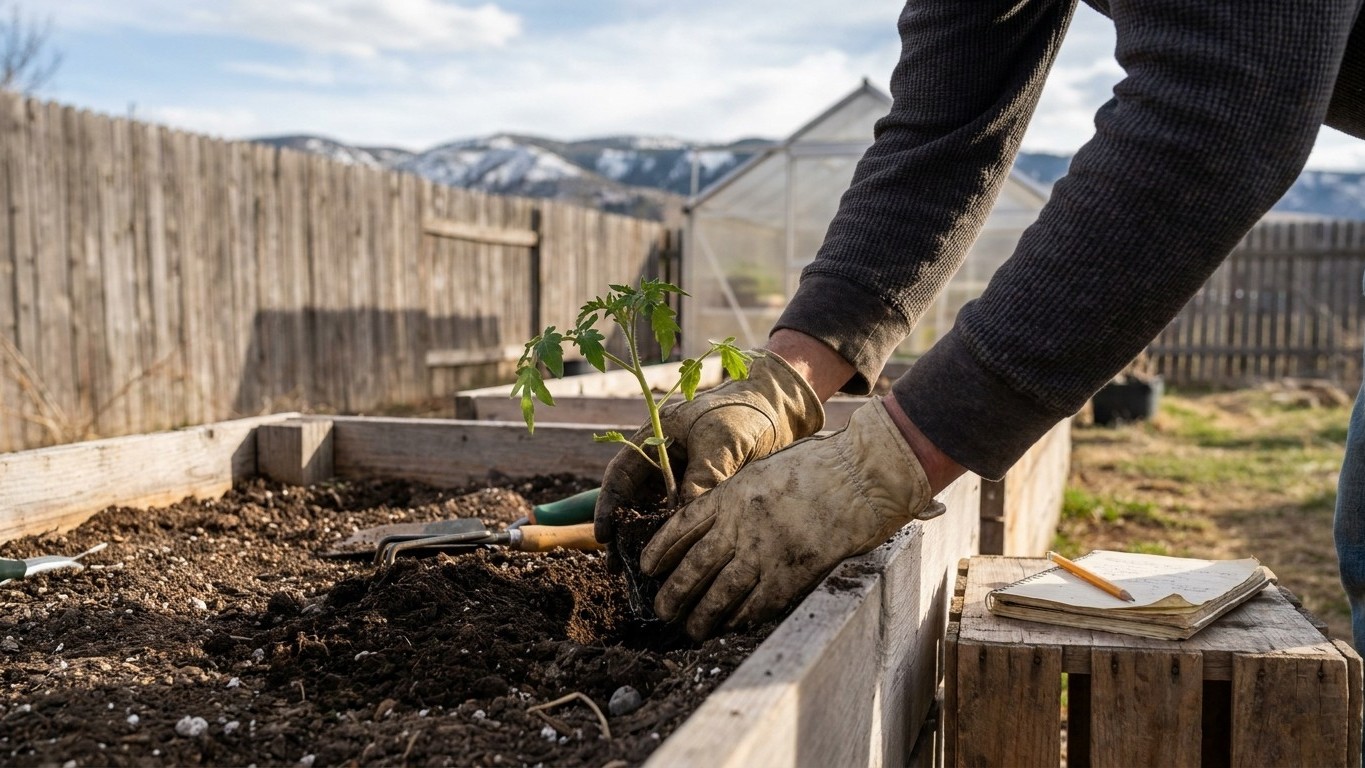

In Wyoming, Tomato Planting Dates hinge on the last spring frost, which NOAA’s NCEI 1991-2020 Climate Normals put at May 7 to May 18 for the Cheyenne station. To find your own transplant window, take a variety’s days-to-maturity figure and count backward from that range, then start seed indoors that many weeks earlier. Before you commit to a date, check your county’s own average last frost against Cheyenne’s, since the window moves with elevation across the state.
What this comes down to in Wyoming

Late May, and not a day before your last-frost date has actually passed — that’s the honest answer for most Wyoming gardens, with Cheyenne-area transplants typically going in between May 20 and June 10 once nights hold above freezing. Everything else is subtraction from there: count back six to eight weeks for starting seed indoors, and forward from transplant day for your variety’s days-to-maturity, because Wyoming’s frost-free window rarely stretches past mid-September and often closes sooner at elevation.
That window is short by national standards, and NOAA’s data carries a caution worth repeating: at 6,000 feet, a Wyoming garden gets roughly 130 frost-free days in an average year, and frost is possible in any month at higher elevations. That’s not a scare line, it’s the reason season extension in this state isn’t a nice-to-have. Row cover, cold frames, and walls-of-water around transplants aren’t optional extras here the way they might be in a longer-season state; they’re part of how Wyoming gardeners routinely beat a frost window this tight.
If you haven’t already worked through the basics of growing tomatoes in Wyoming, that’s the place to start before you fix a date, since soil temperature, hardening off, and site selection all affect when a transplant can safely go in. Once you’ve got that groundwork down, the planting date question becomes mostly arithmetic: how many days does your chosen variety need, and does the Cheyenne-area frost window give it enough room. The answer changes by variety, which is exactly why Tomato Varieties That Ripen in Time in Wyoming exists as its own page rather than a footnote here.
Working it out for your own garden
The method is the same whether you’re near Cheyenne or gardening at a very different elevation: count backward from the frost window using the variety’s days-to-maturity figure, and treat every result as a range, not a day.
The arithmetic, step by step
- Start with NOAA’s Cheyenne last-frost range: May 7 to May 18.
- Growers typically start tomato seed indoors six to eight weeks before their expected transplant date, so subtract that from the frost range to get an indoor-sowing window, not a single sowing day.
- Add the variety’s catalogue days-to-maturity, counted from transplant, to the transplant window itself to estimate a first-ripe-fruit range.
- Compare that ripening range against the fall frost window, September 24 to October 5, with some cushion, since catalogue figures shift by a week or two depending on the season’s heat.
Run that math on a short-season cultivar and the margin is comfortable. ‘Early Girl‘, roughly 50 days to maturity, transplanted anywhere in the May 7 to May 18 window, ripens well before midsummer and finishes with a full month or more of slack before the earliest fall frost date. That slack matters, because a cool, cloudy stretch in August can slow ripening by a couple of weeks and a short-season variety can absorb that. A cultivar like ‘Brandywine‘, often listed at 80 to 100 days, cannot absorb it the same way: transplanted at the later end of the frost window and counted out, its ripening estimate lands close enough to the September 24 start of the fall frost range that a slow season leaves it exposed. That’s not a reason to avoid it, but it is a reason to treat it as a variety that needs every extension trick available, not one to plant on a whim.
What changes across the state
Cheyenne’s frost data is a starting point, not a statewide instruction. The USDA Plant Hardiness Zone Map, using the same 1991-2020 climate normals, places Wyoming across zones 3a to 6a, and that spread tells you how much the state varies before you even get to frost dates. A garden at higher elevation than Cheyenne will typically see its last spring frost run later and its first fall frost run earlier than the Cheyenne window, which shortens the already tight frost-free season further. A garden at lower elevation, in a sheltered valley, or in a location that benefits from a large water body’s moderating effect can see the opposite: an earlier last frost and a later first one.
North versus south matters too, though not as a fixed offset you can apply everywhere. Latitude interacts with elevation and local terrain, so a northern county at a lower elevation can easily have a milder frost window than a southern county sitting higher in the mountains. Cheyenne’s numbers are a reference point, and every other part of the state needs its own station data to be treated as more than a rough guess.
Cold air pooling in valley bottoms, wind exposure on open plains, and the difference between a south-facing slope and a north-facing one can all shift frost timing by a meaningful margin within the same county, sometimes within the same few acres. If your garden sits in a low spot that collects cold air on clear, still nights, expect frost there before it shows up on a forecast built around a valley or town station a few miles away.
The mistakes this state punishes

The most common one is trusting a warm week too early. A stretch of 70-degree afternoons in early May feels like permission to transplant, but NOAA’s Cheyenne data puts the last frost as late as May 18 in a normal year, and a single clear night after a warm spell is often colder, not warmer, because there’s no cloud cover to hold heat in. Transplants set out into soil that hasn’t caught up to the air temperature sit and sulk even if they survive the cold snap, losing time they can’t get back in a 130-day season.
The second is picking a variety for its flavor reputation rather than its days-to-maturity figure. A 90-to-100-day heirloom is a fine choice in a state with a long, forgiving fall, but Wyoming’s first frost arriving as early as September 24 near Cheyenne doesn’t leave room for a slow finish. Match the variety’s catalogue days to the actual window you have, using the arithmetic above, before you fall in love with a seed catalogue photo. The Tomato Varieties That Ripen in Time in Wyoming page works through named cultivars against that same math in more depth.
The third mistake is timing pest management around a calendar date rather than watching for the pest itself. Wyoming’s tomato pests show up on their own schedule tied to temperature and plant stage, not the date on a seed packet, and missing the early window on one of them costs more than a late transplant does. The Tomato Pests in Wyoming page breaks down Which Ones Actually Show Up Here and when to start checking for them.
Checking this against your county
Cheyenne’s frost window is measured at one NOAA station, and it will not match every county in Wyoming. Before you lock in a planting date, check your own county’s frost data against it, and treat any gap as real rather than rounding it away. Your county extension office keeps records specific to your area, and the University of Wyoming Extension, at uwyo.edu/uwe, is the place to start looking for both that contact and the state’s own tomato growing guidance. A five-minute call or a look at their published data is worth more than assuming Cheyenne’s numbers travel unchanged to your backyard.
The Moon calendar is a separate, older custom: see when to plant tomatoes by the moon, written as tradition rather than fact.
Common questions
Can I direct-sow tomato seed outdoors in Wyoming instead of transplanting?
Almost nobody does this successfully here. With a frost-free season as short as roughly 130 days at higher elevations, per NOAA’s data caution, direct-sown seed loses too many weeks of a season that’s already tight, and transplants started indoors are how gardeners in this state make up that difference.
What happens if I plant tomatoes before the last frost date?
You risk losing the plants outright to a freeze, and even if they survive a light chill, cold soil slows root growth and stalls the plant for weeks afterward. Waiting until you’re solidly past the local last-frost range, or using row cover and other protection if you push earlier, avoids both problems.
Do these dates change if I garden at high elevation or in the mountains?
Yes, and usually toward a later last frost, an earlier first frost, or both. The Cheyenne-based window from NOAA is a reference point for that station’s elevation and location, not a fixed statewide rule, so higher gardens should expect a shorter effective season and plan variety choice and season extension around that.
How late can I still transplant tomatoes and expect a harvest?
It depends entirely on the variety’s days-to-maturity figure measured against the fall frost window, September 24 to October 5 near Cheyenne per NOAA. A short-season cultivar transplanted later in the spring window can still finish comfortably; a long-season one pushed late has little to no margin left before fall frost risk sets in.