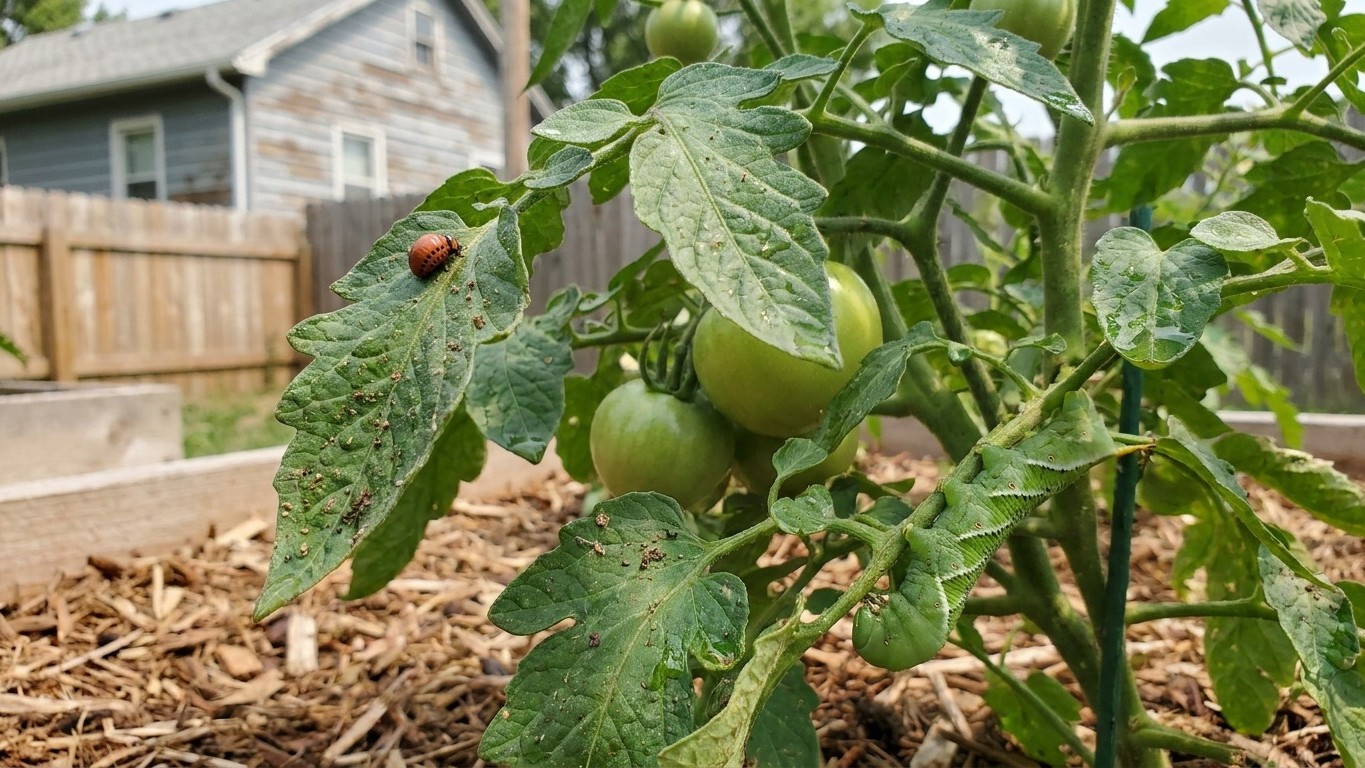

Six insects account for nearly every tomato problem gardeners in South Dakota deal with, and they show up in a fairly predictable order across the season: cutworms and flea beetles right after transplant, Colorado potato beetles and aphids through early summer, then spider mites and tomato hornworms as the season heats up toward the first fall freeze, which NOAA’s 1991-2020 climate normals put at September 24 to October 4 near Sioux Falls. Check your own plants against the descriptions below before you reach for a spray.
What this comes down to in South Dakota

If you’ve already worked through the basics of growing tomatoes in South Dakota, the pest side of the job is mostly about timing: knowing which insect to expect at which point in the season so you’re not scouting for the wrong thing. Most of the damage that gets blamed on disease or weather in South Dakota gardens is actually one of these six insects, caught too late because nobody was looking for it yet.
Cutworms
These show up the week or two right after you set out transplants, cutting young stems clean through at the soil line overnight. A collar of cardboard or foil pushed an inch into the soil around each stem stops them cold. There’s rarely a need for anything more.
Flea Beetles
Flea beetles hit seedlings and young transplants hardest, riddling leaves with tiny holes before the plant has enough leaf area to shrug it off. Floating row cover over young plants until they’ve hardened off keeps the beetles from ever landing; once plants are established, the damage looks worse than it usually is.
Colorado Potato Beetle
This one moves onto tomatoes from nearby potato plants or overwintering sites in the soil and can strip a plant of leaves fast once the larvae hatch. Hand-picking adults and squashing the orange egg clusters on the undersides of leaves works well in a home garden before the larval population builds.
Aphids
Aphids build up through early to midsummer on new growth and leaf undersides, curling leaves and leaving a sticky honeydew that then grows sooty mold. A hard spray of water knocks most colonies down, and ladybugs and lacewings usually keep small populations from ever becoming a problem if nothing broad-spectrum has already killed them off.
Spider Mites
These favor hot, dry stretches in mid to late summer and are easy to miss until leaves already look dusty and bronzed. A hose-end spray on the undersides of leaves, repeated every few days, breaks up the population; mites thrive in dust and dry heat more than in a healthy, well-watered plant.
Tomato Hornworm
Hornworms show up from midsummer into fall and can strip a branch of leaves in a night once they reach full size. They’re large enough to hand-pick despite their camouflage; look for dark, pellet-like droppings on the leaves below as the giveaway that one is feeding above.
Working it out for your own garden
Most of the guesswork in tomato pests comes down to matching the damage pattern to the culprit, since more than one insect can leave a similar-looking hole or a similar wilted stem. Start with where the damage is and what stage of the plant it’s on, then work outward from there.
Match the symptom to the pest
| What you see | Likely pest | Damaging life stage |
|---|---|---|
| Stem severed at soil line, seedling toppled | Cutworm | Caterpillar (larva) |
| Small round shot-holes across young leaves | Flea beetle | Adult beetle |
| Leaves stripped to the veins, orange larvae present | Colorado potato beetle | Larva |
| Curled, yellowing new growth, sticky residue | Aphid | Adult and nymph |
| Fine pale speckling, webbing on leaf undersides | Spider mite | Adult and nymph |
| Large chunks missing from leaves and green fruit | Tomato hornworm | Caterpillar (larva) |
That table gets you most of the way to an identification without a magnifying glass. If the damage doesn’t match any row cleanly, take a photo and a sample leaf to your county extension office rather than guessing at a treatment. Treating the wrong pest wastes a spray cycle and can kill off the predators that would have handled the real problem for you. The same logic applies to timing your defenses around transplant: if you haven’t nailed down when to actually put plants in the ground, work that out first using the frost window and the guidance in Tomato Planting Dates in South Dakota: Counting Back From Your Frost Window, since cutworm and flea beetle pressure both hit hardest in that first couple of weeks after transplant.
What changes across the state
The reference figures above come from the airport station near Sioux Falls, and pest timing shifts with the same factors that shift frost dates. The USDA Plant Hardiness Zone Map places South Dakota across zones 3b to 5b, and that spread tells you the western part of the state, especially at higher elevation near the Black Hills, runs a shorter and cooler season than the eastern river valleys. A shorter season generally means a compressed pest window too: Colorado potato beetle and aphid populations that build slowly over a long warm stretch near Sioux Falls may barely get a second generation going in a cooler, higher spot further west.
Distance from the Missouri River corridor and local topography also matter more than most gardeners expect. Low-lying gardens near water tend to hold humidity longer into the evening, which favors aphid buildup, while drier upland gardens are more prone to the dusty conditions spider mites like. None of this changes which six pests you’re watching for, just how early each one shows up and how fast it builds once it does. If your county consistently runs a week or two behind or ahead of the Sioux Falls window for frost, expect pest arrival to shift by roughly the same margin.
The mistakes this state punishes

The single most common mistake is reaching for a broad-spectrum insecticide the first time damage shows up, before confirming which pest is actually responsible. That approach kills the ladybugs and lacewings that would have kept aphids in check on their own, and it does nothing for cutworms, which feed underground and at night where a foliar spray never reaches them.
The second mistake is skipping row cover on young transplants because the plants look sturdy enough. Flea beetles do the most damage in that first week or two after transplant, before the plant has built enough leaf area to outgrow the holes, so cover matters most exactly when it’s easiest to skip.
The third is letting Colorado potato beetle egg clusters go unchecked because they’re mistaken for a harmless insect egg mass. A few minutes checking the undersides of leaves for the tight, orange-yellow clusters every few days through early summer catches the problem before the larvae hatch and start stripping foliage, which is far less work than hand-picking a full-grown larval outbreak later.
- Confirm the pest before spraying, using damage location and life stage, not just “there’s a bug on it.”
- Cover transplants against flea beetles for the first couple of weeks, not just the first few days.
- Check leaf undersides weekly for Colorado potato beetle eggs through early summer.
Checking this against your county
Every figure and pattern here is a starting point built around the Sioux Falls reference station, and pest pressure in your own yard depends on your county’s microclimate, your soil, and what was planted nearby last year. For a second opinion tuned to your county, check with SDSU Extension, which fields exactly these identification questions and can point you to current, local guidance. If you’re still deciding which cultivar to plant around this pest calendar, Tomato Varieties That Ripen in Time in South Dakota covers that ground separately.
Common questions
Do I need to spray for hornworms every year?
Not necessarily. Hand-picking is usually enough in a home garden, and some years the population barely shows up at all, especially if parasitic wasps have already found the caterpillars, which you’ll see as small white cocoons stuck to the hornworm’s back.
What eats tomato hornworms naturally?
Braconid wasps are the main one, and a hornworm covered in small white rice-grain-shaped cocoons should be left alone rather than squashed, since it’s already been parasitized and will die on its own while the wasps do the work for you.
Are Colorado potato beetles only a problem if I grow potatoes too?
No. They’ll move onto tomatoes and eggplant from potato plants, weedy nightshades, or just overwintering adults in your soil, so a potato-free garden doesn’t guarantee you’ll never see them.
Why do my leaves look speckled and dusty but I can’t find any bugs?
That’s the classic sign of spider mites, which are small enough to be nearly invisible to the naked eye. Check the underside of a speckled leaf for fine webbing, and if you find it, a strong spray of water on the leaf undersides every few days is usually enough to knock the population back.