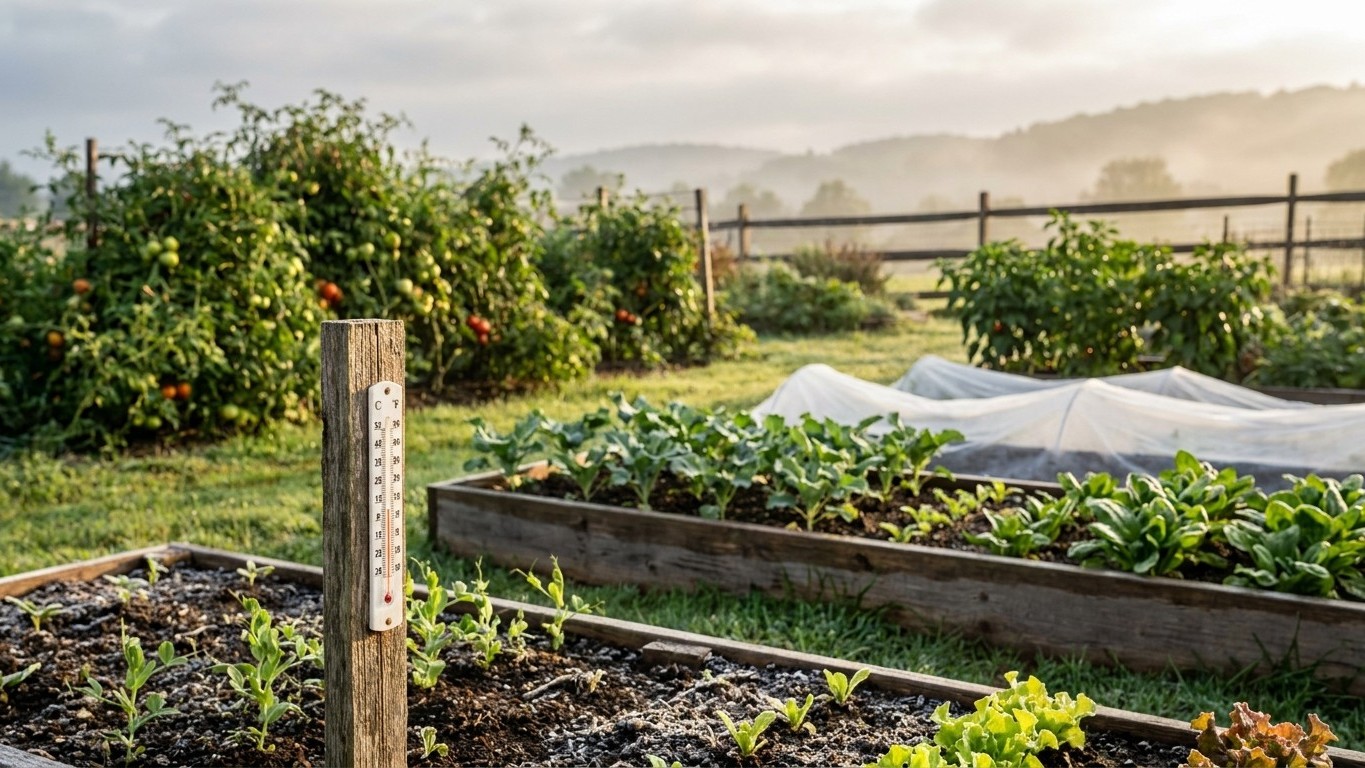

Pennsylvania’s growing season runs from a last spring frost in late March to early April down south to a first fall frost in early-to-mid November, but that range hides a lot: the state stretches across three USDA hardiness zones, and a planting date that works in Philadelphia can be weeks off in the northern tier. Here’s what the numbers actually allow, and where they stop being useful.
How long your season really is

Three figures set the boundaries of what you can grow here. The USDA places Pennsylvania across zones 5a through 7b, built on the average annual extreme minimum temperature. The average last spring frost falls between March 29 and April 6. The average first fall frost falls between November 5 and November 16. Subtract one from the other and you get the frost-free window, the single number that decides everything else you might attempt in a Pennsylvania garden.
| Measure | Value |
|---|---|
| USDA Hardiness Zone | 5a to 7b |
| Average last spring frost | March 29 to April 6 |
| Average first fall frost | November 5 to November 16 |
Depending on where you sit inside that range, you’re looking at something like seven months, give or take, between the two frost dates. That’s enough for a full run of long-season tomatoes and peppers if you’re near Philadelphia (see this guide on Growing Peppers in Pennsylvania for variety-specific timing), and considerably tighter if you garden in the Alleghenies or the northern counties, where both frost dates shift two to four weeks in the harder direction: later in spring, earlier in fall. A 90-day watermelon variety that comfortably matures in the southeast can run out of season entirely in the state’s colder pockets, and long-vining crops like those covered in this guide on Growing Pumpkins in Pennsylvania need that timing checked carefully too, though cold-hardy crops fare better in those shorter windows, as covered in these guides on Growing Beets in Pennsylvania, Growing Parsnips in Pennsylvania, Growing Spinach in Pennsylvania, and Growing Carrots in Pennsylvania.
The word “average” here is doing real work, and it’s worth taking seriously. These dates come from a 30-70% freeze probability band in the NOAA 1991-2020 climate normals, which means they’re not a guarantee. By definition, roughly half of all years bring a frost later than the spring date or earlier than the fall date. Treating the average as a safe date is how gardeners lose a tray of pepper seedlings to a mid-April cold snap that was never against the odds, just against the average. Build in a buffer of a week or two on both ends, especially for anything started indoors and transplanted early.
What the summer does to a garden here
Heat load matters as much as season length, and Pennsylvania’s summers aren’t uniformly mild. The reference station averages 24.0 days a year at or above 90F, and the coldest month brings an average daily minimum of 26.0F. That second figure is what determines whether a perennial or a fall-planted crop actually survives the winter here, not the season’s record low, but the typical overnight floor during the coldest stretch.
The heat number changes how you should think about the growing calendar. Above roughly 90F, tomato flowers drop instead of setting fruit, lettuce and spinach bolt and turn bitter, and most cool-season crops simply stop being viable outdoors. With 24 days a year crossing that line, Pennsylvania gardens don’t get one uninterrupted growing season so much as two productive shoulders with a rough patch in the middle. Spring plantings of lettuce, spinach, and peas need to be in and mostly harvested before the heat arrives; a second round goes in as temperatures ease in late summer for a fall harvest.
That middle stretch, typically mid-July through August, isn’t dead ground. It’s just the wrong window for cool-season crops and the right one for the heat-lovers: tomatoes, peppers, squash, and beans that were started early enough to already be established before the hottest days hit. Gardeners who plant everything at once in May and expect steady production through September are usually the ones disappointed by a lettuce bed that bolted in June and a tomato plant that stalled in late July.
What tends to go wrong in Pennsylvania
Penn State Extension’s home garden pest reports point to a recurring cast, not an endless list. Knowing when each one shows up matters more than memorizing its name.
- Brown marmorated stink bug: shows up from midsummer through fall, feeding on developing fruit and leaving discolored, dimpled patches on tomatoes and tree fruit.
- Spotted lanternfly: nymphs appear in late spring, adults from midsummer into fall, both stages feeding on plant sap and excreting a sticky residue that can lead to sooty mold.
- Tomato and tobacco hornworm: caterpillars turn up in mid-to-late summer, stripping tomato and pepper foliage fast enough to defoliate a plant in days.
- Japanese beetle: adults emerge in early-to-midsummer, skeletonizing leaves on a wide range of plants down to the veins.
- Squash vine borer: adult moths lay eggs in early summer, and by midsummer the larvae are tunneling inside stems, causing sudden wilting in otherwise healthy squash plants.
Aphids, Colorado potato beetle, flea beetles, cabbage worms and leafminers, and onion thrips and maggot round out the list Penn State Extension flags for home gardens. None of this means every garden in the state sees every pest every year; pressure varies by county and by season. It does mean these are the ones worth checking for before assuming a problem is something rarer.
Where to check before you plant
Everything above is a state-level average, and Pennsylvania is big enough that a state-level average can mislead you at either edge. A planting calendar tuned to Philadelphia’s frost dates and heat load doesn’t hold up in Erie or in the higher elevations of the Alleghenies, where spring arrives later, fall arrives sooner, and the effective growing season can run three weeks shorter than the figures above suggest.
Penn State’s land-grant extension service is the resource built for that gap. Its home gardening program publishes region-specific planting guides, pest identification tools, and soil testing services that account for local variation the state averages can’t capture. Your county extension office goes a step further, with staff who track what’s actually happening in local gardens that season, from a wet spring delaying planting to a pest showing up earlier than usual.
Understand the shape of a Pennsylvania growing year: the length of the frost-free window, the summer heat load, the pests worth watching for. Use the extension service to pin down what that means for your specific county, your specific soil, and the specific week you should be putting seeds in the ground.
Where to Go Next, Crop by Crop
None of this matters as an abstraction — it only means something once you’re deciding what to put in the ground and when. If you’re weighing whether the state’s winters actually get cold enough to split cloves properly, the guide to growing garlic in Pennsylvania works through that county by county, starting with the supposedly mild corner around Philadelphia. If your patch of ground is really just a yard, the piece on Pennsylvania lawn care gets into why the state’s short bursts of punishing heat, not the cold, are what actually wreck a cool-season lawn, and why there’s no single seed blend that covers the whole state. And if tomatoes are the point of the whole exercise, the rundown on growing tomatoes in Pennsylvania lays out why a planting date that works in Erie can ruin a tray of seedlings near Philadelphia, and the reverse. Read them with your own frost dates and soil in mind — the point of each one is to replace a single statewide rule with the version that applies to where you actually garden.