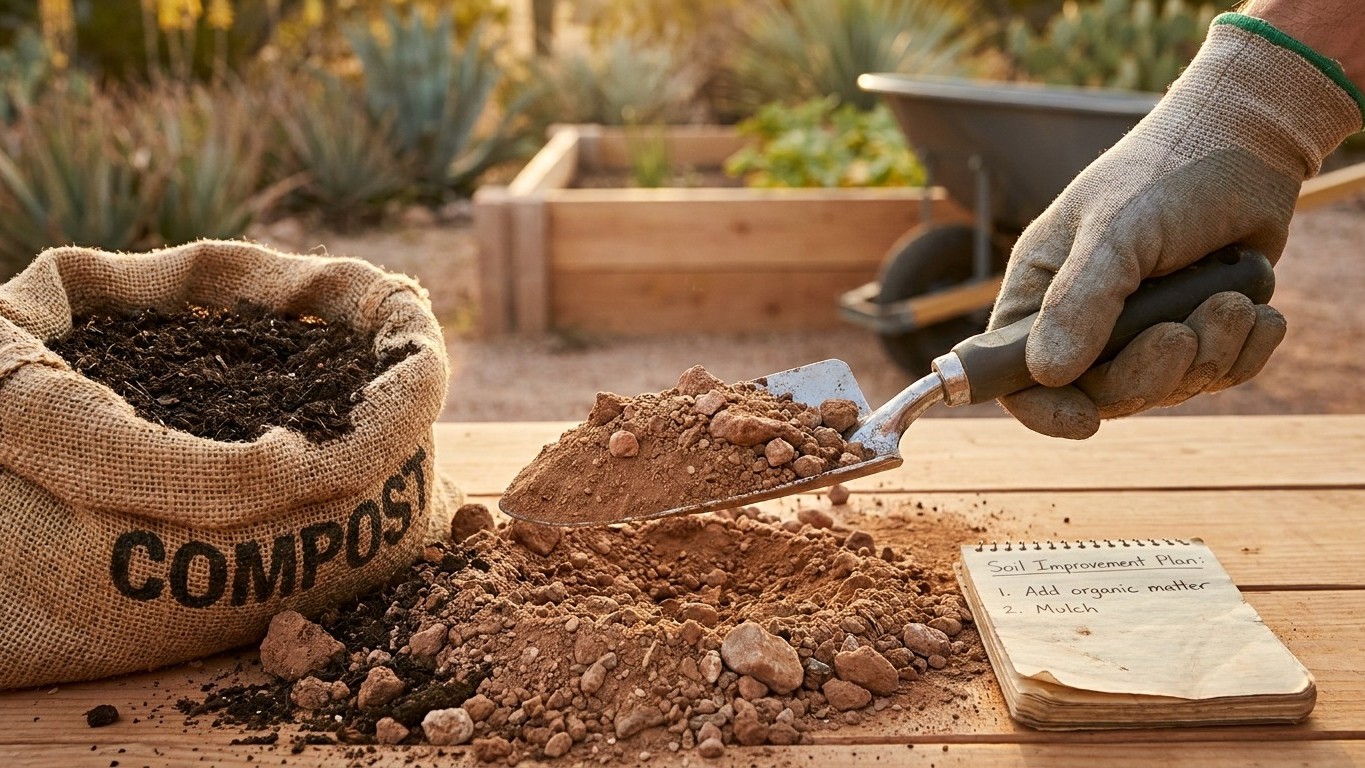

Casa Grande soil is the ground that represents Arizona: sandy, alkaline, and thin on organic matter, nothing like the dark rich loam most gardening advice assumes you have. Dig a shovel down almost anywhere in the low desert and you’ll likely hit pale, gritty dirt that drains fast and holds almost nothing back. Grab a handful and run the ribbon test on it before you buy a single bag of amendment.
What is under your garden

The soil USDA lists as representative of Arizona is the Casa Grande series, an Aridisol, the classification given to dry-climate ground that has never had enough rainfall to wash its salts and minerals away. According to USDA NRCS Soil Data Access, the surface horizon of the Casa Grande series runs about pH 8.5, decidedly alkaline, and is 64 percent sand, 14 percent clay and 22 percent silt, with organic matter around only 0.8 percent. USDA NRCS also classes it as well drained, which sounds like good news until you realize a sandy, low-organic-matter soil like this one drains so fast it can’t hold water or nutrients for long either.
That combination, sandy, alkaline, and starved of organic matter, is what shapes gardening advice across the low desert around Phoenix, where the Casa Grande series was mapped. It is not a verdict on your particular yard. Arizona runs from mountain forest to river bottom to desert flat, and the soil under any one of those can look nothing like the state figure, especially if you garden elsewhere in the state, an area our Arizona guides cover in more detail. Ground a builder scraped, graded and refilled during construction is its own animal entirely, compacted subsoil dumped where topsoil used to be, with none of the structure either the original ground or the Casa Grande series ever had.
Reading your own dirt in five minutes
Two home tests tell you more in five minutes than any brochure. For the ribbon test, wet a small handful of soil until it holds together like putty, then squeeze it between thumb and forefinger and let it slide upward into a ribbon. Sandy soil won’t ribbon at all, it just crumbles apart. Silty soil forms a short ribbon that breaks within an inch or two. Clay-heavy soil ribbons out two inches or more before breaking, and it feels slick rather than gritty as you work it between your fingers.
The jar test takes longer but shows you actual proportions. Fill a clear jar about a third full of soil, top it off with water, shake it hard, and set it down undisturbed overnight. Sand settles to the bottom within a minute, silt follows over the next hour or so, and clay stays suspended longest, settling out last as a fine layer on top, sometimes taking a full day to finish. Comparing the thickness of each layer gives you a rough read on your own sand-silt-clay ratio, and that number is worth more to your garden plan than the state average ever will be.
Testing before you amend
Guessing at soil amendments wastes money twice: once on the bag you didn’t need, and again when the plant that actually needed something else keeps struggling. A lab soil test tells you what your eyes cannot, the real pH, the phosphorus and potassium levels, and often a salinity reading, a genuine concern on ground descended from Aridisols like the Casa Grande series. None of that shows up by looking at or squeezing the dirt.
Take a representative sample, not a single scoop from one spot. Pull six to eight cores from around the bed, avoiding the edges and any spot where you’ve recently dumped ash or fertilizer, at the depth roots actually occupy, roughly the top six to eight inches for most vegetables. Mix the cores together in a clean bucket, break up clumps by hand, and send in about a pint of the combined soil.
Given the Casa Grande series’ surface pH of about 8.5 as measured near Phoenix, per USDA NRCS, a gardener anywhere in the low desert can reasonably expect alkaline ground before the results ever come back. Expecting is not knowing, though. Your particular pH could run higher or lower depending on irrigation water, past amendments, and how much the site has been disturbed, and the only way to plan a correction with real confidence is the number on your own report, not the regional figure.
When the results arrive, compare the organic matter reading against that 0.8 percent state figure for the Casa Grande series. A bed that has had compost worked in for a few seasons often tests well above that, and a number close to zero tells you the bed needs organic matter before it needs anything else. Watch the salinity reading too. Aridisols often carry salts that never got rained away, and a high electrical conductivity result means the bed needs a deep, thorough leaching watering before you plant, not just another round of fertilizer.
Amending it

The Casa Grande series’ surface pH of about 8.5 points one direction only, this ground runs alkaline, and every correction you make should push it down, gently, never up. Never add lime to soil in this range. Lime is a tool for acid ground, and Arizona’s representative soil sits nowhere near acid. Piling lime on already alkaline soil only locks nutrients further out of reach.
The honest correction for alkaline desert soil is elemental sulfur and organic matter, worked in over time. Sulfur reacts slowly with soil bacteria to form sulfuric acid, nudging pH down a little each season, and it needs moisture and warmth to do that work at all. Compost, aged manure and leaf mold do double duty here. They buffer pH toward neutral and replace some of the 0.8 percent organic matter this soil starts with, according to the state figure. Expect this to take seasons, not weeks. Nobody sulfurs a bed in spring and expects a different number by early summer.
High pH is also why iron goes out of reach for plants long before the soil is actually short of it. At a pH near 8.5, iron converts to forms roots can’t absorb, and the classic symptom is new leaves turning yellow while the veins stay green, iron chlorosis, common on roses, citrus and many vegetables grown in unamended desert soil. A foliar iron chelate gives a quick green-up. Lowering the pH with sulfur and organic matter is the slower fix that keeps the problem from returning every season.
The sand and clay figures matter just as much as the pH. At 64 percent sand and only 14 percent clay, the Casa Grande series drains fast and holds almost nothing back, water or nutrients alike. The fix is organic matter again, worked into the top six to eight inches, plus a shorter, more frequent watering schedule than you’d use on heavier ground, because a sandy profile like this one simply can’t store a deep soak the way clay soil would. Gardeners coping with the opposite problem, heavy acid clay that needs lime rather than sulfur, will find that whole correction laid out in our Georgia soil guide. Never try to fix sandy soil by adding clay, and never try to fix clay by adding sand. In the wrong ratio those combinations behave more like concrete than either soil did alone.
Some of this work pays off fast. A load of compost changes how sandy soil holds water within a single watering cycle. Pushing an alkaline pH down a full point is a three-season project at best, and gardeners who expect it to happen in one season usually end up over-applying sulfur and stressing the plants they were trying to help.
Drainage and compaction
USDA NRCS lists the Casa Grande series as well drained, and in practice that means water landing on it moves through the top layers quickly rather than pooling. That’s a mixed blessing. It also means the bed dries out fast between waterings, and organic matter worked into fast-draining, sandy soil under desert heat burns off faster than it would in slower, heavier soil elsewhere.
Running your own percolation test
Don’t take the series figure as a guarantee for your own yard, particularly if the site has been graded or filled. Dig a hole about a foot deep and a foot across, fill it with water, and let it drain completely once to saturate the surrounding soil. Fill it a second time and time how far the water level drops in an hour.
- More than 2 inches an hour: fast-draining, close to what the Casa Grande series figure suggests, and you’ll need to water more often in smaller amounts.
- About half an inch to 2 inches an hour: a normal range for most garden plants without special adjustment.
- Less than half an inch an hour: standing water and root rot risk, usually a sign of compaction or a clay lens under fill soil, not the native series itself.
Compaction from foot traffic, wheelbarrows and equipment squeezes the pore space out of any soil, sandy or not, and a compacted layer a few inches down will perch water above it even in ground that’s naturally well drained. Prairie soils that hold water far longer to begin with face a different version of this problem, covered in our Nebraska soil guide. Double digging, once standard advice for breaking up compaction, has fallen out of favor because it destroys soil structure and microbial layers that take years to rebuild, often for a fix that lasts one season before foot traffic compacts the bed right back down.
On ground that’s been scraped and refilled during construction, or anywhere the percolation test comes back slow, a raised bed is often the honest answer rather than three years spent amending soil you didn’t choose. Building up twelve to eighteen inches of good soil over compacted fill sidesteps the drainage problem entirely and lets roots grow in a mix you can actually control.
Local help
The most useful next step for any Arizona gardener is a real soil test rather than another guess. Arizona Extension runs soil testing through its county offices, and a county agent will typically walk through the results with you rather than just mailing back a number sheet. Bring your sample and ask specifically about pH and salinity, given how much of the state sits on alkaline, salt-prone ground like the Casa Grande series.
Common questions
Why does my Arizona soil have a white crust on top?
That’s usually salt, not lime or mineral buildup. Aridisols like the Casa Grande series often carry salts that were never rained away, and they rise to the surface as irrigation water evaporates. A deep, slow watering that pushes moisture well below the root zone flushes salts down rather than letting them concentrate at the top.
If I already know the region runs alkaline, do I still need a soil test?
Yes. The 8.5 figure for the Casa Grande series is measured near Phoenix and tells you what to expect, not what your yard actually has. Irrigation water, old amendments and site disturbance can all shift your number in either direction, and sulfur applications based on a guess instead of a lab result waste both money and a season.
Can I grow vegetables in Arizona soil without amending it first?
Rarely, given the Casa Grande series’ organic matter figure of around 0.8 percent. Most vegetable crops want considerably more organic matter than that to hold moisture and feed roots between waterings, so working in compost before planting saves you a season of disappointing yields.
Is a cheap home pH kit good enough, or do I need a lab test?
A home kit gives a rough ballpark and is fine for checking whether sulfur applications are moving the needle over time. For the actual number, plus phosphorus, potassium and salinity, a lab test through your county extension office reads more accurately and is worth doing before you commit to a full amendment plan.