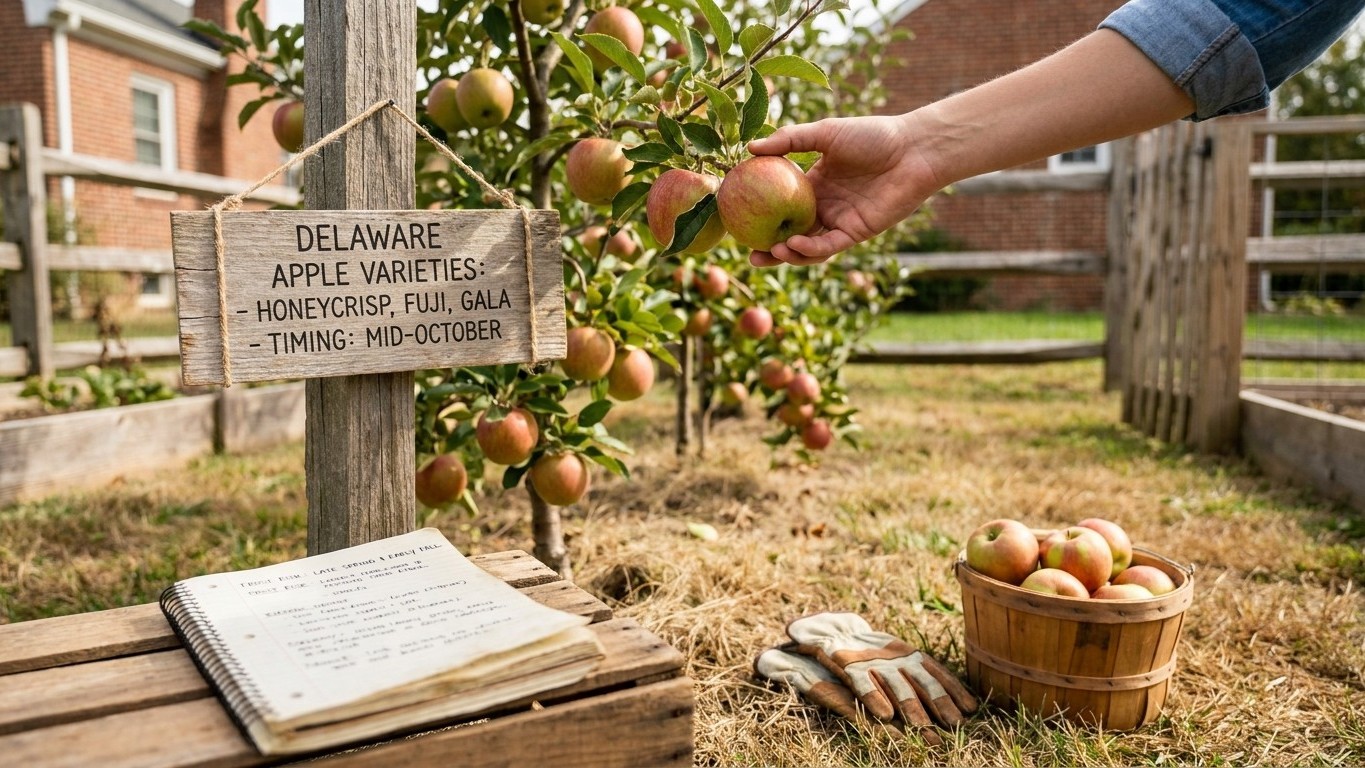

Delaware grows apples reliably in most of the state. NOAA’s 1991-2020 climate normals put the coldest month’s average minimum at 24.6°F at the Wilmington reference station, and the USDA Plant Hardiness Zone Map (2023 update, based on 1991-2020 normals) puts the state in zones 7a to 8a. That range is warm enough to grow apples without winter kill as long as you match the variety’s chill requirement to a mid-Atlantic winter. Do this first: check your county against the USDA map before ordering trees, since a Wilmington-area yard and a spot further inland or at higher ground can sit in different zones within the same state.
Can you grow apples in Delaware
Yes. Apples need real winter cold to set fruit well, and Delaware has it. The Wilmington reference figures from NOAA’s NCEI, a coldest-month average minimum of 24.6°F and a hardiness range of 7a to 8a, sit squarely in the range where standard commercial apple cultivars perform. That is milder than New England or the Missouri Ozarks, but nowhere close to the near-frost-free winters that rule out apples along the Gulf Coast.
Hardiness versus microclimate
Hardiness zone tells you whether the tree’s wood survives winter. It does not tell you whether the tree will flower and fruit well, and it does not describe every backyard in the state the same way. Wilmington’s numbers come from an airport weather station, and a garden a few miles inland, at higher elevation, or away from the moderating effect of the Delaware River will run colder in winter and colder on a spring morning than the reference figures suggest. Treat the Wilmington numbers as a starting point, not a guarantee for your own yard, and check your specific county placement on the USDA map before you commit to a cultivar bred for a narrower zone range.
Southern Delaware, close to the Delmarva coast, tends to run a touch milder than the northern part of the state near Wilmington, which matters mostly for how early bud break starts, not for whether the tree survives. Growers anywhere in the state can plant the same core list of cultivars. What changes county to county is spring timing, best tracked with a Delaware apple Calendar, and how much frost protection a given site needs.
The bigger risk in Delaware is not winter cold killing the tree. It is a warm stretch in late winter pushing buds out early, followed by a frost that catches the flowers when they have already opened or nearly opened. That risk is the same one growers deal with across the Mid-Atlantic and it is the reason variety choice and bloom timing matter as much as raw hardiness.
Which varieties suit this climate

Start with hardiness, then filter by winter hardiness and bloom timing; for a full rundown of cultivars that perform well here, see Delaware apple Best varietiester chill, the number of hours a tree needs below roughly 45°F before it will break dormancy and flower evenly. Get the chill wrong and the tree does not die. It flowers thin, ragged, and over a longer stretch than it should, which cuts pollination and yield. Delaware’s winters supply plenty of chill for the moderate-to-high chill cultivars bred for the mid-Atlantic and Northeast, so the filter here works in the grower’s favor rather than against it. That is the opposite problem faced by growers further south: a page on Florida apples has to steer readers toward low-chill selections bred for under 400 hours, and a Delaware-bred low-chill tree would simply be the wrong tool for a colder winter, not a better one.
‘Liberty’

‘Liberty’ is bred for disease resistance, with strong field resistance to apple scab and good tolerance of cedar apple rust and fire blight, which cuts spray needs. Catalog hardiness runs roughly zone 4 to 7, chill requirement around 800 to 1,000 hours, and it blooms mid-season with an early-to-mid fall harvest.
‘Enterprise’

‘Enterprise’ is another scab-resistant selection, hardy through roughly zone 4 to 8, needing around 800 chill hours. It blooms on the later side of mid-season and keeps well in storage after a late-fall harvest, which suits a grower who wants fruit past October.
‘Gala’

‘Gala’ is widely grown from roughly zone 5 to 8 and needs a comparatively modest 500 to 600 chill hours for a mid-Atlantic tree, which Delaware supplies without trouble. It blooms early to mid-season and ripens in late summer to early fall, well before most other cultivars on this list.
‘Golden Delicious’

‘Golden Delicious’ covers roughly zone 5 to 9 and needs around 600 to 700 chill hours. It blooms mid-season and is a reliable diploid pollen source, which makes it a common second tree in a two-tree planting even for growers who are not planning to eat many Golden Delicious apples themselves.
‘Arkansas Black’

‘Arkansas Black’ runs roughly zone 5 to 8 with a higher chill need, around 800 to 1,000 hours, blooms late, and is harvested late in the fall. It stores for months in a cool cellar, which is its main selling point over the earlier-ripening cultivars above.
| Variety | Catalog hardiness zone | Approx. chill hours | Bloom timing | Disease resistance |
|---|---|---|---|---|
| ‘Liberty’ | 4-7 | 800-1,000 | Mid-season | Scab-immune, good rust and fire blight tolerance |
| ‘Enterprise’ | 4-8 | ~800 | Late mid-season | Scab-resistant |
| ‘Gala’ | 5-8 | 500-600 | Early to mid-season | Average, needs a spray program |
| ‘Golden Delicious’ | 5-9 | 600-700 | Mid-season | Average, prone to scab in wet years |
| ‘Arkansas Black’ | 5-8 | 800-1,000 | Late | Good, ages well in storage |
No Delaware-specific university list ranking these cultivars for the state was available for this page. The chill and hardiness figures above come from standard nursery and extension catalog data, which is the same everywhere the tree is sold. Confirm your final short list with the state extension service before ordering, since local spray timing and disease pressure can shift the calculus between two otherwise similar cultivars.
Planting a pair that works here
Almost no apple variety reliably pollinates itself. Plant two different cultivars that bloom at overlapping times, close enough for bees to move between them, and at least one of the two needs to produce fertile, viable pollen.
Good pairings for this climate
Among the varieties above, ‘Gala’ and ‘Golden Delicious’ overlap well since both fall in the early-to-mid-season bloom window, and ‘Golden Delicious’ is a dependable pollen source. ‘Liberty’ and ‘Enterprise’ also work as a pair, both blooming mid-to-late season with fertile pollen on both sides, and both bring scab resistance to the planting. Pairing an early bloomer like ‘Gala’ with a strictly late bloomer like ‘Arkansas Black’ is the riskier combination, since a narrow overlap at the tail end of one tree’s bloom and the front end of the other’s leaves fewer days for bees to do the work.
Watch for triploid varieties with sterile pollen, such as ‘Winesap’ and ‘Jonagold’. A triploid tree still needs a pollinator itself, and it will not do the job for a second tree, so a planting built around a triploid needs a third, diploid variety in the mix to pollinate both. This single detail sinks more first-time two-tree orchards than winter cold does.
Crabapples with overlapping bloom also work as pollen donors if you are short on space, since many flower reliably and produce ample pollen without taking up a full tree’s worth of ground.
The frost that costs a crop here

NOAA’s NCEI 1991-2020 climate normals put the last spring freeze at the Wilmington reference station between April 3 and April 14, based on the 30 to 70 percent freeze probability band. That is a range, not a single date, and it comes from an airport station. Suburban and rural gardens elsewhere in the state typically see their last frost later than that window, sometimes by a week or two, and gardens at higher elevation or in low-lying frost pockets can run later still. Check your own county’s frost history rather than relying on the Wilmington figure alone.
What frost actually kills
The tree itself tolerates a hard freeze once it is dormant. The danger window opens once the flower buds show pink, the stage just before the petals open, and it stays open through bloom and petal fall. A freeze that hits an apple orchard once the buds are showing pink or the flowers are open kills the flowers, and with them the year’s crop, while the tree itself leafs out fine and looks perfectly healthy a week later. That mismatch, a healthy-looking tree with no apples, confuses a lot of first-year growers who assume something is wrong with the tree rather than the timing.
A late-blooming cultivar is the real insurance against this risk in a climate where frost lingers into April. Among the varieties above, ‘Enterprise’ and ‘Arkansas Black’ bloom later than ‘Gala’, which buys extra days past the Wilmington frost window before the flowers are exposed. Growers further inland dealing with sharper, more continental frost swings, the kind covered on Growing Apples in Missouri: Varieties, Timing and Frost Risk, lean on late bloom even harder, since Missouri’s spring frosts can be more abrupt than Delaware’s milder, coastal-moderated pattern.
Practical steps that help on a frost-threatened night include:
- Covering young or dwarf trees with row cover or old sheets before a forecast freeze during bloom
- Planting on a slight slope rather than a low spot, since cold air pools in the lowest ground on a clear, calm night
- Delaying pruning until late winter so the tree does not push growth too early in a warm spell
- Choosing at least one later-blooming variety in a two-tree planting as a hedge against an early bloomer losing its whole crop
None of these steps move the frost date. They buy a tree a few degrees of protection or a few extra days of bud dormancy, which is often the margin between a full crop and none.
The apple year in Delaware
Apple timing is best read off the tree’s own stage, not the calendar, because a warm March or a cool April shifts every stage by a week or more in either direction.
Dormancy

This runs through winter into late February or early March in most of the state. Prune during this stage, before any bud swelling starts, and this is also the window to plant new bare-root trees.
Green tip
Buds start showing a point of green as temperatures warm. This is the last easy window for a delayed dormant spray if disease or pest pressure from the prior season calls for one.
Pink
Flower buds swell and show pink color through the closed bud scales. From this point on, a freeze can damage the crop even though the tree stays undamaged, so this stage marks the start of frost watch given NOAA’s Wilmington window of April 3 to 14 for the last freeze.
Bloom
Flowers open fully and pollinators need several days of overlap between the two varieties to move pollen. Cold, wet, or windy weather during this stage cuts bee activity and fruit set even without a frost.
Petal fall
Petals brown and drop, and the first sign of the developing fruitlet appears at the base of the old flower. This is typically past the worst of the frost window in most years, but not guaranteed in a late-cold spring.
Fruit set
Small green fruit swells over the following weeks. Thin excess fruit down to one apple per cluster around this stage to get larger, better-colored apples at harvest instead of a heavy crop of small ones.
Harvest
Timing depends entirely on the cultivar, from late summer for ‘Gala’ through late fall for ‘Arkansas Black’. Color, ease of separation from the spur, and a taste test are better guides than a date on the calendar. Growers weighing Delaware’s frost timing against a much longer, warmer growing season further south can compare it with Growing Apples in Florida: Varieties, Timing and Frost Risk, where the whole chill and frost calculation runs almost in reverse.
Local help
For a variety list vetted for local disease pressure, and for spray timing keyed to Delaware’s own bloom dates rather than a generic calendar, contact the University of Delaware Cooperative Extension. Its county offices are the right source for current fire blight, scab, and pest pressure specific to your part of the state, which shifts from year to year in ways a general guide cannot track.
Common questions
Do I need to spray my apple trees every year in Delaware?
Most cultivars grown in the Mid-Atlantic’s humid summers need at least a basic disease and pest program, since scab, cedar apple rust, and codling moth are all present in the region. Disease-resistant cultivars like ‘Liberty’ and ‘Enterprise’ cut the number of sprays needed but rarely eliminate the need entirely in a wet year.
Can I grow just one apple tree in a small yard?
A single tree usually sets little to no fruit unless a neighbor’s apple or a nearby crabapple is blooming at the same time and close enough for bees to cross-pollinate. If you only have room for one tree, ask around before assuming there is nothing else blooming nearby.
Why did my tree bloom fine but set almost no apples?
The most common causes are a lack of a compatible pollinator, a late frost that damaged the open flowers, or poor pollinator activity during a cold, wet bloom period. A triploid variety like ‘Winesap’ planted without a second pollinator variety will also bloom normally and still fail to set fruit.
How long before a new apple tree produces fruit?
A dwarf or semi-dwarf tree on the right rootstock typically bears its first meaningful crop within a few years of planting, while a standard-sized tree on seedling rootstock takes longer. Catalog estimates vary by rootstock and nursery, so check the specific rootstock listed for the tree you buy.
Is Delaware too warm for apples that need a hard winter?
No part of the state is too warm for the moderate-chill cultivars covered here, since Delaware’s winters supply enough chill hours for standard mid-Atlantic apples without difficulty. The concern in this climate runs the other way: a late frost catching an early bloom, not a lack of winter cold.