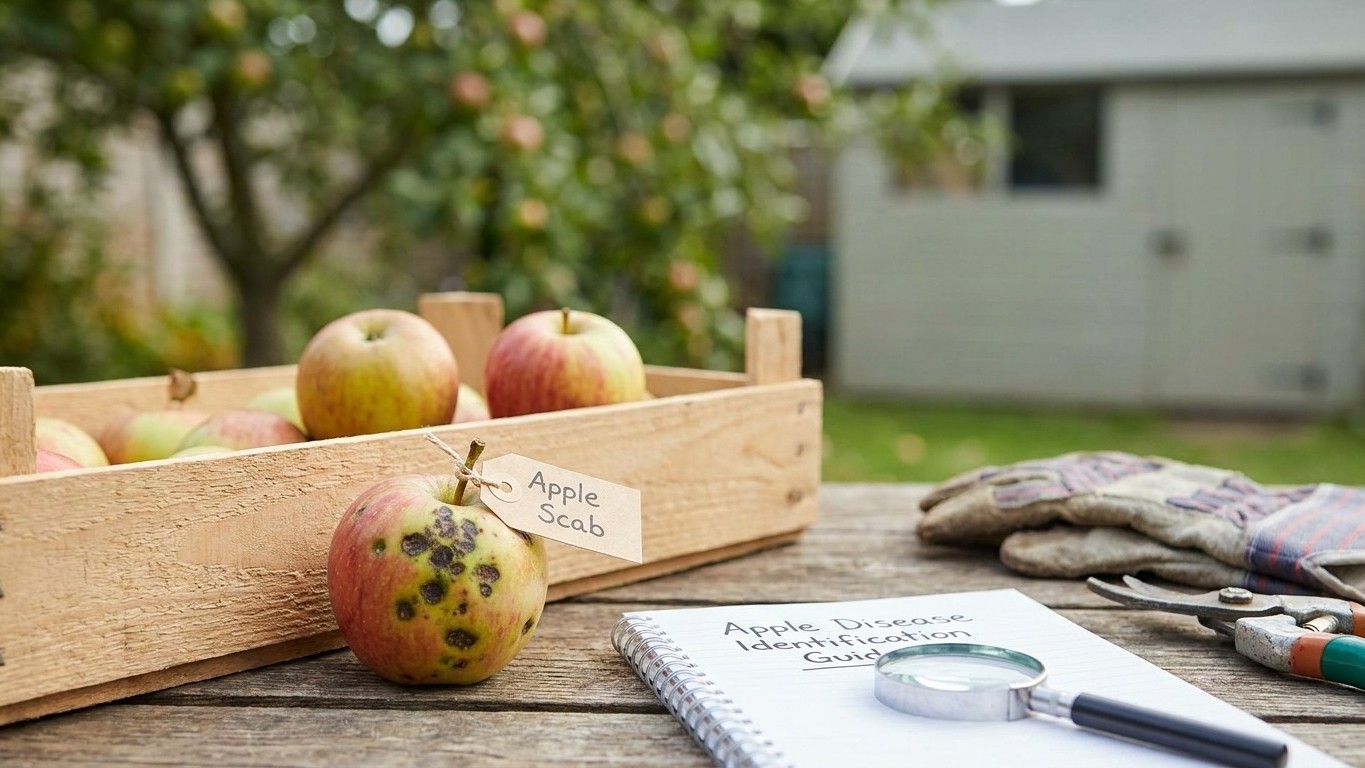

Apple scab, fire blight, apple Cedar Apple Rust, apple Powdery Mildew, apple Black Rot, apple Bitter Rot and Collar Rot: When the Trouble Is at Ground Level don’t share one look, and treating by guess wastes a spray and a season. Apple Scab: The Olive Blotches That Come With Wet Springs shows up as dark, velvety blotches on leaves and fruit skin. Fire blight wilts new shoots into a blackened, hooked “shepherd’s crook.” Cedar-apple rust paints orange-ringed spots on leaves that rarely touch the fruit at all. Check the leaf pattern first, then the fruit, then the bark, before you open any spray bottle: where the damage sits tells you more than what color it is.
Why it matters
Misreading a disease costs you twice. You spray for the wrong problem, and the real one keeps spreading while you wait to see if the treatment worked. Getting the identification right at the first sign, whether that’s a spot on a leaf at green tip or a wilted shoot at petal fall, is the only thing that lets you act while the damage is still small enough to cut out or contain.
Tree size changes how much of this you can actually see. A tree on M.9 rootstock tops out at 8-12 feet, according to USU Extension’s variety guide for the home garden, which means every leaf on the tree is within reach from a stepladder. A tree on seedling rootstock can reach 35-40 feet by the same USU figures, and a disease working its way through the upper canopy of a tree that size can spread for weeks before anyone standing on the ground notices the top third thinning out. If you’re planting new trees with disease scouting in mind, that’s a real argument for a dwarfing or semi-dwarfing rootstock over a full-size one, and it’s worth reading through the basics at Growing Apples before you commit to a rootstock you’ll be climbing for the next twenty years.
This work belongs at every stage of the tree’s year, not just one. Dormant season is when you find and remove the cankers and blighted wood the growing season leaves behind. Green tip through bloom is when the earliest infections take hold and are easiest to catch. Petal fall through summer is when the visible damage on leaves and fruit finally tells you what actually got in. Skipping any one of those windows means you’re diagnosing after the disease has already had its say.
When to do it
Apple disease scouting runs on the tree’s stage, not the calendar, because the stage moves with the season and the weather while its order stays fixed. Dormancy is for looking at bark and old wood: sunken, discolored cankers on limbs are last year’s apple Fire Blight or black rot sitting quietly until the tree leafs out again. Green tip, when the first green shows at the bud, is when the earliest scab lesions can already be forming on the unfolding leaf tissue, usually invisible until the leaf has expanded enough to show it.
Pink, when the blossom clusters swell and show color but haven’t opened, is when scab risk climbs fastest, because the fungus infects young, unhardened leaf and blossom tissue during wet stretches at this stage. Bloom itself is the single riskiest window for fire blight, since the bacterium enters almost entirely through open blossoms. This is where the flowering order among varieties actually matters: Clemson Cooperative Extension’s HGIC 1350 fact sheet groups apple varieties by how closely their bloom times cluster, with Anna and Dorsett Golden in group A, a large cluster including Fuji, Gala, Ginger Gold, Granny Smith, Jerseymac, Mollie’s Delicious, Mutsu, Red Delicious and Yates in group B, and Arkansas Black, Golden Delicious, Jonagold, Ozark Gold, Priscilla, Rome Beauty and Stayman in group C. Trees in the same group open together, so their fire blight exposure window overlaps too. The exact date that window falls on shifts with your local spring, but the order between groups holds wherever you garden.
Petal fall is when the season’s first visible scab lesions usually show up on leaves that were infected back at pink, and it’s also when cedar-apple rust spores start showing on the leaf underside. Sooty blotch and flyspeck, which mark the fruit skin rather than the leaf, tend to show later, through the humid stretch of mid to late summer. None of these have a fixed date. All of them have a fixed order relative to bloom, and that’s the timing worth tracking.
How to do it

Work from the outside in: leaves first, then fruit, then bark and wood. Most of these diseases show on the leaf before they show anywhere else, and the leaf pattern narrows the list fast.
| Disease | First visible sign | Plant part | Stage most visible |
|---|---|---|---|
| Apple scab | Olive-green to black velvety spots | Leaf, later fruit | Green tip through petal fall |
| Fire blight | Shoot tip wilts and blackens into a hook | Blossom, then shoot | Bloom through petal fall |
| Cedar-apple rust | Orange-yellow spot with red border | Leaf, rarely fruit | Petal fall onward |
| Powdery mildew | White to gray powdery coating | New leaf, shoot tip | Bloom through summer |
| Black rot | Purple-margined leaf spot, “frogeye” | Leaf, fruit, limb | Petal fall through harvest |
Apple scab

Look at the top surface of the leaf first. Scab starts as small, dark, almost velvety olive-green spots that darken toward black as they age. On fruit, the same fungus produces corky, raised scabs that crack the skin and can distort the fruit’s shape if the infection is heavy enough. Wet, cool weather at green tip through pink is what drives the worst outbreaks.
Fire blight

This one moves fast and shows first at the blossom. Infected flowers brown and wither but stay stuck to the twig instead of dropping. From there it runs down the shoot, blackening the tip and curling it into the shepherd’s crook that gives the disease away at a glance. In humid weather you may see a thin, sticky bacterial ooze on the bark just below the dead tissue.
Cedar-apple rust

This is the easiest one to place because it needs a second host nearby: eastern red cedar or another juniper. On the apple leaf, look for bright orange-yellow spots ringed in red-orange on the upper surface, with small tube-like orange projections forming on the underside later in the season. Fruit is rarely affected as heavily as leaves.
Powdery mildew

Unlike scab, this one favors warm, dry stretches rather than wet ones. It shows as a white to grayish powdery film over new leaves and shoot tips, and affected leaves often curl, fold, or take on a silvery cast. Heavily infected shoot tips can stay stunted for the rest of the season.
Black rot

On the leaf, look for small purple-flecked spots that grow into a brown center ringed in purple, the “frogeye” pattern that gives the leaf spot its common name. On fruit, black rot starts as a firm brown-to-black lesion, often at the blossom end, that can spread into a wider rot with faint concentric rings. Fruit that shows any of this at harvest will keep breaking down in storage rather than holding, so it’s worth reading through Storing Apples: What Keeps Until Spring and What Does Not before you decide what’s worth putting away.
What goes wrong
The most common mistake is treating the symptom that’s easiest to see instead of the one actually driving the loss. Sooty blotch and flyspeck look alarming on the fruit skin but are largely cosmetic and wipe or wash off much of the way; black rot on the same fruit is not cosmetic and will keep spreading in the crate. Confusing the two means either wasting a fungicide application on a low-stakes problem or ignoring a real one because it looked similar from ten feet away.
Disease damage also gets confused with insect damage more often than growers expect, since both can leave a leaf spotted or a fruit blemished. It’s worth cross-checking against the leaf-mining trails, stings, and chewed margins covered at Apple Pests: The Mark Each One Leaves before assuming a spot is fungal or bacterial rather than an insect’s work.
A quieter mistake is blaming disease for what’s actually a pollination gap. Jonagold, Mutsu, Stayman and Winesap all carry sterile pollen, according to Clemson HGIC 1350, UGA Circular 740, and USU Extension, meaning each can be pollinated by another variety but cannot pollinate anything itself, including another tree of the same kind. A garden holding only two of these varieties, or one of these paired with nothing else in bloom at the same time, will set little or no fruit and can look at a glance like a disease problem when the tree itself is perfectly healthy.
- Pruning fire blight in wet or humid weather, which can spread bacteria on the tool and the cut surface instead of containing it
- Leaving cedar galls untreated on a nearby juniper while chasing rust spots on the apple leaf, when the alternate host is the actual source
- Waiting for fruit symptoms to confirm a disease that already showed clearly on the leaf weeks earlier
- Assuming a light crop means disease when a self-sterile pairing is the real cause
Each of these delays the correct response by a stage or more, and on a fast-moving disease like fire blight, a single missed stage can mean the difference between cutting out a foot of wood and cutting out a limb.
What changes where you are
Disease pressure follows the weather more than it follows the calendar, and your local climate decides which of these problems shows up hardest. A humid, wet spring pushes scab and fire blight risk up together, since both depend on moisture at the tissue level to establish. A dry, warm stretch tends to favor powdery mildew instead, since it doesn’t need free water on the leaf surface to infect. None of that changes which disease looks like what, only how much of it you’re likely to see and how fast it moves once it starts.
The stages themselves, dormancy, green tip, pink, bloom, petal fall, hold everywhere apple trees grow. What shifts from one place to the next is which calendar date lines up with each stage, and how much rain or humidity accompanies it. Your state’s land-grant extension service tracks that regional pressure and often issues local disease alerts timed to the actual stage the trees have reached in your area, which is a far better guide than any national calendar date.
Rootstock choice plays into this too. A smaller tree on M.26 or G.11, both topping out at 12-15 feet by USU Extension’s figures, is easier to scout completely and easier to spray to full coverage than a 30-35 foot tree on MM.111. If disease pressure runs high where you garden, that height difference is worth weighing before you plant, since a tree you can’t fully inspect is a tree where the first sign of trouble is the one you miss.
Common questions
Can I tell scab from sooty blotch just by looking at the fruit?
Mostly yes. Scab produces raised, corky, cracked scabs embedded in the fruit skin, while sooty blotch sits as a smudgy, dark, blotchy film on the surface that often rubs off partially with a cloth or a firm wipe. If a mark wipes away at all, it’s not scab.
My tree has fire blight, do I need to cut the whole branch off?
You need to cut back into clean wood well below where the visible blackening ends, not just to the edge of the discoloration, since the bacteria travel ahead of the visible symptom inside the wood. Exact cutting distances and any recommended tool sanitizer are best confirmed with your state extension service, since guidance varies by region and by how severe the outbreak is.
Why does one side of my tree get rust and the other doesn’t?
Cedar-apple rust spores travel from a nearby juniper or eastern red cedar, so the side of the apple tree facing that host tree usually shows heavier infection. Removing the juniper isn’t always practical, but knowing where it sits relative to your apple tree explains the lopsided pattern.
Is it worth spraying a young tree that hasn’t fruited yet?
Leaf infections on a young, non-fruiting tree still matter, because a tree that loses leaf area early to scab or rust every year grows more slowly and takes longer to reach full production. Treat leaf disease on a young tree the same as you would on a bearing one rather than waiting until it starts to fruit.