
Zone 5b to Zone 7a is the real spread hiding inside “Indiana,” and it’s why the question of whether apples grow here has a flat yes for an answer. Winter cold isn’t what limits a tree in this state — nearly every cultivar sold by mail-order nurseries shrugs off colder than the 20.5°F average low Indianapolis sees in its coldest month. What actually shifts, sharply, is timing: bloom and harvest run a week or two earlier near the Ohio River than up along the Michigan line.
Can you grow apples in Indiana
Indiana spans a wide climate gradient for a single state. The USDA Plant Hardiness Zone Map (2023 update, based on NOAA’s 1991-2020 normals) places the state’s range at Zone 5b to Zone 7a, with the coldest zones running along the Michigan border and the mildest along the Ohio River in the south. That’s roughly two and a half zones of difference between the far north and far south, more spread than most home gardeners expect from a single state.
At the Indianapolis reference station, near the geographic middle of that range, NOAA’s NCEI puts the average minimum temperature of the coldest month at 20.5°F. That figure matters because it’s what a standard apple tree’s dormant wood has to survive most winters, not the occasional record cold snap. Most named apple cultivars sold through mail-order nurseries are rated hardy to Zone 5 or colder, so winter survival is rarely the limiting factor anywhere in the state.
What differs sharply between north and south is timing, not survivability. Southern Indiana runs earlier in spring and later into fall than the area near the Michigan line, so a grower near the Ohio River can expect green tip and bloom a week or two ahead of a grower up north, and the reverse pattern holds in autumn.
Elevation and slope matter too. Cold air drains downhill and pools in low spots on a calm night, so an orchard site on a gentle slope with open air movement will run several degrees warmer at bud break than a low field nearby, regardless of which USDA zone the county falls in. Choosing higher ground over a hollow is often worth more to a home orchard than an extra half zone of hardiness.
None of this rules out any part of the state. Standard, semi-dwarf and dwarf apple trees are grown successfully from the Michigan border to the Ohio River, and the real work of choosing a variety comes down to two separate questions: does the tree survive an Indiana winter, and does it get enough winter chill to bloom evenly in an Indiana spring. Hardiness answers the first question, and The Best Apple Varieties for Indiana breaks down which cultivars hold up best across the state’s zones. Chill answers the second, and it’s the one growers skip — The Indiana Apple Calendar, Stage by Stage walks through exactly when each of those stages happens.
Which varieties suit this climate

Indiana’s hardiness range calls for cultivars rated hardy to Zone 5 or colder for reliable winter survival across most of the state, with the mildest southern counties able to carry some Zone 7 selections that would struggle farther north. A dependable core list includes ‘Honeycrisp’ (rated hardy to roughly Zone 3, a midseason apple), ‘Liberty’ (Zone 4-8, bred for scab resistance and reliable cropping in humid summers), ‘Enterprise’ (Zone 4-8, resistant to fire blight and cedar-apple rust, a late-season keeper), and ‘GoldRush’ (Zone 5-8, a late-harvest cultivar from the Purdue-Illinois-Rutgers cooperative breeding program, bred specifically for scab resistance). Closer to the Ohio River, ‘Fuji’ and ‘Winesap’, both generally listed Zone 5-8, come into range as well, though ‘Winesap’ carries sterile pollen despite blooming well, a detail that matters for the pairing question below.
| Variety | Hardiness zone | Disease resistance | Harvest season |
|---|---|---|---|
| ‘Honeycrisp’ | Zone 3-8 | Moderate scab susceptibility | Midseason |
| ‘Liberty’ | Zone 4-8 | High scab resistance | Midseason |
| ‘Enterprise’ | Zone 4-8 | Fire blight and cedar-apple rust resistant | Late season |
| ‘GoldRush’ | Zone 5-8 | High scab resistance | Late season, long keeper |
Hardiness and chill are different filters
Hardiness only answers whether the tree survives winter. The second filter, and the one home orchard guides skip most often, is winter chill: the number of cold-but-above-freezing hours a tree needs before it breaks dormancy evenly. A low-chill cultivar bred for the Deep South or coastal California, something like ‘Anna’ or ‘Dorsett Golden’, tends to break bud too early during an Indiana warm spell in late winter, then lose that growth to the next hard freeze. Indiana’s winters run long and cold enough that under-accumulation of chill is rarely the problem here. The mismatch to actually watch for is planting a variety suited to a much milder climate than Indiana’s, not one suited to a colder one.
Treat the cultivars above as catalogue-verified choices rather than an official recommendation, and confirm local performance before committing an orchard to any one of them. Growers in Iowa work with a broadly similar hardiness ceiling and the same trade-off between older standards and modern disease-resistant cultivars. Growers in Prince Edward Island sit at the opposite end of the scale, where a short growing season limits variety choice more than winter chill ever does.
Planting a pair that works here
Apples need cross-pollination from a genetically different variety blooming at the same time, and a single tree, however healthy, will set little or no fruit on its own. In practice that means planting two named varieties within a hundred feet or so of each other, or grafting a second variety onto an existing tree, so their bloom windows overlap enough for bees to move pollen between them.
From the varieties suited to Indiana’s hardiness range, ‘Honeycrisp’ and ‘Liberty’ bloom in the same midseason window and pollinate each other well, making a straightforward first pair for a home orchard anywhere in the state. ‘Enterprise’ also blooms in that general window and adds fire blight resistance to the planting, useful in humid Indiana summers when that disease pressure runs high.
Watch for triploid varieties with sterile pollen. ‘Winesap’, despite blooming at a useful time and carrying good hardiness for southern Indiana, produces pollen that will not fertilize another tree’s flowers. A block planted with only ‘Winesap’ and one other triploid variety will bloom well and still set almost no fruit. Where a triploid variety is wanted, plant it alongside two diploid varieties that bloom together, so at least one of them can pollinate both the triploid and itself.
A home orchard of just two trees works fine as long as neither is a triploid and both bloom in the same window. Where space allows a third tree, adding a variety with a slightly earlier or later bloom widens the pollination window against a season that runs early or late, which happens often enough in Indiana’s variable springs to be worth the extra tree. A flowering crabapple planted nearby works as an additional pollen source too, since most ornamental crabapples bloom within the same window as standard apple varieties and produce fertile pollen freely, a useful trick on a small lot where there isn’t room for a dedicated second apple tree.
The frost that costs a crop here

NOAA’s NCEI 1991-2020 climate normals put the last spring freeze at the Indianapolis station somewhere between April 9 and April 21, the window in which a 32°F freeze has a 30 to 70 percent chance of occurring. Purdue Extension adds a further caution worth taking seriously: there remains roughly a 10 percent chance of a freeze even after that later date, so a spring that looks settled by mid-April can still deliver one more hard frost. Other parts of the state run earlier or later than this Indianapolis window by two weeks or more.
Why bloom timing matters more than the calendar
The real danger to an Indiana apple crop isn’t a frost that kills the tree. It’s a frost that arrives after the flower buds show pink and open, which kills the blossoms and the year’s crop while leaving the tree itself perfectly healthy. A tree can look completely normal through May and still produce no apples that year, simply because a single cold night in April caught the flowers open. Southern Indiana, blooming earlier under a warmer spring, can actually carry a longer exposure window to this risk in some years, since bloom sometimes opens before the last-frost window has fully passed, while northern Indiana’s later bloom sometimes lines up closer to its own later last-frost date.
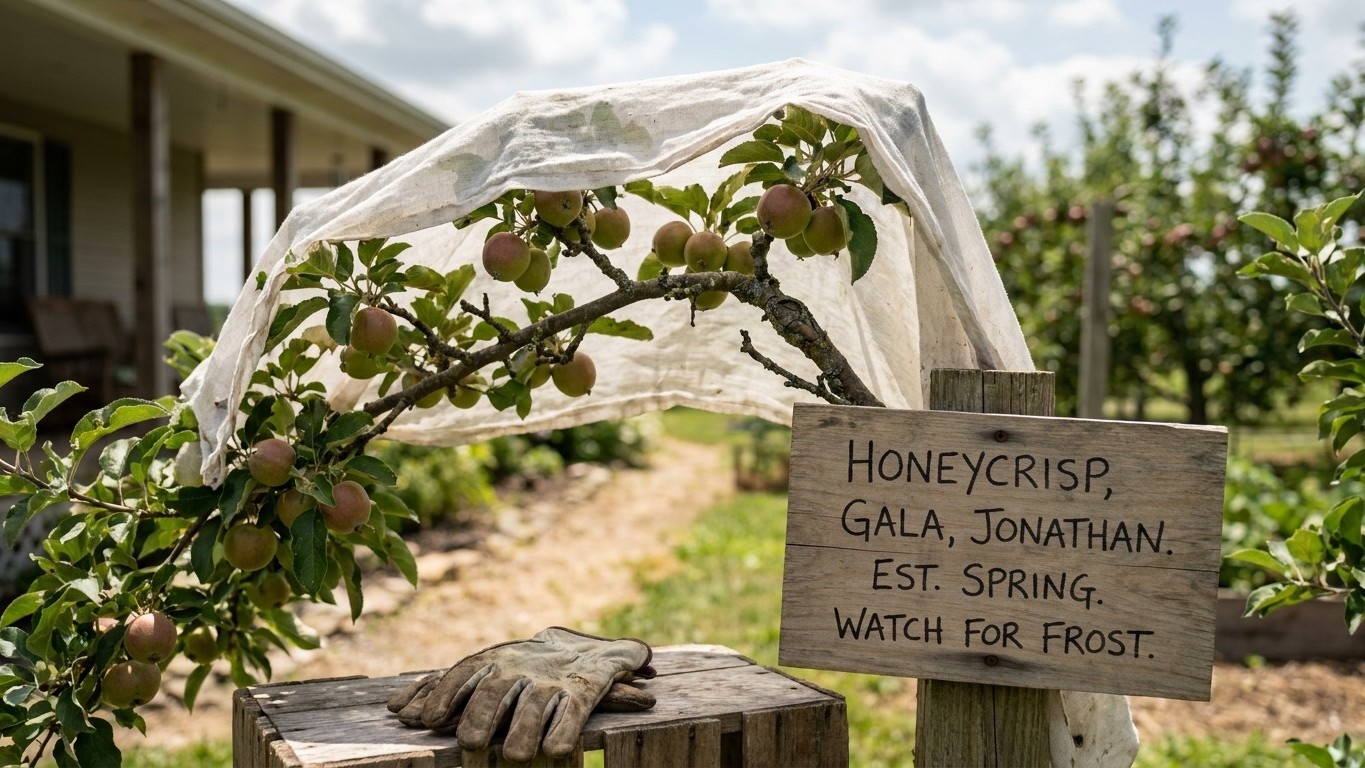
There isn’t much a home grower can do to protect a full-sized standard tree from a hard freeze at bloom. Dwarf and semi-dwarf trees, being shorter, can be covered overnight with row cover or old sheets weighted at the base, which traps enough ground heat to lift the air temperature under the cover by a few degrees, often the difference between a damaged bloom and a lost one. Running overhead irrigation through the freeze, a technique commercial growers sometimes use because the latent heat released as water freezes on the bud can hold it slightly above the lethal point, is a more advanced trick and easy to get wrong on a home scale.
The more reliable protection is choosing a variety that blooms late enough to clear most of the risk window in the first place. ‘GoldRush’ and ‘Enterprise’ both bloom on the later side for the varieties suited to this climate, which gives them a real practical edge in a spring that turns cold after an early warm spell, exactly the pattern that catches Indiana orchards most often. This frost risk is a separate calculation from winter hardiness. A tree can be perfectly hardy for its zone and still lose its entire crop to one bad night at bloom.
The apple year in Indiana
Apple trees move through the same sequence of stages every year, but the calendar date that sequence lands on shifts with the local frost windows described above.
- Dormancy (roughly December through February): the tree is fully hardened off. This is the window for pruning, since cuts made now heal without inviting disease that spreads more easily during active growth.
- Green tip: buds swell and show a sliver of green, typically well ahead of the April 9-21 last-frost window at the Indianapolis reference station. Southern counties near the Ohio River reach this stage earlier than counties near the Michigan line.
- Pink: buds show color but haven’t opened yet. This is the most frost-sensitive stage before bloom itself, and the point at which growers start watching the overnight forecast closely.
- Bloom: flowers open, usually landing close to or just after the local last-frost window, which is exactly why a late spring freeze at this stage is the single costliest event of the year.
- Petal fall: within a couple of weeks of bloom, once pollination is complete. This is when the first cover fungicide spray typically goes on for growers managing scab.
- Fruit set: small fruitlets swell, a natural thinning drop follows, and growers often hand-thin further to improve size on the fruit that remains.
- Harvest: timing depends entirely on variety, from midseason cultivars like ‘Honeycrisp’ and ‘Liberty’ picked well before the October 21-30 first-fall-frost window at Indianapolis, to late keepers like ‘GoldRush’ and ‘Enterprise’ that can hang closer to it.
None of these stages arrive on a fixed date. They arrive on accumulated warmth, so a warm March pulls green tip and bloom earlier across the whole state, while a cold, slow spring pushes bloom later and can, paradoxically, make it safer by keeping flowers closed until the frost risk has mostly passed. Fall frost matters less to the crop itself, since fruit already picked is unaffected, but a hard freeze at or after the October 21-30 window at the Indianapolis station pushes leaf drop and signals the start of the next dormancy period, whichever county’s own timing runs a bit earlier or later than that reference date.
Local help
Purdue Extension keeps county-specific variety notes, pest and disease spray calendars, and fire blight and scab management guidance updated for Indiana’s growing conditions. Because bloom timing and disease pressure both shift meaningfully between northern and southern counties, checking with the Purdue Extension office nearest the orchard site, rather than relying on a single statewide figure, is the most reliable way to fine-tune the choices in this article to one specific piece of ground.
Common questions
Can I grow apples in a container in Indiana?
A dwarf apple on a container-friendly rootstock can be grown in a large pot, but the roots have far less insulation than a tree planted in the ground and are more exposed to winter cold. Move a potted apple tree against a wall or into an unheated garage for the coldest stretch of winter rather than leaving it exposed on a deck.
How many years until a new apple tree bears fruit?
Most nursery apple trees on dwarfing rootstock begin bearing a meaningful crop within three to five years of planting, though the first year or two of flowers are often best removed to let the tree build structure first. Standard-sized trees on full-sized rootstock generally take longer to bear than dwarf or semi-dwarf trees.
My tree blooms every year but never sets fruit. What’s wrong?
The most common cause is a missing or incompatible pollinator, especially if the tree is a triploid variety like ‘Winesap’ planted alone or with only one other variety. Check whether a second, fertile-pollen variety is blooming nearby at the same time, and if not, plan to add one or graft a compatible variety onto an existing limb.
Do I need to spray a home apple tree for pests and disease?
Most named apple cultivars in Indiana’s humid summers will develop some scab, fire blight or codling moth pressure without any intervention, though resistant varieties like ‘Liberty’ and ‘GoldRush’ need less spraying than older susceptible cultivars. A home orchard spray schedule should follow county-specific guidance rather than a generic national calendar, since disease pressure and pest emergence both shift with local weather.
Should I grow apples from seed instead of buying a nursery tree?
Apple seeds don’t grow true to the parent variety, so a seed-grown tree will produce fruit unlike either parent and usually of lower quality than named cultivars. Buying a grafted tree of a known variety on a known rootstock is the reliable way to get a predictable tree and a predictable harvest.