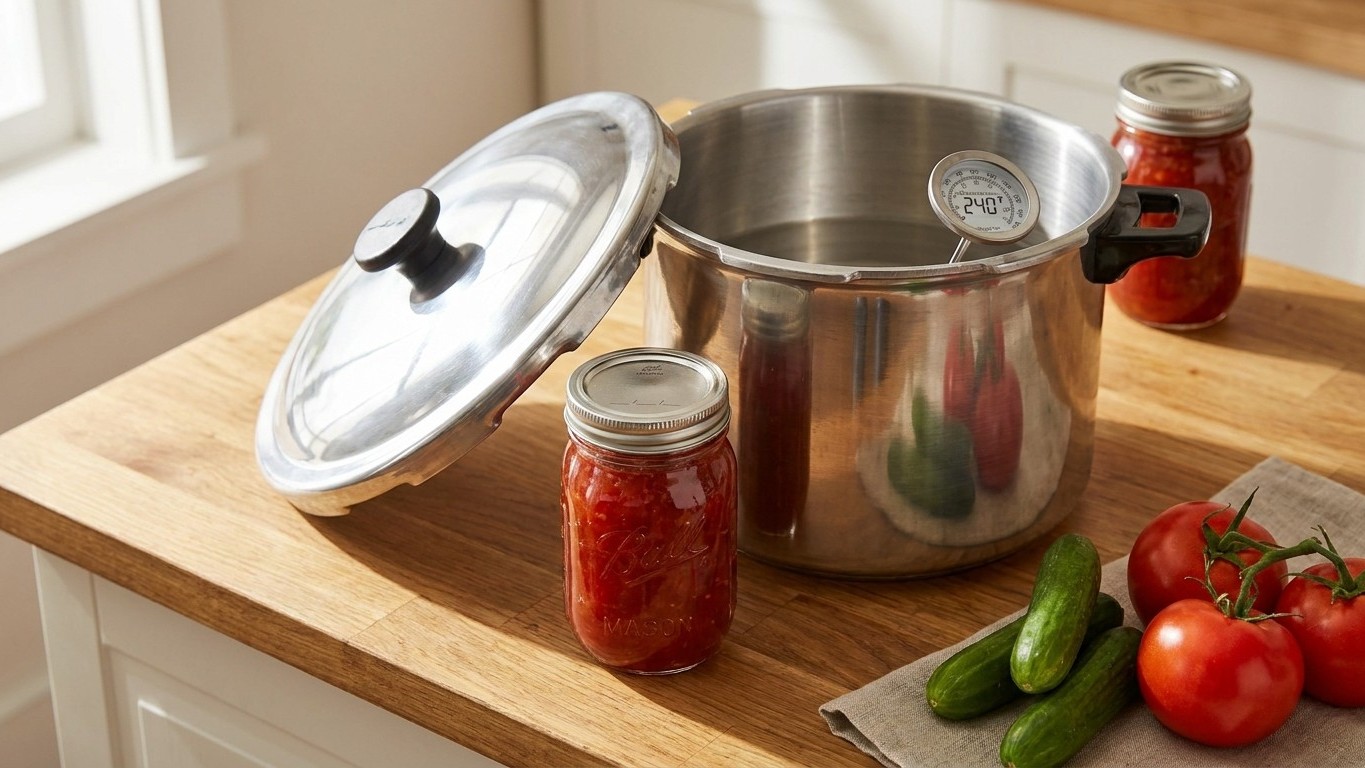

Home canning uses heat and a sealed jar to make food shelf-stable at room temperature, provided you follow the guidelines for Storing Home-Canned Food once the jars have cooled, and provided you know Testing a Canning Seal, and What to Do When It Fails. It does not sterilize every jar completely, it does not make a low-acid food safe just because the lid pops down, and it cannot substitute for the correct method for a given food. The National Center for Home Food Preservation (NCHFP) at the University of Georgia is the reference this whole subject runs on.
Canning

Canning works by heating filled jars long enough to destroy the microorganisms and enzymes that would otherwise spoil the food, then forming a vacuum seal as the jar cools. That seal keeps air and new contaminants out. It’s a preservation method built on physics and time, not on a recipe’s flavor or a cook’s instinct about “how long feels right” — which is also why it’s worth understanding Canning Methods That Are Not Recommended, and Why before improvising.
What it does not do is make every jar sterile in the way a hospital instrument is sterile. A boiling-water canner reaches 212 F at sea level, which is enough to destroy the yeasts, molds and most bacteria that spoil acid foods, but as The Boiling-Water Canner: What It Can and Cannot Do makes clear, it is not hot enough to destroy the heat-resistant spores of Clostridium botulinum, the organism behind botulism. Those spores survive boiling water easily. They only die at the higher temperatures produced by The Pressure Canner, generally 240 to 250 F, sustained for a specific length of time. This is why the method has to match the food, not the other way around — a decision that starts with Acid or Low-Acid? The Question That Decides Your Canner, and it’s exactly why a low-acid vegetable like Canning Potatoes demands a pressure canner rather than a boiling-water bath, the same logic behind Preserving Onions and Preserving Garlic, while acid foods like Canning Tomatoes or Canning Apples can safely rely on the boiling-water method. It’s also why elevation changes the math entirely: Canning at Altitude: Why the Same Jar Needs Longer explains why the same jar of food needs a longer processing time as elevation increases and boiling point drops.
Canning also does not tenderize food the way slow cooking does, though heat processing softens texture as a side effect. It does not replace refrigeration for anything that isn’t actually shelf-stable once sealed, and it does not forgive a shortcut on preparing your Canning Jars and Lids, headspace or acidity adjustment — a step explained in detail by Why Tomatoes Must Be Acidified Before Canning. A jar that looks perfectly sealed can still carry a lethal toxin if the food inside was wrong for the process used.
Why the seal isn’t the safety test
People often assume that if a lid sealed, the food inside is safe. A vacuum seal only proves that air pressure did its job, not that the contents are free of spoilage — see How to Spot a Spoiled Jar — and How to Handle It for the signs that actually matter, not the seal itself.essure was reduced as the jar cooled. It says nothing about whether the internal temperature reached the level needed to destroy dangerous spores. A jar of low-acid vegetables processed in a boiling-water bath can seal perfectly and still support the growth of Clostridium botulinum, because that organism thrives in exactly the sealed, low-oxygen environment a canning jar creates once it’s closed.
That distinction, between “sealed” and “safe,” is the entire reason the method has to be chosen based on the food’s chemistry rather than on convenience or on what equipment happens to be sitting in the pantry.
Which foods this method suits
Every food that goes into a jar falls on one side or the other of a single number: pH 4.6. Above that line, a food is low-acid. At or below it, a food is acid. The line isn’t a suggestion; it determines which canner a food requires, because the two categories support different microbial threats and need different amounts of heat to become safe.
Low-acid foods need a pressure canner, the only home appliance capable of reaching 240 to 250 F, because that is the range required to destroy Clostridium botulinum spores reliably.
- Red meats
- Seafood
- Poultry
- Milk
- Nearly all fresh vegetables (except most tomatoes)
Acid foods can be processed in a boiling-water canner, which reaches 212 F at sea level, sufficient to destroy the yeasts, molds and less resistant bacteria that threaten foods in this pH range.
- Fruits
- Pickles
- Sauerkraut
- Jams, jellies and marmalades
- Fruit butters
Tomatoes complicate this picture, and it’s worth being precise about why. Some tomato varieties are now known to have pH values slightly above 4.6, putting them right at the edge of the acid category rather than safely inside it. Figs have the same issue. Both must be acidified, with a measured amount of bottled lemon juice or citric acid, before they can be safely processed in a boiling-water canner. Skipping that acidification step treats a borderline low-acid food as if it were reliably acid, and that assumption is exactly the kind of gap that lets botulinum spores survive a process that was never hot enough for them in the first place.
This is also why mixed recipes (a low-acid vegetable combined with an acid ingredient, for instance) can’t be judged by eye. The finished mixture’s actual pH determines the canner, not which ingredient seems to dominate the flavor.
What goes wrong
Most canning failures trace back to a handful of repeatable mistakes, and each one has a fix built into recognizing it.
- Using a boiling-water canner for a low-acid food. Vegetables, meats and poultry processed this way never reach a temperature capable of destroying botulinum spores. The remedy is simple in principle: any food above pH 4.6 goes into a pressure canner, no exceptions based on how the food is prepared.
- Skipping acidification on borderline foods. Tomatoes and figs sit close enough to the pH 4.6 line that natural variation between batches, growing conditions and varieties can push an individual batch above it. Adding a measured acid before processing removes that uncertainty rather than trusting a single fruit’s typical pH.
- Ignoring elevation. Water boils at a lower temperature as elevation rises, and a lower boiling temperature kills fewer microorganisms in the same amount of time. The correction is to increase the process time (for boiling-water canning) or the canner pressure (for pressure canning), following the adjustment tables in the USDA Complete Guide to Home Canning rather than using a sea-level time at altitude.
- Trusting an old or improvised recipe. Family recipes, forum posts and pre-internet cookbooks sometimes predate current science on jar sizes, densities and safe acidification. The fix is checking any recipe against a currently tested source before relying on it, rather than assuming that because a method was used for decades it was always safe.
- Judging safety by taste or smell. A jar that harbors botulinum toxin can look, smell and taste completely normal. There is no sensory test that replaces using the correct method and the correct time for the food in the jar.
Where the exact times come from
The National Center for Home Food Preservation publishes tested times for individual foods, and that’s the source to check before filling a single jar.
The reason this matters as much as it does comes down to one fact: botulinum toxin has no taste and no smell. An untested time might look identical to a tested one right up until someone opens the jar and eats from it. There’s no way to catch the error afterward by inspection alone, which is exactly why the time has to be right before the jar ever goes into the canner.
Common questions
Can I can any recipe I find online if the ingredients seem acidic?
No. “Seems acidic” isn’t a measurement. Tomatoes and figs, for example, can sit above pH 4.6 depending on variety and growing conditions, so a recipe needs a tested acidification step rather than an assumption based on taste.
Does a longer boil make up for using the wrong canner?
No. A boiling-water canner tops out at 212 F at sea level regardless of how long it runs, and that temperature never reaches the 240 to 250 F range needed to destroy botulinum spores in low-acid food.
If a jar seals properly, does that mean the food inside is safe?
Not necessarily. A seal only shows that a vacuum formed as the jar cooled. It doesn’t confirm the food reached a safe internal temperature, and a sealed jar of improperly processed low-acid food creates the exact low-oxygen, moist environment botulinum needs to grow.
Why does elevation change how canning is done?
Water boils at a lower temperature at higher elevation, so a process timed for sea level won’t deliver the same heat exposure higher up. Both process time and, for pressure canning, canner pressure need to be adjusted upward to compensate, using tables from the USDA Complete Guide to Home Canning.