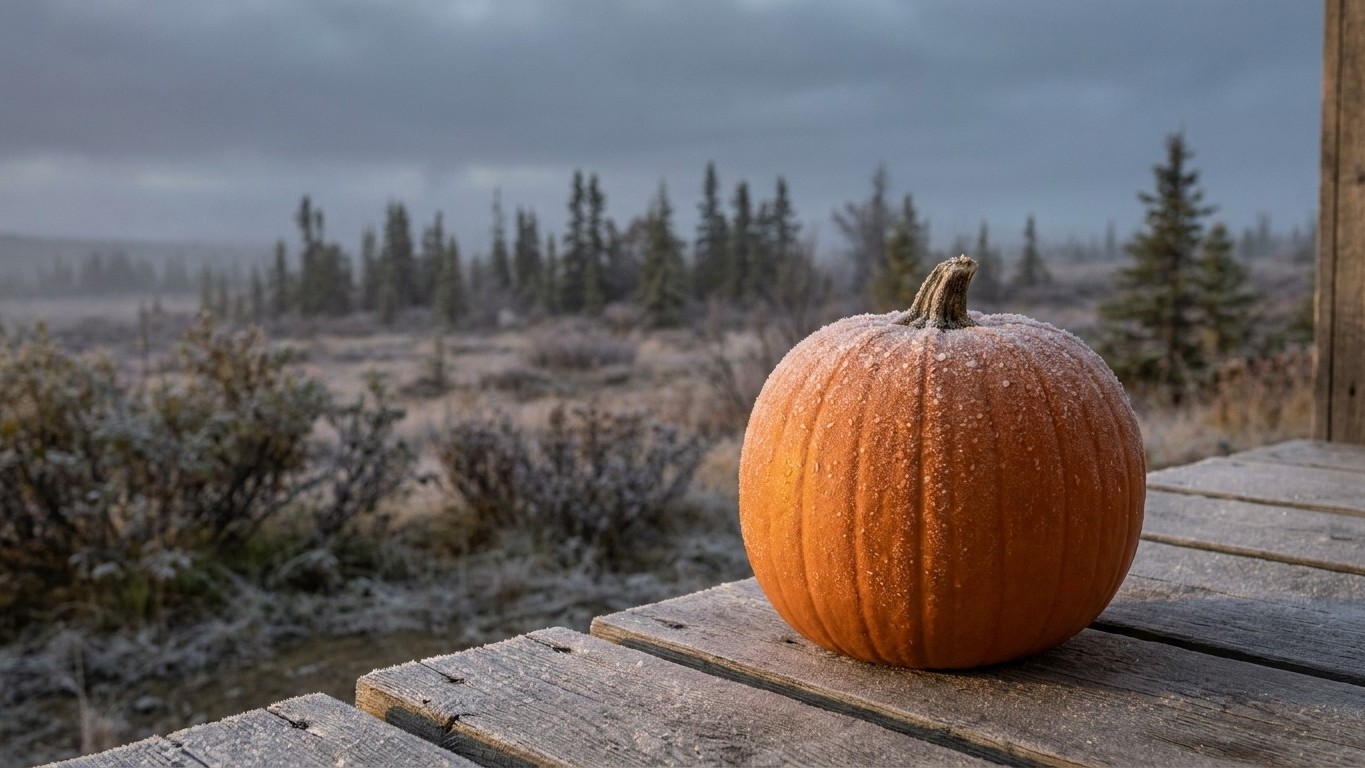

In Nunavut, the mean first fall frost arrives around September 13, weeks before jack-o’-lanterns typically show up on doorsteps. That timing changes everything about how you plan for October 31. A pumpkin left outside here isn’t waiting for frost, it’s living through weeks of it already. Here’s what that means for choosing a carving day and keeping your pumpkin intact until then.
The short answer

Start with the number: around September 13 is the mean date of the first fall frost at the Rankin Inlet A station, the reference point Environment and Climate Change Canada uses for this region. That’s a mean, not a guarantee, so treat it as a midpoint rather than a fixed line on the calendar. In roughly half of all years, frost shows up even earlier than that. In the other half, it comes later, but rarely by much.
Do the math against Halloween and the picture is stark. September 13 falls about 48 days before October 31. That means the “before frost” window that pumpkin owners in milder climates count on simply doesn’t exist here. By the time October rolls around in Nunavut, frost isn’t a risk on the horizon, it’s already settled in weeks earlier. The entire month, including Halloween itself, sits well past that mean frost date.
This flips the usual question. Elsewhere, the question is when frost will hit and whether a carved pumpkin can survive it. Here, frost has already happened, repeatedly, before most people even buy a pumpkin. So the practical window for carving isn’t measured by counting days until frost. It’s measured by how close to Halloween you can hold off, because every day earlier is a day longer that a cut pumpkin sits exposed to conditions far colder than any storage guideline calls for.
The safest approach given this territory’s climate: buy or select your pumpkin whole, keep it whole and indoors for as long as possible, and carve it as close to October 31 as your plans allow. There’s no research-backed number for how many days a carved pumpkin holds up once cut, not from University of Illinois Extension, not from Utah State University Extension, not from anyone doing controlled research on the question. What is documented is how to choose a pumpkin that starts strong and how to store the whole, uncarved fruit so it lasts as long as possible before that knife comes out. In a climate where the cold arrives this early and stays this hard, that head start matters more than usual.
Frost or heat: which one gets it here
The cold end
University of Illinois Extension recommends keeping a whole pumpkin in a cool, dark spot between 45 and 50 degrees Fahrenheit. That’s a narrow band, and it assumes a location that’s cool but not actually freezing. Nunavut blows past the cold edge of that band well before Halloween even arrives.
Consider the numbers. The mean daily minimum temperature during the coldest month here runs at -29.8 degrees Fahrenheit, a figure from the same Environment and Climate Change Canada normals used for the frost date. That’s not a record low or an unusual cold snap, that’s the average low for the coldest stretch of the year. Long before that coldest month even arrives, the region has already crossed its mean frost date in mid-September. So an entryway, a porch, or a garage that isn’t heated will spend late October well under 45 degrees, likely well under freezing outright. A pumpkin left in a spot like that isn’t just outside the recommended storage range, it risks the flesh freezing solid, which changes its texture entirely once it thaws.
The warm end
In warmer parts of the country, the opposite problem shows up: temperatures that stay too high for the 45 to 50 degree band, which speeds up softening and rot. That risk doesn’t apply here. Nunavut’s late October climate doesn’t hover near room temperature waiting to spoil a pumpkin through warmth, it’s the cold side of that band that matters, and only the cold side. Anyone following general pumpkin storage advice written for a milder climate needs to mentally flip the warning: the danger sitting on your porch isn’t heat, it’s frost and hard freeze.
Where to keep it until you carve
Given how far outdoor temperatures drop here before Halloween, storage in Nunavut is really about finding an indoor spot that gets as close to that 45 to 50 degree window as a house allows, since the outdoors is off the table for most of the season. Here’s a practical order of steps:
- Skip the porch, entryway, or unheated mudroom as a storage spot once the season turns. With coldest-month lows averaging -29.8 F, any unheated space attached to the house can easily sit well below freezing by the time Halloween approaches.
- Look for the coolest room inside the heated part of the house, ideally a north-facing room, a room away from a furnace vent, or a basement landing that doesn’t get direct heat. The goal is a spot that reads cooler than the rest of the house without dropping toward freezing.
- Keep the pumpkin in the dark, or close to it. A closet floor, under a stairwell, or a shaded corner of a cool room all work better than a sunlit windowsill.
- Keep it away from any ripening fruit or vegetables, including apples, potatoes, or tomatoes. Ripening produce gives off ethylene gas, which speeds up a pumpkin’s own aging process, so a fruit bowl on the same counter is one of the worst neighbors a whole pumpkin can have.
- Check the stem before you store it and again before you carve. University of Illinois Extension recommends choosing a pumpkin with 1 to 2 inches of stem left intact. Once that stem breaks off, the spot where it was attached becomes exposed, and that’s where spoiling tends to start early. Never carry or lift a pumpkin by the stem, that’s exactly the kind of handling that snaps it off.
- Carve as close to October 31 as your schedule allows. No extension service publishes a number of days a carved pumpkin lasts, because that answer depends on too many variables nobody has controlled for in research. What’s documented is choosing well and storing whole, so let those two steps do the work and treat the carving itself as the last thing you do before the pumpkin goes on display.
Checking this against your own county
The numbers here come from a single reference station, Rankin Inlet A, and Nunavut is a large territory where conditions vary by community and by how close you are to open water or higher ground. A mean frost date from one station is a starting point, not a forecast for every hamlet.
For a closer look at how frost timing and fall conditions play out in your specific community, Agriculture and Agri-Food Canada is the federal resource worth checking. It’s a starting point for finding more localized data and guidance than a single territorial average can offer.
Common questions
How many days before Halloween should I carve in Nunavut?
There’s no fixed count, but given that the mean frost date sits around 48 days before Halloween, the outdoor window most guides assume simply doesn’t exist here. Carve as close to October 31 as you reasonably can, and keep the pumpkin whole and indoors until then.
Can I store my pumpkin outside once it gets cold?
Not if you want it to hold up. With coldest-month lows averaging -29.8 F, outdoor storage risks freezing the flesh solid, which is far colder than the 45 to 50 F range University of Illinois Extension recommends for whole pumpkins.
How long will a carved pumpkin last once I cut it?
That figure isn’t published by University of Illinois Extension or Utah State University Extension, and no credible research backs up specific day counts floating around online. What is documented: choose a pumpkin with an intact stem and no soft spots, keep it whole as long as possible, and carve it close to the day you plan to display it.
Does the stem actually matter that much?
Yes. University of Illinois Extension notes that a pumpkin should have 1 to 2 inches of stem remaining, since a broken stem exposes that section of the fruit and speeds up spoiling. Treat the stem as a seal, never as a handle for carrying the pumpkin.