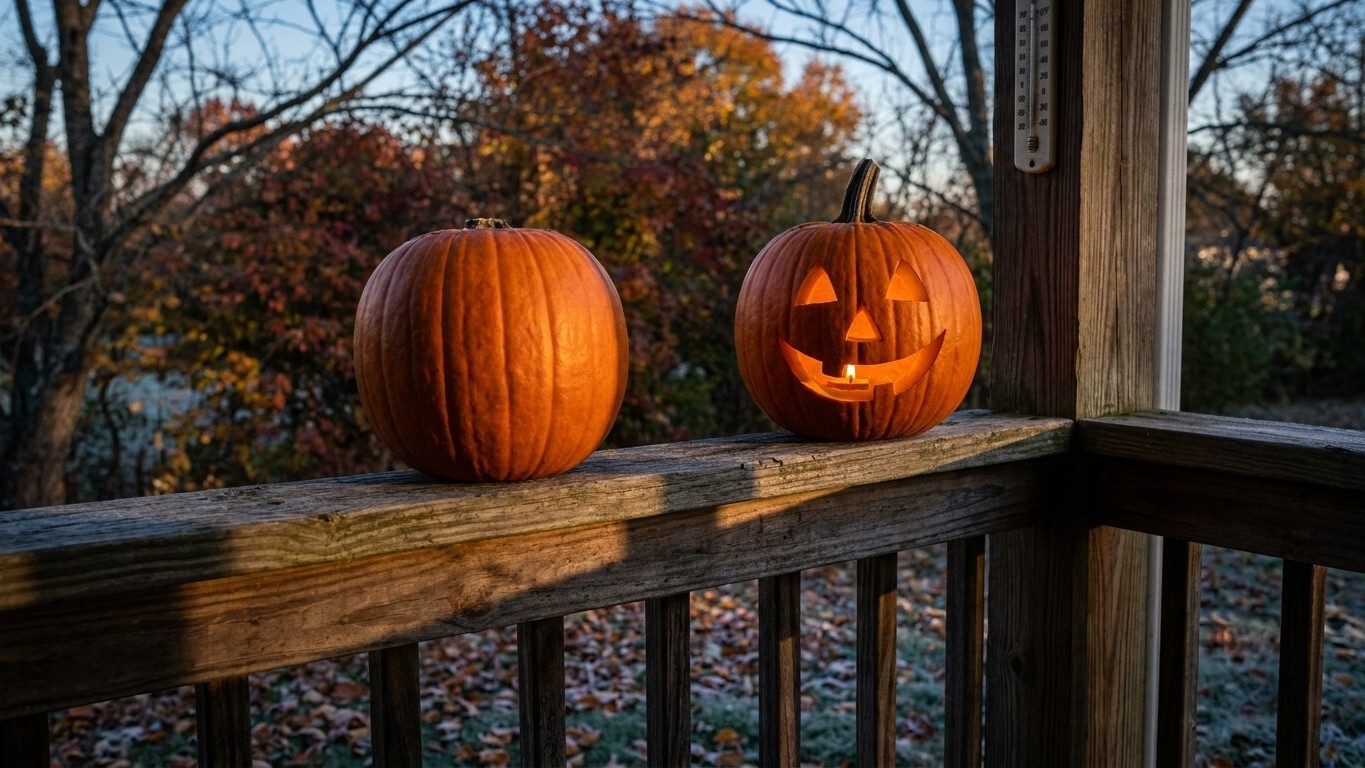

Delaware’s mean first fall frost runs from around October 26 to November 7, based on 1991-2020 climate normals from the Wilmington reference station. That range straddles Halloween almost exactly, which means the safest carving window sits in the week before Halloween, with the day itself as the natural deadline. A pumpkin kept whole and cool holds fine until then, no matter which side of that frost window the calendar lands on this year.
The short answer

Look at that frost range again: October 26 to November 7. Halloween falls right in the middle of it. In some years the first freeze shows up almost a week before the holiday. In others it holds off until well past it. That’s the nature of a mean date, it’s an average pulled from three decades of weather, not a promise about this particular October. So the honest answer for Delaware isn’t “frost always beats Halloween” or “frost never touches it” — it’s that the two events land close enough together that either order is plausible in any given year.
What that means practically: carve within roughly a week of Halloween, and don’t assume you have a huge cushion of mild weather stretching deep into November. If your pumpkin is still whole and uncarved by mid-October, it’s in good shape, since a whole pumpkin stores for three to six months when it’s kept cool and dark, according to University of Illinois Extension. The clock that matters more than frost is the one that starts ticking the moment you cut into the rind.
Reading the window correctly
Treat “around October 26 to November 7” as a range to watch on a local forecast, not a fixed date to circle. If a hard freeze warning pops up for your part of the state in the days before Halloween, that’s useful information for anything still growing on the vine in a garden, less so for a pumpkin already sitting on a porch step. The porch pumpkin’s real enemies aren’t frost at all — they’re time, warmth, and whatever fruit happens to be sitting near it. Carve close to when you plan to display it, and you sidestep most of the guesswork this frost range creates.
Frost or heat: which one gets it here
The cold end
Delaware’s coldest month has a mean daily minimum of 25.6 F, well below the 45-50 F range recommended for storing a whole pumpkin. But that figure describes the depths of winter, not late October. By the time temperatures are routinely dropping into the mid-20s overnight, pumpkin season is long over in most households. The lesson from that number isn’t “watch out for frost in October” — it’s “don’t leave a pumpkin in an unheated garage or shed all winter expecting it to hold.” Once true winter cold arrives, it will freeze and eventually mush the flesh, whole or not.
The warm end
The more relevant risk in Delaware during the actual carving window is warmth, not frost. Because the state’s mean first frost sits right around Halloween, much of October still runs mild here, with afternoon temperatures frequently sitting above that 50 F storage ceiling. A pumpkin left in direct sun on a covered porch, or stored in a garage that heats up in the afternoon, can spend hours above the recommended range even while overnight lows dip into the 40s. That daytime warmth is what speeds softening and shortens the window before a whole pumpkin starts to decline. In Delaware, the practical enemy for most of pumpkin season is heat exposure during the day, with frost only becoming a factor in the final stretch before Halloween itself.
Where to keep it until you carve
- Pick a spot that stays near 45-50 F. An unheated but insulated garage, an enclosed porch out of direct sun, or a cool basement corner all work better in Delaware’s mild October climate than anywhere near a heated living space.
- Keep it dark, or at least out of direct sun. Afternoon sun through a window or on an open porch can push the pumpkin well above that upper storage limit even on a cool day.
- Separate it from ripening fruit. Apples, potatoes, and tomatoes give off ethylene gas as they ripen, and that gas ages a pumpkin faster. A pumpkin sitting in a decorative arrangement next to a bowl of apples is losing shelf life every day it sits there.
- Check the stem before you buy, not after. Look for one to two inches of stem still attached. Once that stem breaks off, the exposed spot becomes an entry point for rot, and there’s no fixing it after the fact.
- Never lift or carry a pumpkin by the stem. It isn’t a handle. Snapping it off defeats the one protection you had going for you, and it happens more often than people expect when a pumpkin gets carried by that one visible grip point.
- Move it to its display spot only when you’re ready to carve. Once cut open, a pumpkin’s flesh is exposed to air, insects, and whatever temperature swings that display spot sees, so shorten that stretch as much as you can.
Checking this against your own county
The frost figures here come from a single reference station, and Delaware’s coastal areas, inland farmland, and anywhere with a bit of elevation can all see meaningfully different timing. Frost tends to arrive earlier in low-lying or inland spots than the airport-station average suggests, sometimes by a week or two. Before you lock in a carving date, check conditions specific to your county through the University of Delaware Cooperative Extension, which tracks local growing and frost conditions across the state and is the more reliable source than any statewide average for a backyard in a particular part of Delaware.
Common questions
How long does a carved pumpkin actually last?
No university extension publishes a specific number of days for a carved pumpkin, and there’s no verified preservation protocol behind the bleach dips or petroleum jelly tricks that circulate online. What’s actually documented is guidance for whole pumpkins: choose one with an intact one to two inch stem, no soft spots, and keep it whole and cool for as long as possible. Carve close to the day you plan to display it rather than looking for a way to extend a carved pumpkin’s life, since that answer simply isn’t backed by published research.
What if a frost hits before I’ve carved my pumpkin?
A whole, uncut pumpkin sitting somewhere near 45-50 F isn’t especially vulnerable to a light frost the way a plant on the vine is. The bigger concern is prolonged exposure to freezing temperatures over days, not a single frosty night. If a hard freeze is forecast, bring the pumpkin into an unheated garage or enclosed space rather than leaving it exposed outdoors overnight.
Does the stem length really matter that much?
Yes. The stem functions as a seal over the top of the pumpkin. Once it snaps off, that spot is exposed and becomes the most likely place for rot to start. A pumpkin with one to two inches of intact stem, no blemishes, and a heavy feel for its size is a better bet than one chosen purely for a symmetrical shape.
Should I keep my pumpkin in the refrigerator or a walk-in cooler?
Most home refrigerators run colder than the recommended 45-50 F range, and a whole pumpkin also takes up more space than most kitchens can spare for months at a time. A cool garage, basement, or shaded porch that naturally sits in that range is a more practical choice for Delaware’s mild fall than trying to force refrigerator space to work.