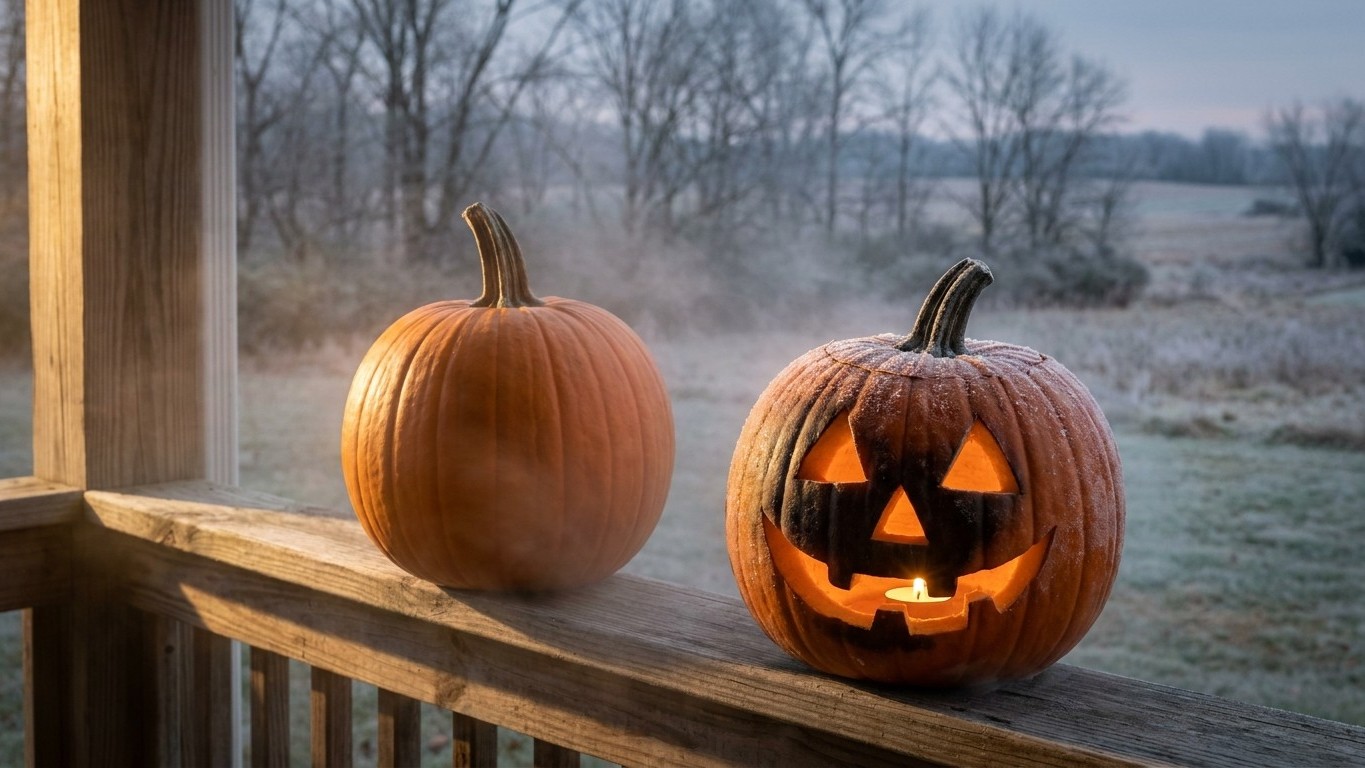

Ohio’s mean first fall frost lands somewhere around October 5 to October 15, depending on where in the state you garden, according to Ohio State University Extension’s zone 6a data. That’s roughly two to three and a half weeks before Halloween, which means the cold usually arrives well ahead of trick-or-treat night, not on it. A pumpkin sitting on an Ohio porch in late October is almost always facing sub-45 F air before the calendar even hits Halloween.
The short answer

Carve close to Halloween itself, not the day the first frost shows up. In Ohio, the mean first fall frost falls around October 5 to October 15, which puts real cold weeks ahead of Halloween on October 31. That gap matters because a whole, uncarved pumpkin tolerates a lot more than a carved one does. The rind is the barrier; once you cut through it, the exposed flesh is directly at the mercy of whatever the air is doing.
So the practical window looks like this: keep the pumpkin whole and stored properly through most of October, and save the knife for the final stretch before Halloween. There’s no research-backed count of exactly how many days a carved pumpkin holds up, and neither University of Illinois Extension nor Utah State University Extension publishes one. What both do publish is guidance on choosing a sound pumpkin and storing it whole, which is the part of this you actually control.
Here’s why the timing matters more in Ohio than in a milder state. Once the season’s first frost has passed, around that October 5 to October 15 stretch, nighttime temperatures in central and northern Ohio routinely dip toward freezing. A carved pumpkin left outside on those nights can have its cut edges freeze and then thaw the next afternoon, and that freeze-thaw cycle is what turns crisp flesh to mush fast. A whole pumpkin, rind intact, shrugs off a light frost far better.
None of this means you have to carve on October 31 itself. It means the closer you carve to Halloween, the less time your jack-o’-lantern spends exposed to the freeze-thaw swings that define late October in this state. If you want a carved pumpkin sitting out for a week of porch display, expect it to show the effects of Ohio’s fall temperature swings faster than a pumpkin carved two or three days before the holiday. Buy or pick your pumpkin early in October if you like, but hold the knife until the back half of the month.
Treat the frost window as a planning tool, not a hard deadline. “Around” October 5 to October 15 is an average built from years of data, not a promise about this particular year. Some Octobers bring frost earlier, some later. Watch your local forecast in the two weeks leading up to Halloween and let that, not the calendar average, decide the exact carving day.
Frost or heat: which one gets it here
The cold end
Ohio’s problem in late October is cold, not warmth. NOAA’s 1991-2020 Climate Normals put the mean daily minimum temperature for the coldest month (measured at the Columbus reference station) at 22.0 F. That’s the number that tells you whether a plant, or in this case a pumpkin sitting outdoors, is dealing with real winter cold once the season turns. It’s well below the 45-50 F range that whole pumpkins are supposed to be stored in, which means Ohio’s outdoor air in the back half of fall runs colder than a pumpkin actually wants.
That 22.0 F figure is a coldest-month average, not a late-October forecast, and it’s worth keeping separate from the hardiness zone rating. Zone 6a describes how well perennial plants survive a typical Ohio winter; it says nothing about which week the first frost shows up in your yard. The frost date (around October 5 to October 15) and the winter cold severity (22.0 F average low in the coldest month) are two different pieces of data answering two different questions, and mixing them up is how people end up carving too early or too late.
The warm end
Heat simply isn’t the Ohio problem in October. In parts of the country where late fall still brings daytime highs into the 60s and 70s with mild nights, a stored pumpkin can sit above that 45-50 F band for weeks, which speeds up softening and rot from the warm side rather than the cold side. Ohio doesn’t have that issue by late October. Once the calendar turns toward Halloween, the state’s temperatures are heading down, not up, so warmth-driven spoilage is rarely what ages an Ohio pumpkin. Cold, and the freeze-thaw cycling that comes with it, is the direction to watch here.
Where to keep it until you carve
Ohio’s fall temperature swings make storage location the one variable you can fully control. Here’s a practical order of preference for keeping a whole pumpkin close to that 45-50 F sweet spot until you’re ready to carve:
- An unheated garage. Usually the closest match to 45-50 F in an Ohio home during October, and it’s dark enough to slow softening.
- A basement or root cellar. Cooler and darker than living spaces, and generally more temperature-stable than a garage on nights when the outdoor air drops hard.
- An enclosed, unheated porch or mudroom. Works well in early October before the coldest nights set in, but check it against the forecast as you get closer to that October 5 to October 15 frost window.
- Never a heated living room or kitchen counter for long-term storage. Indoor heating pushes well past 50 F, which accelerates softening from the warm side.
- Never directly outdoors once nightly lows approach freezing. Given Ohio’s 22.0 F average low in the coldest month, outdoor exposure late in the season risks a hard freeze the pumpkin isn’t built to handle.
Wherever you store it, keep the pumpkin away from apples, potatoes, and tomatoes. Ripening fruit gives off ethylene gas, and that gas ages a pumpkin faster than most people realize. It’s an easy mistake since apple crates and pumpkins both show up in the same porch or garage in October.
Handle it by the body, not the stem. Look for 1 to 2 inches of stem still attached when you buy or pick your pumpkin. That stem isn’t a handle; it’s the seal over the one weak point in the rind. Break it off and that spot becomes an open door for spoilage, which defeats the purpose of careful storage in the first place.
Checking this against your own county
Ohio spans a real range of microclimates, from the milder Ohio River valley in the south to the colder lake-effect belt near Lake Erie in the north, and the October 5 to October 15 frost window is a statewide average sitting on top of that variation. Your specific county can run a bit earlier or later than that range.
Ohio State University Extension maintains county offices across the state with local frost data and gardening calendars tailored to each region. Start at extension.osu.edu and look up your county’s office for the most locally accurate frost timing before you settle on a carving day.
Common questions
Does Ohio ever skip frost before Halloween entirely?
It’s uncommon. The mean first fall frost sits around October 5 to October 15, well ahead of October 31, so most years bring at least one frost before Halloween arrives. Treat any given year’s timing as a possibility around that average, not a guarantee.
Should I pick my pumpkin at the patch based on the frost date?
Not really. Pick based on the pumpkin itself: 1 to 2 inches of stem, no soft spots or blemishes, and a heavy feel for its size. Shape doesn’t matter. Timing your carving, not your picking, is what the frost date should influence.
Is there a way to make a carved pumpkin last longer in Ohio’s climate?
No university extension publishes a preservation protocol or a specific number of days a carved pumpkin lasts, so there’s nothing verified to recommend beyond choosing a sound pumpkin and carving close to Halloween. What is published is storage guidance for the whole pumpkin: 45-50 F, dark, and away from ripening produce.
Does the zone 6a rating mean I should carve later in warmer parts of Ohio?
Not directly. The hardiness zone describes winter cold severity for plant survival, not the date of first frost. Use the October 5 to October 15 frost window for carving timing, and check your county extension office for how that window shifts locally.