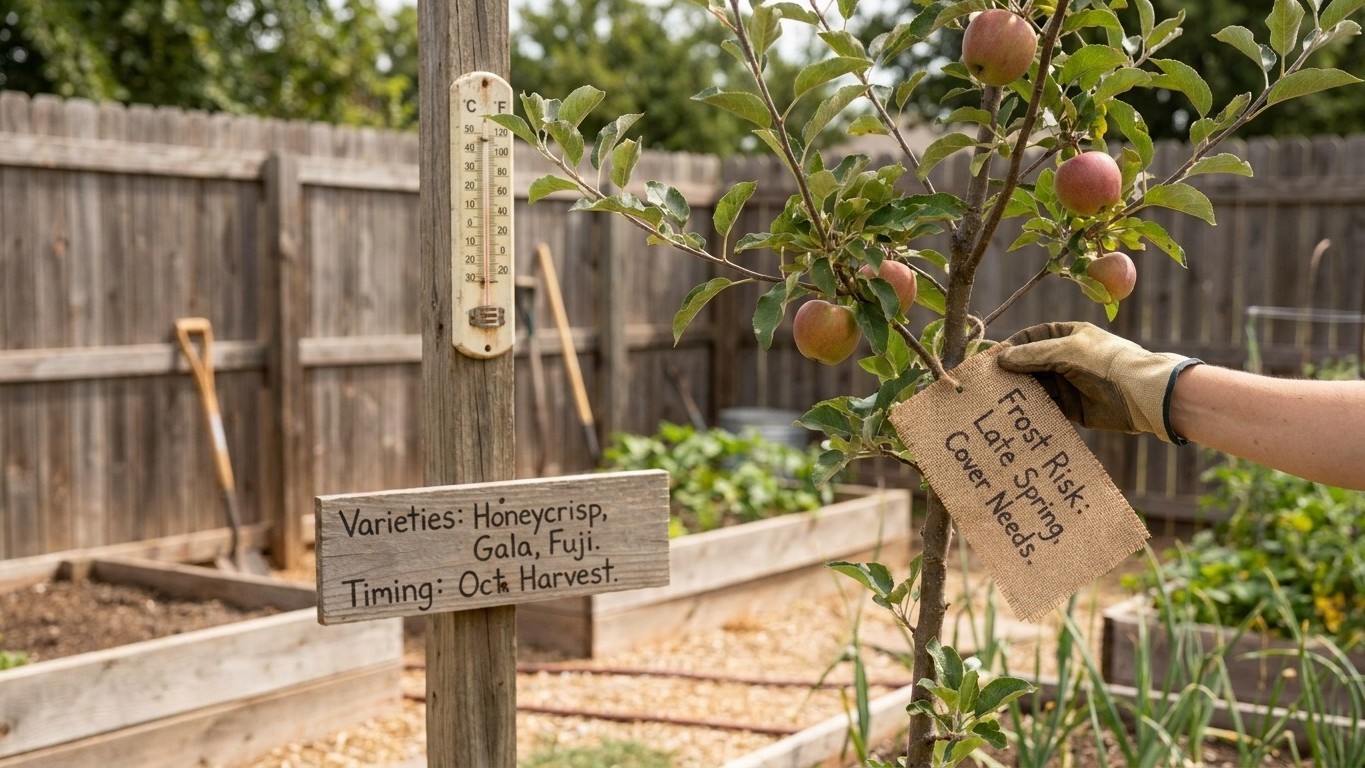

Apples grow across Oklahoma. USDA’s 2023 hardiness map, built on NOAA’s 1991-2020 climate normals, places the state in zones 6a to 8a, a range that covers most named apple cultivars sold at nurseries. The one thing to check before you buy a tree is winter chill, not just cold hardiness, since the two filters answer different questions and a tree can pass one and fail the other.
Can you grow apples in Oklahoma
Zone 6a to 8a is the spread Oklahoma covers, and that single fact decides more about your apple trees than any planting guide will admit. The panhandle chills harder and later than the southeast, so a variety that thrives near McAlester can struggle near Guymon. Oklahoma City’s numbers are just a reference point. The real answer lives in your county’s frost dates, your soil drainage, and how much wind your site takes — not in a statewide average.
USDA’s hardiness map puts Oklahoma at 6a to 8a. The panhandle and higher northwest counties run colder, toward 6a, while the south-central and southeastern parts of the state sit closer to 8a with a longer, milder growing season. Oklahoma City’s figures are a reference point, not a statewide guarantee, and a grower in Guymon or in McAlester should check their own county’s data rather than assume the capital’s numbers apply.
Where the climate gets genuinely difficult is the drier, windier western third of the state, where late freezes and thin soils make young trees harder to establish. That is not a reason to skip apples there. It is a reason to lean on hardier, later-blooming varieties and to plant on a site with some wind protection and decent drainage. The eastern half of the state, with more rainfall and a longer frost-free window, is the more forgiving place to start if you are new to fruit trees. No part of Oklahoma should be written off for apples, but the variety list and the planting timing both need to match the county, not the state average — for month-by-month guidance, check this Oklahoma apple Calendar.
Which varieties suit this climate

Two filters matter here, and guides that only mention one are giving you half the picture. The first is cold hardiness, which decides whether the tree survives winter. The second is winter chill, the number of cumulative cold hours a tree needs during dormancy before it can flower normally. Get the hardiness right and get the chill wrong, and the tree lives but blooms thin and ragged, or not at all some years. For a rundown of cultivars that handle both filters well, see this guide to Oklahoma apple Best varieties.
Oklahoma sits in the moderate-chill middle of the country, not at either extreme. A low-chill apple bred for the Gulf Coast, the kind covered in Growing Apples in Texas: Varieties, Timing and Frost Risk, tends to break dormancy too early here and gets caught by a return freeze most years. A high-chill variety selected for the short, deeply cold winters described in Growing Apples in Vermont: Varieties, Timing and Frost Risk can sit underchilled in a mild Oklahoma winter and flower unevenly. The varieties below are the ones whose published hardiness and chill needs sit in that middle band.
Gala

A reliable, moderate-chill variety with a published hardiness range that covers zones 4 through 8, so it comfortably fits Oklahoma’s 6a-8a span. It blooms midseason and carries fertile pollen, which makes it a useful partner tree as well as a fruiting one.
Fuji

Similar hardiness range to Gala and a similarly moderate chill requirement, with midseason bloom that overlaps Gala’s closely. Fuji keeps well in storage, which matters given Oklahoma’s warm autumns can shorten the window for picking and eating fresh.
Granny Smith

Rated for zones 5 through 8 on most nursery tags, with a slightly higher chill requirement than Gala or Fuji and a later bloom. That later bloom is worth remembering when frost timing comes up below.
Arkansas Black

A regional heirloom with a hardiness range that fits zones 5 through 8 and a chill need on the higher side of moderate. It blooms late and stores exceptionally well, both useful traits in a state with a long, warm fall.
Enterprise

Bred for resistance to apple scab and fire blight, both diseases that show up more in humid years, which Oklahoma gets. Its hardiness range covers zones 4 through 8 and its bloom falls midseason.
Liberty

Another scab-resistant selection, rated for zones 4 through 8, with midseason bloom that overlaps Enterprise closely enough to make the two a workable disease-light pairing.
Oklahoma State University’s Extension does not publish a single statewide “recommended list” that covers every county’s microclimate, so treat the varieties above as a starting shortlist to cross-check against your own site rather than a final answer.
Planting a pair that works here
Almost no apple variety is reliably self-fertile, so plan on two trees from the start, and make sure at least one of them carries fertile pollen. Some well-known cultivars, including ‘Jonagold’ and ‘Mutsu’, are triploids with sterile pollen. They need two other varieties blooming at the same time nearby, and they contribute nothing back as a pollinizer themselves. Plant a triploid alone with just one other tree and you may get a light crop on the triploid and nothing at all on its neighbor.
| Pair | Bloom timing | Pollen fertility | Notes |
|---|---|---|---|
| ‘Gala’ and ‘Fuji’ | Midseason, overlapping | Both fertile | Either serves as the other’s pollinizer |
| ‘Enterprise’ and ‘Liberty’ | Midseason, overlapping | Both fertile | Disease-resistant, low-spray pairing |
| ‘Jonagold’ plus two pollinizers | Midseason | Sterile pollen | Needs two fertile neighbors, pollinates neither |
| ‘Mutsu’ plus two pollinizers | Midseason | Sterile pollen | Same triploid limitation as Jonagold |
For most home orchards in Oklahoma, ‘Gala’ paired with ‘Fuji’, or ‘Enterprise’ paired with ‘Liberty’, is the simplest reliable choice. Both pairs bloom close enough together that a normal spring gives the bees a real overlap, and neither pair depends on a sterile third tree to make fruit.
The frost that costs a crop here

NOAA NCEI’s 1991-2020 climate normals put the last spring frost at the Oklahoma City reference station in the window of March 28 to April 10, based on the 30 to 70 percent freeze-probability band. That is an airport-station figure, and suburban and rural gardens elsewhere in the state typically see their own last frost run one to two weeks later, sometimes more at higher elevation. Check your own county’s data before you plant on faith in the capital’s window.
What frost actually kills
A frost that hits after the buds have opened to the pink stage does not kill the tree. It kills the open or nearly-open flowers, and with them the year’s crop, while the tree itself leafs out fine a week later looking completely healthy. That gap between “the tree survived” and “the crop survived” is the single most common disappointment new growers report, and it is worth understanding before your first bloom rather than after.
There is not much a home grower can do about a hard freeze across an entire orchard, but a light frost on a still night is a different matter. Covering young trees with row cover or old sheets before a clear, calm night in the frost window, running a sprinkler to coat the buds in ice (which releases a small amount of heat as it freezes and can hold the tissue just above the kill point), and avoiding low, cold-air-pooling planting sites all help. The more dependable protection, though, is variety choice: a variety that blooms late, such as Granny Smith or Arkansas Black, is far less likely to be in flower during the March-to-April frost window than an early bloomer, and that timing advantage does more work than any single night of frost protection.
The apple year in Oklahoma
Track the tree’s stage, not the calendar. A warm February can push green tip two weeks ahead of a cold one, and the calendar date that mattered last year may be meaningless this year.
- Dormancy: prune while the tree is bare, before any bud movement, to shape structure and remove damaged wood.
- Green tip: the first sign buds are breaking. Watch the forecast closely from here, since this is when a tree becomes frost-vulnerable.
- Pink: buds show color just before opening. This is the stage where a frost does its worst damage to the flowers inside.
- Bloom: flowers open, usually landing near or just after the reference window of March 28 to April 10 that NOAA NCEI reports for Oklahoma City, later in cooler counties.
- Petal fall: pollination has either happened or it has not. There is nothing more to do here but wait and watch fruitlets form.
- Fruit set: thin the fruitlets to one or two per cluster, spaced by hand, to get size and to keep limbs from breaking under a heavy crop.
- Harvest: pick before NOAA NCEI’s first fall frost window of October 29 to November 8 at Oklahoma City, earlier in cooler counties, though most varieties finish well ahead of that date anyway.
The stretch to watch hardest is the run from green tip through petal fall, since that is the entire window in which a frost can erase the crop without touching the tree’s long-term health.
Local help
Oklahoma State University’s Extension service is the right first call for county-specific variety trials, soil testing, and a spray calendar tuned to local disease pressure like cedar apple rust and fire blight. Reach the statewide office through OSU Extension and ask to be routed to your county office, since the county agent, not the state website, will have the numbers that actually apply to your address.
Common questions
Do I need two different apple trees to get fruit in Oklahoma?
Yes, in almost every case. Nearly all common apple cultivars need pollen from a genetically different variety blooming at the same time, and even varieties sold as “self-fertile” usually set a heavier, more reliable crop with a second tree nearby.
What’s the most heat- and humidity-tolerant apple variety for Oklahoma?
Look at disease resistance more than heat tolerance itself, since Oklahoma’s humid stretches drive scab and fire blight harder than they drive heat stress. ‘Enterprise’ and ‘Liberty’ were both bred specifically for resistance to those diseases, which matters more in practice than a marginal difference in heat handling between cultivars.
Can I grow apples in a container in Oklahoma?
You can, on a dwarfing rootstock, but expect more winter care than an in-ground tree needs. A container’s soil freezes and heats faster than garden soil, so a potted apple needs its pot insulated or moved somewhere sheltered for winter, and it needs watering checked far more often through Oklahoma’s hot summers.
How far apart do two apple trees need to be for pollination?
Closer is better. Keep pollinizer pairs within roughly 50 feet of each other where you can, since bees do most of the pollination work and a shorter flight between trees means more visits and a better fruit set.
How long until a new apple tree bears fruit here?
It depends on the rootstock more than the state. A tree on dwarfing rootstock such as M9 or M26 typically starts bearing in about three to four years, while a tree on standard seedling rootstock usually takes six to eight. Location affects vigor, not that basic timeline.