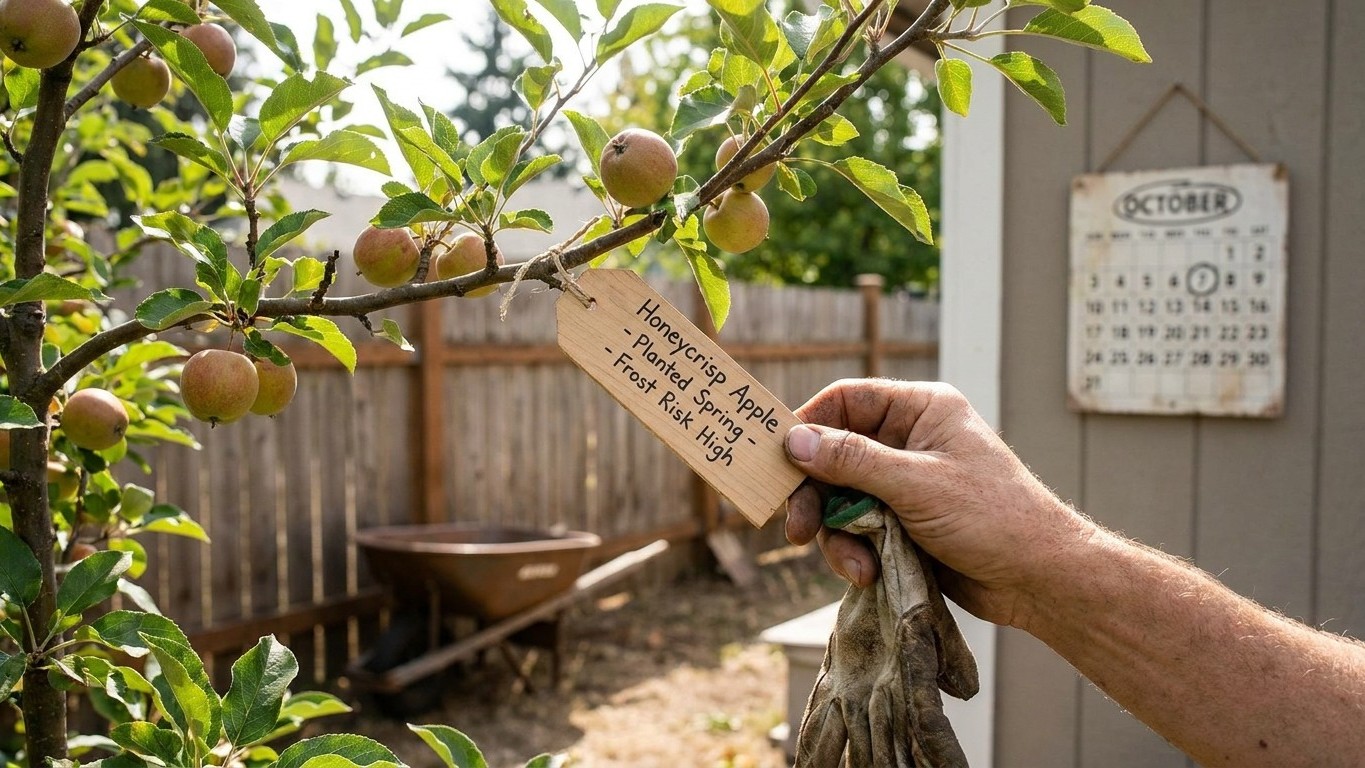

Zone 4a on one side of Oregon, zone 9b on the other — that’s the spread hiding inside the phrase “Oregon climate,” and it’s why a blanket answer about apple trees will fail half the state. A tree bred for the cold end sulks in a mild valley; one bred for the mild end gets killed by a hard winter east of the Cascades. Portland’s numbers, coldest month averaging 35.2°F at night, describe the easy side. Bend and the Columbia Basin play by harder rules.
Can you grow apples in Oregon
Apples do well in most of Oregon, but “Oregon climate” covers a lot of ground. USDA’s Plant Hardiness Zone Map (2023 edition, built on 1991-2020 normals) spans zone 4a to zone 9b across the state, from the high desert basins of the interior to the mild valleys west of the Cascades. That range is too wide to plant from directly. A tree rated for the cold end of that scale is overbuilt for a mild valley, and one rated for the mild end can be caught out by a hard winter further east, which is the single most common reason a young apple tree fails to establish in the wrong spot.
Portland, west of the Cascades, is the reference station NOAA’s National Centers for Environmental Information uses for the western valleys. Its 1991-2020 climate normals put the coldest month’s average daily minimum at 35.2°F, mild enough that winter cold is rarely what limits an apple tree planted in the Willamette Valley. That’s a different growing world from the Columbia Basin or the high desert around Bend, where winter lows run harder and the season is shorter. If you’re east of the Cascades, treat Portland’s figures as a baseline for the mild side of the state rather than a promise for your own yard.
Where the Willamette Valley makes apple growing genuinely easy is the combination of mild winters and a long, mostly dry summer that lets fruit ripen without the fungal pressure a wetter, hotter climate produces. The tradeoff shows up in spring, when the valley still gets a real frost window, covered in detail below. For growers west of the Cascades, the main job is matching variety and planting layout to local bloom timing, not fighting the climate itself; consulting a guide to The Best Apple Varieties for Oregon is a good starting point, and tracking key dates on an Oregon apple Calendar can help keep that timing on track.
Site selection matters as much as variety choice in a climate this mild. Apples want full sun and well-drained soil, and in the Willamette Valley’s clay-heavy ground that often means planting on a slight rise or amending the hole rather than digging into a low spot where cold air and standing water both collect. A frost pocket at the bottom of a slope blooms on the same schedule as the rest of the orchard, but takes the hit that the rest of the orchard escapes, because cold air pools there on a clear, still night. The same tree planted twenty feet uphill can come through a frost that damages the one below.
Which varieties suit this climate

Most standard apple varieties are hardy enough for the Willamette Valley’s winters, so the hardiness filter screens out very little here. ‘Liberty’, bred for scab immunity and hardy well into USDA zone 4, sits comfortably in the mild end of Oregon’s zone range too. ‘Enterprise’ and ‘William’s Pride’, both scab-resistant introductions from the disease-resistance breeding programs of the 1990s, cover the same broad hardiness band and are worth a look if you’d rather not spray for scab through a wet spring. ‘Chehalis’, an older Pacific Northwest dessert apple with a large yellow-green fruit, suits the same maritime climate that runs down through the Willamette Valley, which is worth knowing if you’re comparing notes with growers across the Columbia in Washington.
Hardiness and winter chill are different filters
The filter most planting guides skip is winter chill, the number of cold hours a tree needs before it breaks dormancy and blooms evenly. Get this wrong and the tree doesn’t die. It just blooms thin and ragged over weeks instead of in a tight window, which drags out pollination and shrinks the crop. A low-chill variety bred for the Deep South’s short mild winters is wasted in Oregon’s valleys, which sit on the higher-chill end of that scale. The winters west of the Cascades, while not harsh, run cool and long enough to satisfy the full-chill varieties bred for the northern and mid-Atlantic states, which is the group most nursery catalogs list as standard stock anyway. There’s little reason to hunt for a low-chill selection unless you’re gardening on an unusually warm microclimate at low elevation, and no local source publishes a chill-hour map for the state, so match variety to how your own site actually spends its winter rather than to a figure that doesn’t exist for Oregon yet.
| Variety | Scab resistance | Typical bloom timing | Pollen |
|---|---|---|---|
| ‘Liberty’ | Immune | Mid-season | Fertile |
| ‘Enterprise’ | Resistant | Late | Fertile |
| ‘William’s Pride’ | Resistant | Early to mid | Fertile |
| ‘Chehalis’ | Susceptible | Mid-season | Fertile |
| ‘Gravenstein’ | Susceptible | Early | Sterile (triploid) |
Planting a pair that works here
Apples need a second tree of a different variety blooming at the same time, and at least one half of that pair has to carry fertile pollen. Plant two self-incompatible varieties on the same bloom schedule and you’ll get fruit from cross pollination. But if either tree happens to be a triploid, a variety that produces little or no usable pollen of its own, you actually need a third tree nearby to pollinate the pollinator.
‘Gravenstein’, an old dessert and cider apple still grown in Pacific Northwest orchards, is a classic bad first choice for a two-tree yard. It’s a triploid and won’t set much pollen for its neighbor even though it blooms at a useful time. Pair it with a fertile mid-season bloomer and treat it as the tree that gets pollinated rather than the one doing the work. Among the varieties already covered, ‘Liberty’ and ‘Enterprise’ bloom close enough together in most seasons to work as a straightforward two-tree pair, and both carry fertile pollen, which makes that combination a safer starting point than reaching for a heritage triploid.
Bloom overlap matters more than name recognition. Nursery tags and catalog descriptions list each variety’s bloom group, and pairing two mid-season bloomers is the simplest way to guarantee overlap without tracking exact dates yourself. Growers just north in Washington work through the same pairing logic, since bloom group is a catalog trait that doesn’t shift much between the two states’ maritime climates. A flowering crabapple works as a universal pollen source if space is tight, since most crabapples bloom over a long window and produce abundant fertile pollen, though it won’t give you apples worth eating on its own. For a typical suburban lot, two named eating varieties with overlapping bloom is the more practical choice.
The frost that costs a crop here

NOAA’s NCEI 1991-2020 climate normals put Portland’s last spring freeze, the point where there’s a 30 to 70 percent chance of a 32°F freeze, in the window of March 6 to March 21. That’s deliberately a range, not a date. Some years the risk clears in early March, others it lingers past the equinox, and the exact timing moves with that year’s weather pattern rather than a fixed spot on the calendar. Growers east of the Cascades or at higher elevation should expect a different frost window than this Portland-based figure describes.
The mechanism that actually costs a grower a crop is more specific than “a frost happened.” Apple buds move through visible stages before bloom, and once a bud has opened enough to show pink, a hard frost at that stage kills the flower tissue inside, not the tree itself. The wood, the leaves, and the tree’s ability to bloom again next year come through fine. What’s lost is that single year’s crop, because a dead flower can’t set fruit no matter how healthy the tree looks a week later.
That’s exactly why the March window matters more than a date on a wall calendar. If a cold snap lands while buds are still tight and dormant, the tree shrugs it off. If the same cold snap lands after buds reach pink or open into bloom, whether that’s early in a cold spring or later in a warm one, the flowers are the casualty. There’s genuinely little a home grower can do to protect a full-size tree from a hard freeze at pink or bloom stage. Commercial operations run wind machines or overhead irrigation to hold orchard air a few critical degrees higher. For a backyard tree, covering young trees with frost cloth on a clear, still night helps more than most people expect, but it’s no fix for a widespread hard freeze across a whole valley.
The real long-term protection is variety choice. ‘Enterprise’, from the table above, blooms noticeably later than ‘Liberty’ or ‘William’s Pride’ and by the time it opens has often already dodged the riskiest weeks of March. Growers in continental climates such as Oklahoma deal with a completely different frost pattern, since a continental spring can swing temperature far more violently than the maritime spring west of Oregon’s Cascades, but the underlying lesson, that a late bloomer buys real insurance, holds in both places.
The apple year in Oregon
Apple growth runs by stage, not by month, and each stage’s timing shifts a little with the year’s weather. In the Willamette Valley, using Portland’s NOAA-NCEI normals as the reference point, the season runs between the March 6 to March 21 last-frost window and the November 11 to November 27 first-fall-frost window at the other end.
Dormancy through bloom
Trees sit dormant through winter, and this is the only safe stretch for bare-root planting, structural pruning, and dormant oil sprays for overwintering pests, since none of that work risks a bud that hasn’t started growing yet. Green tip, when the first green growth pushes through the bud scales, typically shows in late winter to early spring as days warm, ahead of or right around the start of that March frost window. Pink follows within a couple of weeks, when flower buds swell and show color before opening, and this is the stage where a frost turns from a non-event into a lost crop, as covered above. Full bloom and petal fall usually clear by the time the last-frost window closes in most years, though a cold spring can push bloom later and straight into frost risk.
Fruit set through harvest
After petal fall, pollinated flowers set fruit, and this is when a home grower can do real thinning. Removing the smaller fruit from each cluster by hand improves the size of what’s left and reduces limb breakage later in a heavy year. Summer is the growing window, with irrigation and pest monitoring the main jobs. Harvest timing depends entirely on variety, since early types come off well before fall while late-keeping types hang on the tree much longer, and either way harvest needs to wrap up well ahead of Portland’s November 11 to November 27 first fall frost, per NOAA’s NCEI normals, so fruit isn’t caught by an early hard freeze still on the tree.
Local help
Oregon State University’s Extension Service is the right first stop for county-specific variety lists, scab and coddling moth spray schedules, and soil test recommendations, since conditions vary enough between the Willamette Valley, the Columbia Gorge, and the high desert that no single statewide answer covers all of it. Contact the office for your own county before settling on a final variety list or spray calendar.
Common questions
Can I grow apples on the Oregon coast?
Coastal sites have their own microclimate, generally milder in winter but windier and foggier than the inland valleys, and Portland’s figures don’t describe them directly. Check with Oregon State University’s Extension Service office for your coastal county before picking a variety.
Do I need to spray my apple trees in Oregon?
It depends on the variety and how wet your spring is. Scab-resistant types like ‘Liberty’, ‘Enterprise’ and ‘William’s Pride’ cut the need for fungicide sprays significantly, while susceptible varieties in a wet, mild spring often need a scab program to keep fruit and leaves clean. Your county extension office publishes the current spray timing for coddling moth and scab for your area.
How many years before an apple tree fruits in Oregon?
Rootstock decides this more than climate does. A tree on dwarfing rootstock generally starts fruiting sooner than one on standard or seedling rootstock, which can take considerably longer to bear a meaningful crop. Check the rootstock listed on the nursery tag, since that catalog detail matters more here than anything specific to Oregon’s climate.
What if I only have room for one apple tree?
You’ll still need a pollen source within range, whether that’s a neighbor’s apple tree, a crabapple planted nearby, or a espaliered second variety against a fence. A handful of varieties are labeled partially self-fertile, but even those set a noticeably heavier crop with a genuine second variety blooming alongside them.
Why did my apple tree bloom but not set fruit?
The usual culprits are a mismatched or sterile pollen partner, a frost that hit the flowers at pink or bloom stage, or cold wet weather during bloom that kept bees from flying. Check which of those applied this particular spring before assuming the tree itself is at fault, since a tree that blooms but doesn’t set fruit is very often otherwise healthy.