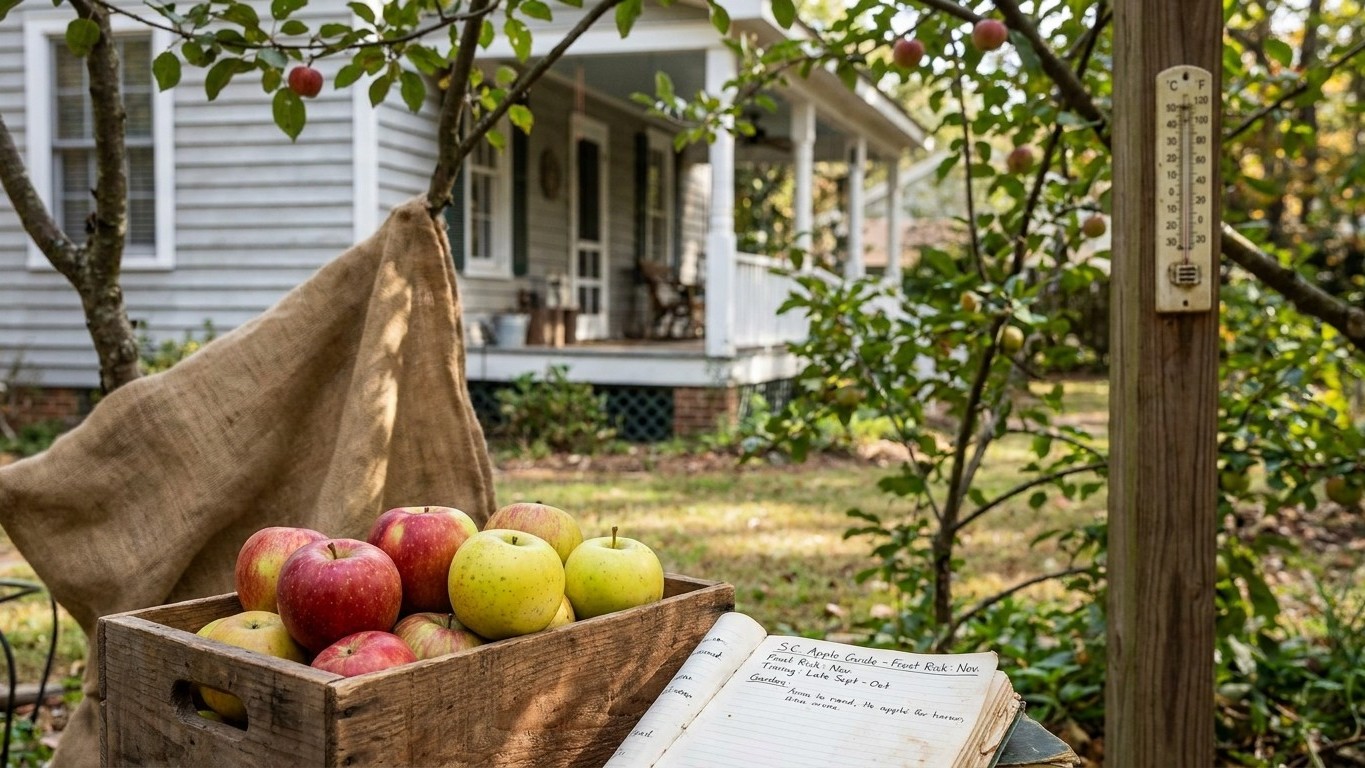

Yes — apples do fine in South Carolina, but which apple you plant matters more than whether it’ll survive the winter. Our winters here are mild enough that a tree bred for colder country can live for years without ever flowering right, so the real question isn’t “will it grow,” it’s “will it bloom.” Before you pick a variety or worry about rootstock or planting dates, look up its winter-chill requirement and check that against where you actually live — coastal Lowcountry, Midlands, or the cooler Upstate foothills, and use a South Carolina apple Calendar to plan around your local timing. That one match decides whether you get a crop or just a healthy, mostly-empty tree.
Can you grow apples in South Carolina
Where the state’s apple country actually is
The USDA’s zone range of 7a to 9a spans a real climate gradient, from the warm coastal Lowcountry near Charleston up through the Midlands and into the cooler foothills of the Upstate. NOAA’s 1991-2020 normals for Charleston describe a place where winters rarely bite hard, which is exactly why South Carolina’s working orchards sit somewhere else. The Upstate, particularly the foothills running through Oconee, Pickens, Cherokee and Spartanburg counties, holds the state’s traditional apple country, and for a simple reason: elevation there knocks real degrees off both the summer highs and the winter lows compared to the coast, giving trees the sustained cold they need to break dormancy cleanly each spring.
Survival is not the same as a good crop
Hardiness zone only answers half of the question. A tree surviving winter is a different matter from a tree flowering well the following spring, and that second question is the one that actually decides whether South Carolina growers get apples worth picking. A ‘GoldRush’ or ‘Enterprise’ planted right on the coast will probably live for years without ever setting much fruit, simply because the winter never gets cold enough for long enough to satisfy what the variety needs before it can bloom properly. If your garden sits anywhere near sea level, treat the Upstate’s harder winter as the benchmark your own site is missing, and choose accordingly. That distinction, covered fully below, is worth understanding before you order a single tree.
Which varieties suit this climate

Hardiness gets you halfway
Apples in general are listed as hardy from roughly zone 4 through zone 8 or so, which means almost any named variety will survive South Carolina’s winters without trouble, everywhere except the very warmest zone 9a pockets right on the coast, where summer heat becomes the bigger stress on the tree than winter cold ever is. For a rundown of which cultivars actually perform well here, see this guide to South Carolina apple Best varieties. That still leaves the harder filter standing.
Winter chill decides whether it flowers
The harder filter is winter chill, the number of cumulative hours a tree spends below about 45°F each winter, which triggers the reset a bud needs before it can break dormancy and flower normally. Skip this filter and a tree can survive for a decade while blooming thin, late, and ragged every single spring. South Carolina sits toward the low end of the national chill scale, and the coast sits lower still than the Upstate, which pushes the state’s realistic variety list toward low- and moderate-chill cultivars rather than the classic Northeastern apples bred for a much colder winter.
The table below gives published chill-hour figures as printed by nurseries and breeding programs, the same everywhere they’re sold, alongside where each fits best inside the state.
| Variety | Approx. chill hours (catalogue figure) | Best fit in South Carolina |
|---|---|---|
| ‘Anna’ | 250-300 | Coastal Lowcountry, zone 9a |
| ‘Dorsett Golden’ | 200-300 | Coastal Lowcountry, zone 9a |
| ‘Fuji’ | 400-450 | Midlands, zone 8a-8b |
| ‘Gala’ | 500-600 | Midlands to Upstate, zone 7b-8b |
| ‘Enterprise’ | about 800, scab-resistant | Upstate, zone 7a-7b |
| ‘GoldRush’ | about 800, scab-resistant | Upstate, zone 7a-7b |
If you garden in the Midlands around Columbia, treat ‘Fuji’ and ‘Gala’ as the safer moderate-chill bet, and confirm locally before betting an orchard on a high-chill cultivar you’re not certain will get satisfied most winters. Further inland and higher in elevation, growers face a longer, colder winter still, with correspondingly higher chill requirements needed for good bloom, a comparison covered in our guide to Growing Apples in Tennessee.
Planting a pair that works here
Avoid the sterile-pollen traps
Apples need a second tree for reliable pollination, and that second tree needs to bloom at the same time with pollen that actually works. Most apple varieties are not self-fertile, and a handful of well-known ones, including ‘Mutsu’ (Crispin) and ‘Stayman’, are triploids that produce sterile pollen of their own. A triploid can carry a full crop, but only if something else nearby supplies the pollen. Two triploids planted side by side, with nothing else in bloom, will flower beautifully and set almost nothing.
Realistic pairs for South Carolina
None of the varieties in the chill-hour table above are triploids, which makes pairing them straightforward. On the coast, ‘Anna’ and ‘Dorsett Golden’ were bred specifically as a pollinating pair for low-chill climates, bloom together reliably, and are the standard low-chill combination sold by southern nurseries for exactly that reason. Further inland, in the Midlands and Upstate, ‘Gala’ and ‘Fuji’ overlap in bloom time closely enough to serve as each other’s pollinizer, and both carry fertile, compatible pollen.
Bloom overlap isn’t guaranteed by the label
Two trees is the minimum, not a guarantee. Bloom overlap depends on the same winter chill that governs flowering quality in the first place, so a tree that broke dormancy late because it never got fully satisfied can drift out of step with a healthy neighbor even when the nursery tag lists both as compatible. Bees do the actual work of moving pollen between the two trees, so plant the pair close enough that a forager can move between them easily rather than treating “somewhere on the property” as good enough. Where possible, buy both trees from the same nursery batch, since stock grown under identical conditions tends to track bloom timing more closely than two trees shipped in from different climates.
The frost that costs a crop here

Why pink is the dangerous stage
NOAA’s 1991-2020 climate normals put the window for the last spring freeze at 32°F between February 28 and March 17 at the Charleston-area reference station (USW00013880), based on the 30 to 70 percent freeze-probability band. That’s an early window by national standards, and it lands right where most apple varieties suited to this climate are pushing bud break, which is exactly the problem. A freeze that arrives while a tree is fully dormant does little harm. A freeze that arrives after the buds have opened to the pink stage, showing color just before the flowers open, kills the flowers themselves while leaving the wood and the tree completely unharmed. The tree survives, but the year’s crop is over, because a frost-killed apple flower does not recover or reopen. That single distinction, flower damage versus tree damage, explains why a tree can look perfectly healthy in a year that produces almost no fruit.
What a grower can do
There’s not much a home grower can do once bloom has already started, but a few choices shift the odds beforehand:
- Plant on a slope or high ground rather than a low spot, since cold air pools in the lowest part of a yard on a clear, still night.
- Cover small trees with row cover or an old sheet on a forecast freeze night, and remove it again once temperatures rise.
- Delay any late-winter pruning on a frost-prone site, since heavy pruning can push a tree toward earlier bloom than it would otherwise carry.
- Choose a later-blooming variety in the first place, which is the only fix that works every year instead of just some.
How the Upstate and the coast differ
Peninsular Charleston itself runs milder than the airport station behind these figures, so a garden close to the harbor often clears its frost risk earlier than the dates above suggest. The Upstate runs the other way. Its higher elevation adds real cold at both ends of the calendar, so both the last spring freeze and the first fall freeze move toward the center of the year compared to the coastal dates, narrowing the safe season in exchange for the extra winter chill that variety needs to flower well in the first place. Growers further north dealing with a last frost that lands weeks later still than even the Upstate’s can compare notes in our guide to Growing Apples in Massachusetts, where the entire bloom calendar shifts by more than a month.
The apple year in South Carolina
Apples move through the same stages everywhere, but the calendar dates that mark them shift with local frost timing, so anchor each stage to what the tree is actually doing rather than a month on the wall.
Dormancy through green tip
Trees sit fully dormant through the coldest stretch of winter, accumulating the chill hours discussed above. Green tip, the first hint of leaf tissue pushing out of the bud, typically begins before NOAA’s Charleston-area last-frost window of February 28 to March 17 has closed, which is why an early-blooming variety carries real frost risk on this coast. In the Upstate, where that window runs later, green tip and the frost risk that follows it both shift later in step.
Pink through bloom
The pink stage is the point where a freeze does the most damage for the least visible reason, since the flower parts are exposed but not yet pollinated. Watch the weather forecast through this single week more closely than through any other stretch of the growing year.
Petal fall through fruit set
Once petals drop, fertilized flowers begin swelling into fruit over the following weeks. Thin the heaviest clusters down to one or two fruit per cluster once they’re roughly marble-sized, which spreads the tree’s energy across fewer, larger apples instead of a crowded branch of small ones.
Harvest and back to dormancy
Harvest timing depends on the variety’s own ripening season more than the calendar. Low-chill types like ‘Anna’ ripen in summer, while ‘Enterprise’ and ‘GoldRush’ hang on into fall. NOAA’s 1991-2020 normals put the first fall freeze at that same Charleston-area station between November 20 and December 5, and once leaves drop after that, the tree returns to dormancy and the chill-hour count starts over for the following spring.
Local help
For county-level variety lists, spray timing, and disease pressure specific to your part of the state, Clemson Cooperative Extension is the authority to check before you plant or spray anything. Their horticulture agents track local chill accumulation, scab and cedar apple rust pressure, and which varieties are actually performing well in nearby test blocks, none of which a national source can give you. Start at Clemson Extension and look for the horticulture or fruit production section for your county.
Common questions
Can I grow apples right on the coast near Charleston?
Yes, but stick to low-chill varieties bred for it, like ‘Anna’ and ‘Dorsett Golden’. The coast’s mild winters, described by NOAA’s Charleston normals, rarely accumulate enough cold for a high-chill Northern apple to flower well.
How many chill hours does my area actually get?
Clemson Cooperative Extension is the right place to ask for a local estimate, or you can compare your average winter against the published chill requirement of the variety you’re considering.
Do I really need two different apple trees?
Almost always, yes. A small number of apple varieties are partially self-fertile, but even those set more and larger fruit with a second, compatible variety nearby, and the coastal and Upstate pairs already covered above are a safer bet than hoping one tree manages alone.
When should I plant a bare-root apple tree in South Carolina?
Plant while the tree is still fully dormant, before green tip shows, and avoid working the soil right after a hard freeze. The exact window shifts with the same frost dates that govern bloom, so a coastal planting can generally start earlier than an Upstate one.
My tree bloomed heavily but set almost no fruit. What happened?
The most common causes are a late frost that killed the open flowers, a missing or poorly timed pollinizer, or a triploid variety like ‘Mutsu’ relying on pollen it can’t supply itself. Check your bloom-week weather first, since a frost during the pink or bloom stage leaves no other visible sign on the tree.