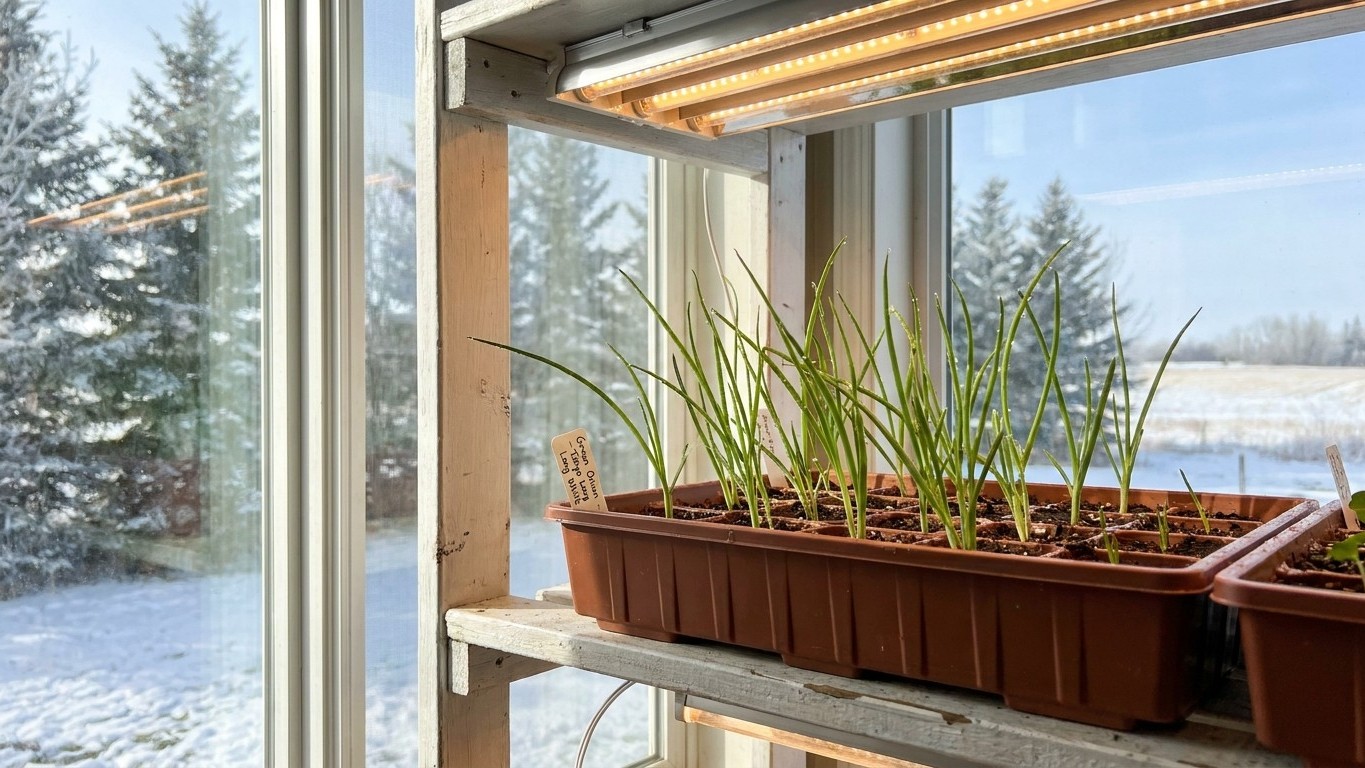

In Alberta, onion planting happens on a windowsill before it happens in the garden. Start seeds indoors around early February, then move transplants outside in late April to early May, once the soil has thawed and hard frost is behind you. Waiting until the ground feels the way it does in Georgia or Texas costs you the harvest, because Alberta’s summer days grow long enough, 16 hours and 20 minutes at the solstice, to trigger bulbing whether your plants are ready or not.
The short answer for Alberta

Calgary sits at 51.11 degrees north, and on the longest day of the year the sun stays up there for 16 hours and 20 minutes. That single number decides almost everything about onion planting in this province. Onions don’t bulb because the weather warms up. They bulb when day length crosses a threshold written into the variety’s genetics, and at this latitude that threshold is reached only by long-day types, the kind bred to wait for 14 to 16 hours of daylight before switching from making leaves to making a bulb.
That fact sets the whole calendar. Alberta’s frost-free window runs roughly from late May to early September in most of the province, and there isn’t time to direct-seed onions outdoors and still have enough leaf mass built up by the time June daylight flips the bulbing switch. So the work happens in two stages. Seeds go into trays indoors around the start of February, under grow lights, and the seedlings move outside as transplants once the soil can be worked and hardened-off plants can handle it, typically the first half of May. Growers who prefer sets, the small dormant bulbs sold for direct planting, can get those into the ground a bit earlier, usually mid to late April, since sets skip the indoor-seedling stage entirely.
Compare that to a state where winters stay mild enough for onions to overwinter outdoors and gardeners plant in the fall. Alberta’s winters make that impossible: the ground freezes solid for months, and nothing survives outdoors from October through March. A southern grower answers “when to plant” with a season. An Alberta grower answers it with a project that starts indoors in the dead of winter and only moves outside once the risk of a hard freeze has passed.
Varieties that fit Calgary’s daylight
Six of the long-day varieties documented on this site have a published range that fully covers Calgary’s 51.11 degrees north: Ailsa Craig (38-60N), Barolo (38-55N), Blush (38-55N), Patterson (38-55N), Redwing (43-65N), and Walla Walla Sweet (35-55N). These are the varieties whose bulbing trigger matches what Alberta’s June daylight actually provides, which is why they’re the safer starting point for a first-time Alberta onion grower.
What will not work here
Planting an onion late in Alberta doesn’t push the harvest back a few weeks the way it might with lettuce or beans. It shrinks the bulb outright. An onion plant reads day length, not the calendar, and once Alberta’s daylight climbs past the trigger point for its variety, the plant stops making leaves and starts making a bulb from whatever leaf mass it has already built. A transplant that goes into the ground three weeks late simply has three fewer weeks of leaf growth behind it, and the bulb it produces is smaller in direct proportion. There’s no catching up once bulbing has started; the plant doesn’t wait for you.
The other way to lose the harvest is choosing the wrong variety, and at 51.11 degrees north with 16 hours and 20 minutes of June daylight, plenty of popular onions are simply the wrong tool for the job. Short-day and intermediate-day types are bred for latitudes where summer days stay closer to 12 or 13 hours. In Alberta they hit their bulbing trigger while the plant is still small, weeks before a proper long-day variety would even begin. The result isn’t a smaller onion, it’s often a marble-sized one, because the plant never got the growing window it needed before bulbing shut leaf production down.
Excluded varieties
Fifteen varieties documented on this site fall outside Alberta’s range, with published latitudes that sit south of Calgary’s 51.11 degrees:
- Cabernet (intermediate-day, 35-45N): triggers far too early for Alberta’s long summer days
- Calibra (intermediate-day, 35-45N): same early trigger, small bulbs here
- Candy (intermediate-day, 33-40N): bred for a much shorter summer day than Alberta provides
- Elsye (intermediate-day, 32-45N): bulbs before Alberta’s leaf-growing window closes
- Expression (intermediate-day, 32-45N): same mismatch, tiny bulbs
- Gabriella (short-day, 20-35N): a southern short-day type, unsuited this far north
- Madalyn (short-day, 20-35N): triggers around 12 hours, far too soon here
- Monastrell (intermediate-day, 35-46N): falls short of Calgary’s latitude
- Powell (long-day, 43-47N): a long-day type, but its range still ends south of Calgary
- Red Carpet (long-day, 40-45N): same issue, range capped below 51.11N
- Red Long of Tropea (intermediate-day, 35-48N): bred for shorter days than Alberta provides
- Red Rock (short-day, 30-36N): a deep-south short-day variety
- Scout (intermediate-day, 32-46N): bulbs too early for Alberta’s daylight curve
- Sierra Blanca (intermediate-day, 32-45N): same mismatch
- White Castle (short-day, 30-38N): another short-day type built for far shorter summer days
Plant any of these in Alberta and the outcome is consistent: healthy green tops all season, a bulbing trigger that arrives too early relative to the plant’s size, and often rot in storage because an undersized bulb never cures properly.
What changes across Alberta
Every figure above comes from Calgary, at 51.11 degrees north, and Alberta is a large province. It runs from the Montana border around 49 degrees north up to nearly 60 degrees north at the boundary with the Northwest Territories, more than ten degrees of latitude. That’s enough to shift both the frost-free window and the exact hours of June daylight a given garden actually experiences.
A gardener near Lethbridge, close to the southern border, gets slightly shorter June days than Calgary and a somewhat longer frost-free season. A gardener near Grande Prairie or Fort McMurray, several degrees north of Calgary, gets noticeably longer June days, sunset lingering well past 10 p.m. near the solstice, but a shorter, more compressed window between the last spring frost and the first fall one. The long-day varieties that suit Calgary generally still suit these more northern gardens, since they were bred for long daylight to begin with, but the tighter season leaves less room for a transplant date that slips by even a week or two.
| Region | Approx. latitude | What changes |
|---|---|---|
| Lethbridge area (south) | ~49.7N | Slightly shorter June days than Calgary; longer frost-free season |
| Calgary (reference city) | 51.11N | 16 h 20 of daylight at the solstice; baseline for this page |
| Edmonton area | ~53.5N | Longer June days than Calgary; similar frost-free window |
| Grande Prairie / Fort McMurray area (north) | ~55-57N | Noticeably longer June days; shorter frost-free season |
Near-the-edge varieties
Seven varieties documented on this site have a published range that ends within about 1.5 degrees of Calgary’s latitude, which puts them in a blurred zone rather than a clear yes or no: Bridger (35-50N), Frontier (40-50N), New York Early (38-50N), Red Long of Florence (38-50N), Rossa di Milano (38-50N), Safrane (42-50N), and Talon (42-50N). These may bulb reasonably well in Alberta’s far south, closer to Lethbridge, but they sit right at the edge of what their catalogue range supports at Calgary’s own 51.11 degrees, so treat them as an experiment rather than a sure thing further north in the province.
Checking this against your own garden
Everything above is built on one city’s numbers. Calgary’s 51.11 degrees north and its 16 hours 20 minutes of solstice daylight are solid, sourced figures, but they describe one location in a province that stretches across more than ten degrees of latitude. Before locking in a planting date or a seed order, it’s worth confirming a few things specific to your own yard rather than assuming Calgary’s numbers apply exactly where you garden.
- Find your own latitude, so you know whether your June days run a little shorter or longer than Calgary’s 16 h 20.
- Check your own last spring frost date; a low-lying yard or a spot farther north may need another week or two indoors before transplants can safely move out.
- Check your own first fall frost date, since that tells you how much curing time your onions realistically get after bulbing finishes.
- Contact Alberta’s provincial agriculture extension service, which tracks frost dates and growing-season length by district and can confirm whether your area matches the Calgary-based figures used here.
- Re-check any variety’s published latitude range against your own coordinates before ordering seed, especially if you garden near the province’s northern or southern edge.
If you follow the almanac, here is when to plant onions by the moon. It is a tradition, not a proven method.