
Ontario tomato growers deal with a predictable lineup of insect pests that arrive in a fairly consistent order each season, tied loosely to the region’s frost-free window. Knowing which ones actually show up here, and when, saves a lot of wasted spray and worry over insects that aren’t even a problem in this province.
What this comes down to in Ontario

Around Toronto Pearson, the average last spring frost falls near April 30 and the average first fall frost lands near October 16, according to Environment and Climate Change Canada’s 1981-2010 climate normals for that station. That window sets the calendar for every pest below, because each one keys off soil warming, transplant timing, or the length of the frost-free stretch rather than a fixed date on paper.
The following pests are the ones that reliably turn up on Ontario tomato plants, listed in the order they tend to appear through the growing season.
Cutworms
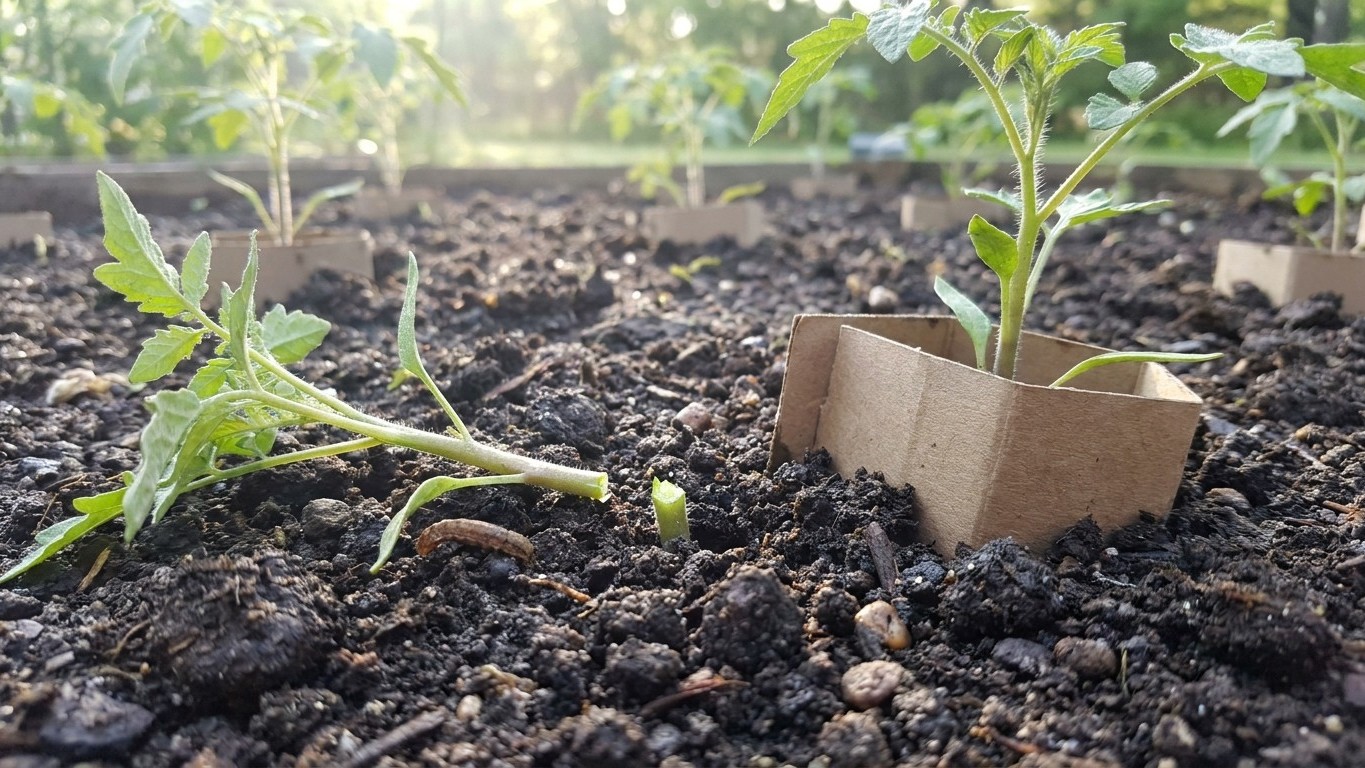
Cutworms are plump, greyish-brown caterpillars, often curled into a C-shape when disturbed, that hide in the soil by day and feed at night. They show up right at transplant time, in the weeks following that late-April average frost date, and the damage is unmistakable: a young seedling severed clean at the soil line, sometimes toppled overnight with almost no warning. A cardboard or foil collar pushed an inch into the soil around each transplant stops them cold, since the larva has to reach the stem from below ground.
Flea beetles
Flea beetles are tiny, shiny black or bronze beetles, barely a sixteenth of an inch long, that jump like fleas when a leaf is brushed. They arrive on young transplants in the same early window as cutworms and riddle leaves with small round shot-holes. Seedlings can outgrow light damage, but a heavy hit on small plants slows growth noticeably. Row cover over transplants until they’re established, plus a stiff spray of water to knock adults off, handles most infestations.
Colorado potato beetle
This beetle is hard to mistake: rounded, roughly a third of an inch, with cream-and-black striped wing covers and, before that, a soft reddish-orange larva with black spots along its side. Both the adult and the larva chew ragged holes through leaves, and a bad infestation can strip a plant of foliage within days. It builds through late May and June. Hand-picking adults and crushing the yellow-orange egg clusters on leaf undersides is often enough on a home scale.
Aphids
Aphids are soft-bodied, pear-shaped insects, usually pale green but sometimes yellow or pink, clustered on new growth and the undersides of leaves. They pierce plant tissue and suck sap, causing curled or yellowing leaves and a sticky residue called honeydew that then grows sooty mold. They build steadily from June onward. A strong water spray or insecticidal soap, applied directly to the clusters, keeps populations from spiraling.
Tomato hornworm
The tomato hornworm is a thick, bright green caterpillar up to four inches long with white diagonal stripes and a curved horn near its tail. It’s the larval stage that does the damage, stripping entire branches of foliage almost overnight and sometimes chewing into green fruit. It shows up in July and August, and its excellent camouflage means the first sign is often scattered black droppings on the leaves below. Hand-picking works, and it’s also the preferred host of a parasitic wasp that leaves small white cocoons along the caterpillar’s back, a sign to leave that individual alone.
Tomato fruitworm
Also called corn earworm, this caterpillar ranges from pale green to brown or nearly black with faint stripes, growing to about an inch and a half. The larva bores directly into ripening fruit, leaving a clean entry hole and rot developing inside. It appears in the warmest stretch of the season, typically August into September. Checking fruit clusters weekly and removing damaged tomatoes before the larva moves to the next one limits losses.
Working it out for your own garden
The frost window is a starting point for figuring out timing, not the timing itself. If a seed packet lists 70 days to maturity and the local transplant date sits around late May, roughly three to four weeks after that April 30 average last frost to let soil warm, count forward: late May plus 70 days lands in early August, comfortably ahead of the October 16 average first frost. A 90-day variety pushes that harvest into late August, still inside the window most years, but it leaves less cushion if frost arrives early, since October 16 is a midpoint and roughly half of all years run later than that, and half run earlier.
Pest identification works on a similar logic of matching timing to symptom rather than guessing from a photo alone. A severed seedling in early June points to cutworms before anything else, simply because nothing else on this list attacks at the soil line that early. Shot-holes in small leaves a week or two after transplant are almost always flea beetles, not disease, and spraying fungicide on them wastes time and money. Skeletonized leaves in June with striped beetles visible on the plant mean Colorado potato beetle, while the same kind of stripping in July with no beetles in sight, just droppings on the lower leaves, means it’s time to search the stems carefully for a hornworm.
Sticky, curling new growth points to aphids regardless of the month, since they’re active for most of the season rather than tied to one window. Damage inside the fruit itself, discovered only when a tomato is picked or cut open, is the signature of the fruitworm, and it shows up late enough in the season that Colorado potato beetle and cutworms are no longer active suspects. Working through symptom, plant part, and calendar together, in that order, narrows the list to one or two candidates almost every time, without needing to catch the insect in the act.
What changes across the state
Ontario’s tomato season is not the same from Windsor to Thunder Bay, and pest timing shifts with it. The Toronto Pearson frost dates describe the southern Golden Horseshoe corridor, moderated by Lake Ontario’s mass, which delays both the last spring frost and the first fall frost compared with areas farther from the lakeshore. Move north away from Lakes Ontario and Erie, or gain elevation toward the Canadian Shield, and that frost-free window narrows from both ends: spring frost risk lingers later into May, and fall frost arrives sooner in September, compressing the stretch during which cutworms, flea beetles, and fruitworm all operate.
Southwestern Ontario, close to Lakes Erie and Huron, tends to warm earlier and stay milder into fall, which can extend the active period for Colorado potato beetle and aphids by a couple of extra weeks on either end. Northern Ontario’s shorter, cooler season generally sees lighter pressure from heat-loving pests like the fruitworm, simply because the warm stretch it needs never lasts as long. Distance from open water, not just latitude, is doing most of the work here, and it’s worth remembering the province’s plant hardiness zone rating (7a on the Canadian system, for the Toronto Pearson area specifically) reflects that same lake-driven moderation and does not apply evenly across the province.
The mistakes this state punishes
Planting out too early after a warm stretch in April is the classic misstep, since a mild week doesn’t cancel the fact that the average last frost sits at April 30, meaning frost is still statistically likely in roughly half of all years right around and after that date. Tender transplants set out during a warm snap get hit twice: first by a late frost, then by cutworms waiting in soil that’s just warmed enough to bring them active.
Skipping the early scouting window is the second costly habit. Flea beetle damage and the first Colorado potato beetle egg clusters both show up in late May and June, and a garden left unchecked for two or three weeks during that stretch can go from a handful of pests to a real infestation. Checking the undersides of leaves every few days during that period catches both while hand-picking still works.
The third mistake is treating a general insecticide as the default answer. Broad-spectrum sprays kill the parasitic wasps that naturally control hornworm populations, which means a garden treated indiscriminately in July can end up with worse hornworm damage the following month than a garden left alone. Matching the pest to a targeted response, hand-picking, row cover, or a soap spray aimed at the actual insect, does better than reaching for a generic product every time.
Checking this against your county
The Toronto Pearson frost dates and the pest timing built around them are a provincial reference point, not a guarantee for any one backyard. Local microclimate, soil type, and even the specific crops grown nearby all shift pest pressure in ways a single weather station can’t capture. For local pest reports and confirmation of what’s active in a specific county or region right now, the Ontario Ministry of Agriculture, Food and Agribusiness is the starting point, alongside a local extension or regional agriculture office for on-the-ground detail.
Common questions
Do tomato hornworms actually sting?
No. The horn at the tail end looks alarming but is soft and harmless. The caterpillar can be picked up bare-handed without any risk of a sting or bite.
Can Colorado potato beetles spread from potato plants to tomatoes?
Yes, readily. Both crops are in the same plant family, and beetles move freely between them, so a potato patch nearby often means earlier and heavier pressure on tomatoes.
Are aphids dangerous to tomato plants or just unsightly?
Beyond the honeydew and sooty mold they leave behind, heavy aphid feeding stunts new growth and can transmit plant viruses, so a light infestation is worth managing rather than ignoring.
Is it worth spraying preventively before any pest appears?
Generally no. Preventive broad-spectrum spraying tends to remove the natural predators and parasites that keep pests like the hornworm in check, often making later infestations worse rather than avoiding them.