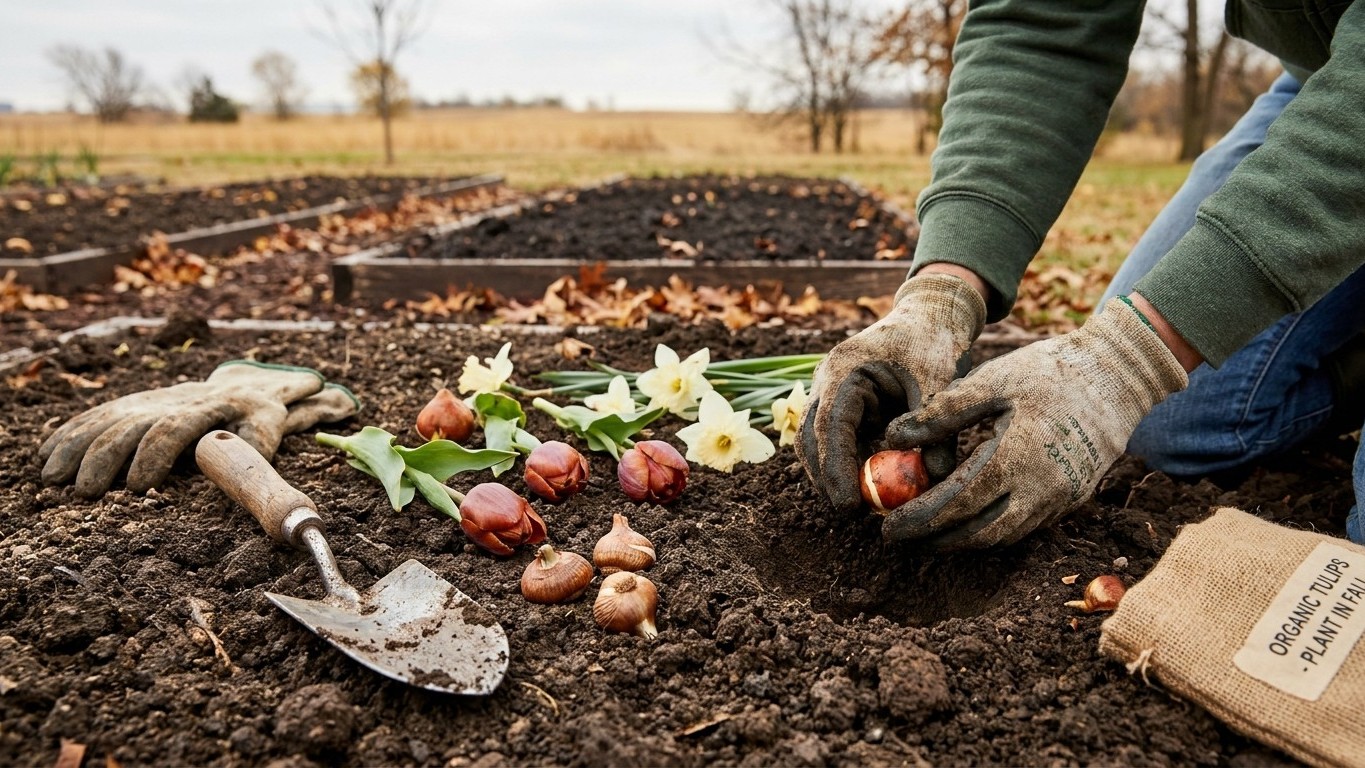

Kansas winters run cold enough to satisfy nearly every classic spring bulb, from tulips to daffodils to crocus. The catch is a handful of popular bulbs that need either a milder winter or drier soil than this state provides, though gardeners can still enjoy them by Forcing Spring Bulbs Indoors in Kansas or by Growing Spring Bulbs in Containers in Kansas. Below is the planting window, the cold math behind it, and which bulbs actually reach bloom here instead of just pushing leaves.
When to plant bulbs in Kansas

Spring bulbs go into Kansas soil once the ground has cooled from summer heat but well before it locks up hard for winter. The rule of thumb gardeners use nationwide, plant roughly six weeks before the ground freezes solid, anchors on the average first fall frost. For the Wichita area, NOAA’s 1991-2020 Climate Normals put that first freeze between October 23 and November 2. Working back from that window, the safe planting stretch for most of the state falls somewhere in the second half of September through the middle of October.
Get the timing wrong on either side and the bulb pays for it. Plant too early, while soil is still warm from summer, and a tulip or daffodil will sometimes push a shoot of top growth before winter arrives. That shoot gets killed back by the first hard freeze, and while the bulb underground usually survives, it wastes stored energy it needed for spring bloom. Plant too late, after the ground has already gone cold and started to firm up, and the bulb goes in without enough time to grow the root system it needs before frost locks the soil. A bulb that skips root establishment often comes up weak the following spring, or skips a year of flowering entirely while it tries to catch up underground.
The frost date is an average, not a promise
That October 23 to November 2 window is a 30-year average, which means roughly half of all years in Kansas see the first fall freeze arrive earlier than October 23, sometimes considerably earlier in a cold year or at higher elevation. The other half see it land later. Treat the range as a planning target, not a guarantee, and lean toward the earlier end of the planting window if your garden sits in a low spot where cold air pools, or if you’ve noticed frost showing up on your grass before it hits neighboring yards. Gardens in open, elevated, or northern parts of the state should plan to plant closer to late September than mid-October.
One more wrinkle worth flagging here: NOAA’s frost data comes from an airport weather station, and airport stations tend to run a little warmer than the surrounding countryside because of pavement and heat retention. Suburban and rural gardens in Kansas often see their first fall frost arrive one to two weeks earlier than the reference station shows, so treat late October as a soft deadline rather than a hard one, especially outside city limits.
Whether your winter is cold enough
This is the question that actually decides whether a spring bulb blooms or just grows leaves. A tulip, daffodil, or hyacinth bulb needs a sustained cold period before it can flower, typically twelve to fourteen weeks with soil temperatures below about 45F. That cold spell triggers a hormonal shift inside the bulb that converts stored energy into a flower stalk. Skip the cold, or cut it short, and the bulb spends its energy on leaves instead, or produces a flower bud so short it never clears the soil line.
Kansas clears that threshold with room to spare. The coldest month at the Wichita reference station averages a daily low of 22.5F, well below the 45F ceiling that matters for bulb chilling. Given that mean minimum, soil at planting depth stays below 45F from roughly mid-November through late February in a typical year, which works out to something closer to fourteen to sixteen weeks of chilling rather than the bare minimum. That margin means gardeners here don’t need to pre-chill hardy Spring Bulbs in the refrigerator before planting; the ground does the work on its own.
The margin matters most for gardeners who might otherwise be tempted to try bulbs bred for warmer climates, or who’ve seen pre-chilled bulbs sold at garden centers and wondered if they need to bother. In Kansas, they don’t. The one place pre-chilling still comes up is for gardeners trying to force bulbs indoors for winter bloom, in which case the standard advice is twelve weeks in a refrigerator crisper, kept away from ripening apples, pears, or other fruit, since the ethylene gas fruit gives off can kill the flower bud inside a chilling bulb before it ever gets planted.
| Bulb | Weeks of cold required | What Kansas delivers | Verdict |
|---|---|---|---|
| Tulip | 12-14 weeks below 45F | ~14-16 weeks | Blooms reliably, no pre-chill needed |
| Daffodil / Narcissus | 12-15 weeks below 45F | ~14-16 weeks | Blooms reliably, no pre-chill needed |
| Hyacinth | 12-14 weeks below 45F | ~14-16 weeks | Blooms reliably, no pre-chill needed |
| Crocus | 8-15 weeks below 45F | ~14-16 weeks | Blooms reliably, no pre-chill needed |
| Allium | 8-10 weeks below 45F | ~14-16 weeks | Chilling need cleared early in winter, blooms reliably |
A gardener anywhere near the middle of the country tends to assume the cold requirement is the hard part. In Kansas it isn’t. The failures that do happen here almost never trace back to insufficient chilling; they trace back to a bulb that was never suited to this climate in the first place, which is the question the next section answers.
Which bulbs suit Kansas
Given a hardiness range of 5b-7a across the state (USDA Plant Hardiness Zone Map, 2023 update) and a coldest-month minimum that clears every major spring bulb’s chill requirement, most of the bulbs sold every fall at Kansas garden centers are legitimately suited to the climate here, not just marketed to it.
- Tulips (Tulipa) – hardy zones 3-8
- Daffodils / Narcissus – hardy zones 3-9
- Crocus – hardy zones 3-8
- Hyacinths – hardy zones 4-8
- Alliums – hardy zones 3-9, depending on species
- Grape hyacinth (Muscari) – hardy zones 3-8
- Snowdrops (Galanthus) – hardy zones 3-7
Every one of those ranges swallows Kansas’s 5b-7a whole, and most swallow it with room on both ends, which is why these bulbs tend to naturalize here and come back year after year rather than needing to be replanted.
Bulbs that disappoint here
Not every bulb sold in the fall bin belongs in a Kansas garden. Ranunculus and anemone coronaria are hardy only to about zone 8, a full zone or more warmer than most of Kansas, and left in the ground over winter here their corms typically rot or freeze outright rather than surviving to bloom. Freesia falls into the same trap, rated for zones 9-10, which makes it a bulb worth growing in a pot and bringing indoors, never one to leave in Kansas clay through January.
The disappointment with borderline bulbs rarely shows up as total failure the first year. More often, a marginal bulb blooms beautifully once, on stored energy from the grower, and then fails to return the second spring because the winter here was harder on it than the label implied. That’s the pattern worth remembering: a gorgeous first-year display from a zone 8 bulb is not the same as a bulb that’s actually suited to this state.
What digs them up here
Squirrels and voles raid Kansas bulb beds every fall, but they don’t raid indiscriminately. The difference between a bulb that gets eaten and one that gets left alone comes down to chemistry, not luck. Daffodils and every member of the onion family, which includes ornamental alliums, contain compounds that make them either toxic or simply unpalatable to rodents. Tulips and crocus contain neither defense, which is exactly why they’re the two bulbs gardeners lose most often to digging.
- Bulbs squirrels and voles take: tulips, crocus
- Bulbs they generally leave alone: daffodils, alliums, hyacinths, snowdrops
Choosing daffodils or alliums over tulips solves the rodent problem before it starts, but for gardeners set on planting tulips or crocus anyway, one measure actually works: lay a sheet of galvanized wire mesh flat over the planting area right after planting, pinned down at the edges, and leave it in place until the ground freezes hard. Squirrels dig in loose fall soil, not frozen ground, so the mesh only needs to hold through that window. Repellent sprays sold for this purpose tend to disappoint, since a single rain washes most of them away and Kansas gets plenty of fall rain to do exactly that.
Where to check for your own county
Every figure in this guide, the frost dates, the coldest-month minimum, the hardiness range, comes from a reference station near Wichita, and Kansas is a big enough state that conditions shift noticeably from one end to the other. A planting calendar built around the state’s central region can run two to three weeks off for a garden near the Colorado border or up against Nebraska, where growing seasons run shorter and winters bite harder.
The most reliable local check is the Kansas State University Research and Extension service, which publishes county-specific planting guides and keeps a directory of local extension offices staffed by agents who track conditions in that specific part of the state. A call to the county office is worth more than any statewide average, since an agent there can confirm whether the frost dates and hardiness assumptions in this guide actually hold for the soil in question, or whether local conditions call for adjusting the calendar by a week or two in either direction.