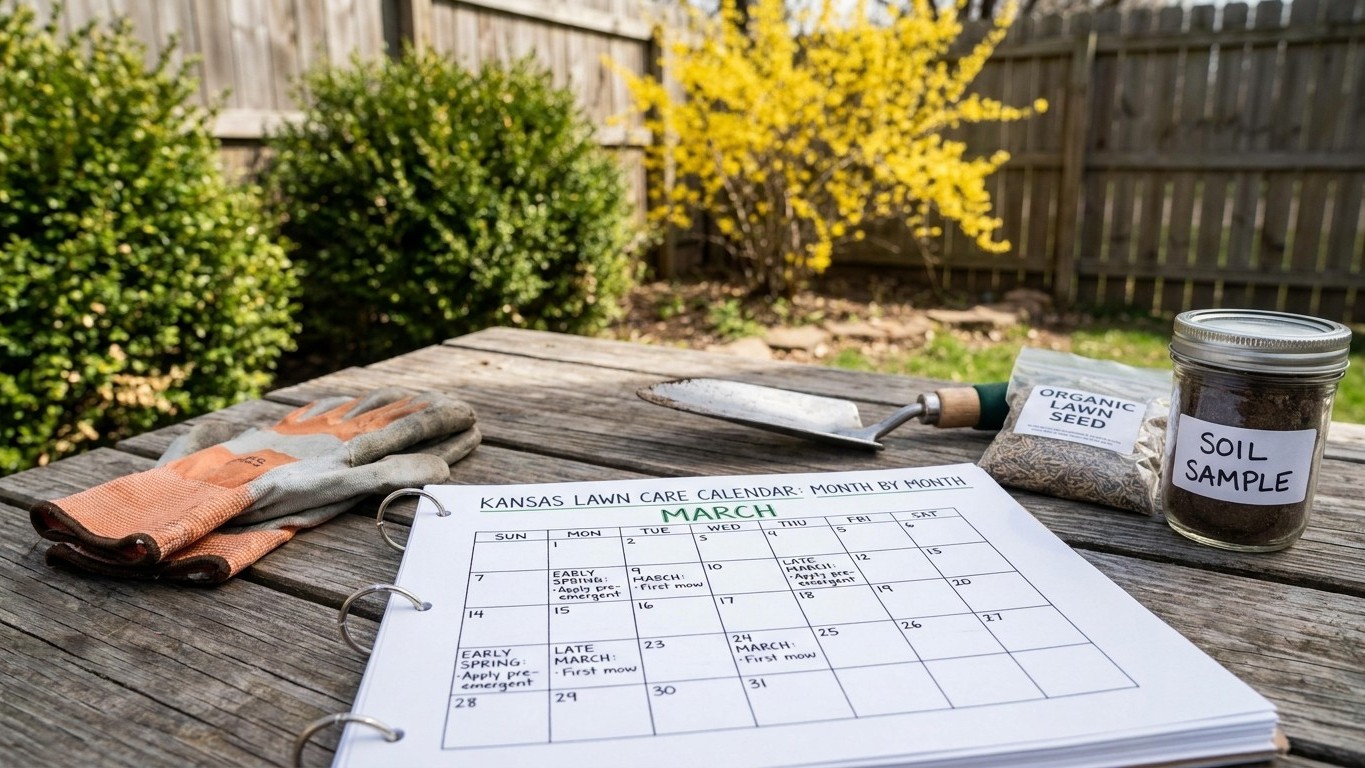

Kansas sits in the transition zone, the strip of the country where no grass gets to relax. Tall fescue that stays green all winter will brown out under July’s heat; zoysiagrass that shrugs off that same heat goes dormant brown the moment the first frost hits. A calendar built for one works against the other, which is why the month that helps your lawn depends entirely on which grass is already growing in it.
The short answer for Kansas
Kansas falls in what turf researchers call the transition zone, the band of the country where neither cool-season nor warm-season grass performs at its best. This placement comes from reading Wichita’s climate normals, the number of days at or above 90°F and the average low of the coldest month, against the season tolerances Clemson Cooperative Extension publishes in HGIC 1214. A cool-season lawn of tall fescue, Kentucky bluegrass or perennial ryegrass stays green through winter but slows and often browns under July heat. A warm-season lawn of zoysiagrass or bermudagrass shrugs off that heat but goes brown from the first fall frost until new growth resumes in spring. These figures come from the Wichita weather station specifically, and a lawn in Goodland or Pittsburg runs on a different clock, covered further down.
Neither answer is wrong. The choice comes down to what you’re willing to give up: winter color, or summer toughness. The right calendar depends entirely on which grass you already have, because a step that helps one can set the other back a full season. If you haven’t settled on a species yet, The Best Grass Seed for Kansas Lawns lays out that trade-off before you lock in a routine.
This calendar also assumes the groundwork in Kansas Lawn Care is already done: a soil test, a mowing height matched to the species you have, and a lawn that isn’t fighting a drainage or compaction problem underneath. Everything below builds on that base.
Working through the year

If you have a cool-season lawn
Tall fescue, Kentucky bluegrass and perennial ryegrass do almost all their growing in spring and fall, and Clemson’s tall fescue maintenance calendar (HGIC 1219) times every major task around those two windows rather than around summer. Spring calls for a pre-emergent herbicide before crabgrass germinates, then mowing at the taller end of the fescue range through the growing months, easing off nitrogen as heat builds. Summer is a holding pattern: mow high, water deeply but infrequently, and expect some browning under drought stress, which is dormancy, not death. Fall is the priority season. NOAA’s 1991-2020 normals put Wichita’s first freeze between October 23 and November 2, and the main nitrogen feeding, plus any overseeding or aeration, needs to happen well ahead of that freeze window so new roots have time to establish before growth stops. Waiting until the window has arrived to overseed wastes the seed.
If you have a warm-season lawn
Zoysiagrass and bermudagrass run on the opposite clock. Clemson’s zoysiagrass calendar (HGIC 1217) and bermudagrass calendar (HGIC 1216) both hold off on nitrogen, dethatching and aeration until the lawn has fully greened up and is growing actively in late spring, since feeding a still-dormant warm-season lawn mostly feeds weeds. Mowing height stays lower than fescue, and mowing frequency rises through the hottest weeks, when these grasses do their best growing. Feeding stops well before the freeze window that NOAA’s climate normals mark at Wichita, October 23 to November 2, because nitrogen applied too close to dormancy pushes soft new growth that has no time to harden off before cold arrives.
The table below lines up the two paths side by side.
| Grass | Season type | Active growth | Extension calendar |
|---|---|---|---|
| Tall Fescue | Cool-season | Spring and fall | Clemson HGIC 1219 |
| Kentucky Bluegrass | Cool-season | Spring and fall | General cool-season pattern |
| Perennial Ryegrass | Cool-season | Spring and fall | General cool-season pattern |
| Zoysiagrass | Warm-season | Late spring through summer | Clemson HGIC 1217 |
| Bermudagrass | Warm-season | Late spring through summer | Clemson HGIC 1216 |
What changes across Kansas
The freeze window above is measured at the Wichita airport, and NOAA’s own guidance about these normals is that gardens away from the measuring station typically see frost earlier in fall and later in spring than the airport figure, sometimes by one to two weeks. Kansas is a big state, and elevation alone moves that clock: the high plains of the west, around Goodland and Colby, sit well above the river valleys of the east, and higher ground cools faster in autumn and holds cold longer in spring. A cool-season lawn in that western strip should plan its fall feeding and overseeding a little earlier than the Wichita dates suggest.
Southeast Kansas, down toward Pittsburg near the Ozark edge, sits lower and milder, and a bermudagrass or zoysiagrass lawn there tends to hold green later into fall and green up earlier in spring than the same lawn in Wichita or points north. None of this is a fixed number you can borrow, it’s a direction: colder and earlier in the northwest high plains, milder and later in the southeast corner, with Wichita and south-central Kansas sitting in between as the reference point these figures actually describe.
Soil differences compound the timing gap. Heavier clay soils common across much of eastern Kansas hold moisture and warm slowly in spring, which delays the green-up a warm-season lawn needs before that first nitrogen application is safe. Sandier soils in parts of the west drain and warm faster but dry out faster too, which matters more for irrigation scheduling than for the calendar dates themselves.
The mistakes this climate punishes
Most Kansas lawn failures trace back to using the wrong grass’s calendar. Feeding a warm-season lawn in September or October is the most common one: bermudagrass and zoysiagrass are winding down for dormancy by then, and a shot of nitrogen pushes tender new growth with no time to harden off before Wichita’s first freeze, typically October 23 to November 2 by NOAA’s normals. The damage doesn’t show until the following spring, when whole sections of lawn are slow to green up or don’t come back at all.
Seeding tall fescue, bluegrass or ryegrass in late spring is the mirror-image mistake. Cool-season seedlings need weeks of mild weather to root before summer arrives, and a Kansas summer routinely delivers the heat and drought stress that kills a shallow-rooted seedling in its first season. The bare patch that shows up in July or August is usually a seeding-date mistake made back in May, not a summer problem at all.
- Fertilizing bermudagrass or zoysiagrass after it starts slowing down for the year
- Seeding fescue, bluegrass or ryegrass anywhere near the start of summer heat
- Mowing any lawn scalp-short during the hottest stretch of summer
- Aerating or dethatching a warm-season lawn before it has fully greened up in spring
Cutting too short compounds heat stress rather than causing it outright. A cool-season lawn mowed short going into a hot, dry stretch loses the leaf area it needs to shade its own roots, and it browns faster and recovers slower than a lawn left a notch or two taller. That browning is drought dormancy, not death, but a lawn already stressed by a low mowing height has less reserve to come back from it.
Checking this against your county
Every date in this calendar is anchored to Wichita’s weather station, and K-State Research and Extension is the place to check how your own county compares, since county agents track local frost and soil conditions the airport figures can’t capture. Reach the statewide directory at K-State Research and Extension and look up the office for your county before locking in a fertilizing or seeding date. If your town has its own long-term weather station, NOAA’s climate normals for that station will generally track your yard more closely than the Wichita figures used here. When county advice and this calendar disagree, follow the county office, since it accounts for local soil and elevation.
Common questions
Can I plant a cool-season and warm-season grass in the same lawn?
Not successfully as a mixed stand. The two grow on opposite schedules, and one will always be dormant while you’re trying to feed or mow for the other, so most Kansas lawns settle on one type and accept its trade-off rather than blending them.
Why does my zoysia lawn look dead all winter?
It’s dormant, not dead. Warm-season grasses like zoysiagrass and bermudagrass turn brown after the first fall frost and stay that color until spring temperatures trigger new growth, which in a transition-zone climate can mean a long, tan winter.
When is it too late to seed fescue in the fall?
Once you’re inside the Wichita-area freeze window that NOAA’s normals mark, October 23 to November 2, new fescue seedlings won’t have enough growing season left to root before winter. Earlier in fall gives roots more time, and local conditions can push that window a week or two either way, so check with K-State Research and Extension if you’re seeding late.
Does Kansas have a state-recommended lawn grass?
No single grass is recommended for the whole state, because Kansas sits in the transition zone where neither cool-season nor warm-season turf has a clear advantage. The real choice is between winter color and summer heat tolerance, and it’s a trade-off, not a verdict.