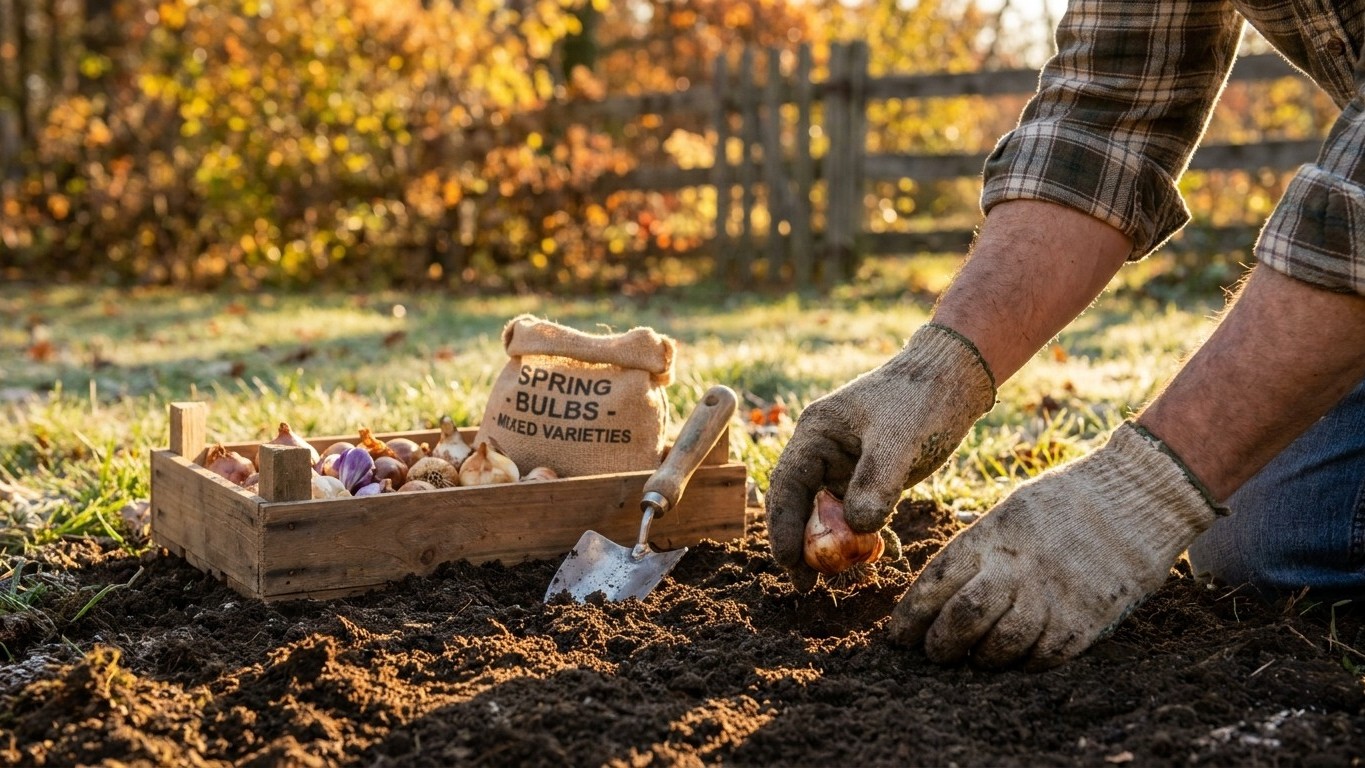

Mississippi gardeners can plant daffodils, alliums, and crocus with confidence, but tulips and hyacinths need a cold winter they mostly won’t get here. The fix isn’t complicated: pre-chill the bulb yourself, skip it and pick something the state’s mild winter already suits, or sidestep the whole problem by Growing Spring Bulbs in Containers in Mississippi where you control the chill.
When to plant bulbs in Mississippi

Spring bulbs go into Mississippi soil once it has cooled from summer heat but before a hard freeze locks it up. That window anchors on the state’s average first fall frost, which NOAA’s 1991-2020 climate normals put at November 7 to November 22, depending on where you sit in the state. Working back from that date, the safe planting stretch runs roughly from mid-October to mid-November, giving bulbs six or so weeks to grow roots before the ground turns cold enough to slow them down.
Plant too early, while soil is still warm from September heat, and a bulb often pushes soft top growth well ahead of schedule. That growth has no defense against a sudden cold snap in December, and a hard freeze can kill it back to the bulb, wasting the season’s flower. Plant too late, after the ground has already chilled hard, and the bulb goes in without enough time to establish roots. The result the following spring is a stunted plant, a flower that opens late and small, or no bloom at all as the bulb spends its stored energy just trying to catch up.
Treat the frost date as an average, not a guarantee
That November 7-22 window is drawn from three decades of weather records, which means roughly half of all years fall on one side of it and half on the other. Some years bring frost in late October; others hold off until early December. Gardeners in the Mississippi Delta or along the Gulf Coast should also expect their actual first frost to land later than the reference-station date, sometimes by a week or two, while higher ground in the northeast corner of the state can see frost arrive earlier. The practical move is to watch your own local forecast in October rather than circle a single calendar date and plant on it regardless of what the season is actually doing.
Whether your winter is cold enough
Here’s the piece that decides everything else on this page. A spring bulb like a tulip or hyacinth doesn’t just tolerate cold, it requires it. The bulb needs a sustained stretch, typically twelve to fourteen weeks, with soil temperatures below about 45°F to complete the internal chemistry that turns a bud into a flower. Skip that cold exposure and the bulb usually still sends up leaves, because leaf growth doesn’t need the same trigger. But the flower stem either never forms, or it emerges so short it stays hidden in the foliage. Gardeners who want reliable blooms without gambling on the weather can sidestep the issue entirely by Forcing Spring Bulbs Indoors in Mississippi, which lets you supply the chill artificially. This is the single most useful number a gardener can carry into any bulb catalog: the weeks of cold required, measured against 45°F.
Mississippi’s own numbers, by NOAA’s measure, tell a mixed story. The coldest month at the Jackson reference station averages a nightly low of just 36.6°F, well under the 45°F threshold. The problem isn’t how cold Mississippi gets. It’s how briefly it stays there. That 36.6°F reading describes one month, typically January, with the months on either side running noticeably milder. The stretch of nights reliably staying below 45°F across the state tends to run only about two months, well short of the twelve to fourteen weeks that tulips and hyacinths are built around.
That shortfall is exactly why so many transplanted Northern gardeners in Mississippi plant a bag of tulip bulbs, get one respectable spring, and then watch the display fade to nothing the following year. The bulb bloomed on stored energy from the nursery, not on a winter that actually met its needs.
| Bulb | Cold required (below 45°F) | What Mississippi’s winter delivers | Verdict |
|---|---|---|---|
| Tulip | 12–14 weeks | Roughly 8 weeks or less most years | Needs pre-chilling almost every season |
| Hyacinth | 12–14 weeks | Roughly 8 weeks or less most years | Needs pre-chilling almost every season |
| Daffodil | 12–16 weeks (varies by cultivar) | Roughly 8 weeks or less most years | Marginal; choose low-chill Southern cultivars |
| Crocus | 8–12 weeks | Roughly 8 weeks in most winters | Workable without chilling in a normal year |
| Allium | 8–10 weeks | Roughly 8 weeks in most winters | Workable, best odds in north Mississippi |
For the bulbs that fall short, pre-chilling is the honest workaround, not a shortcut. That means twelve weeks in a refrigerator, stored well away from apples, pears, or any ripening fruit, because those fruits release ethylene gas, and ethylene destroys the flower bud forming inside the bulb before it ever reaches the ground. Skip that step where the climate doesn’t provide the cold naturally, and a gardener who plants tulips in most of Mississippi without chilling them first has spent money on what amounts to a one-season annual, not a perennial.
Which bulbs suit Mississippi
The bulbs worth planting here are the ones whose hardiness range comfortably covers the state’s 7b-9a zone and whose chill requirement the winter can actually meet on its own. That short list holds up well without any refrigerator involved:
- Daffodil/Narcissus (hardiness zones 3-9), choosing Southern-adapted cultivars for the most reliable rebloom
- Allium (zones 3-9), including ornamental onion types
- Crocus (zones 3-8)
- Grape hyacinth / Muscari (zones 4-8)
- Snowflake / Leucojum (zones 4-9)
- Spanish bluebell (zones 4-9)
Tulips and true hyacinths sit at the edge of trouble here. Their hardiness ranges technically list zones down to 3-7 and 4-8, but Mississippi’s mild, brief winter rarely delivers the sustained chill those bulbs are built around. Planted without pre-chilling, they typically disappoint in one of two ways: either the bulb sends up leaves with no flower stem at all, or it produces one good bloom the first spring, on energy stored at the nursery, then fades to nothing the following year as the bulb fails to recharge.
Crown imperial fritillaria brings a second kind of failure. Its hardiness range covers zones 5-8, putting much of Mississippi at the edge, but the bigger threat is Mississippi’s wet winter soil rather than warmth. Fritillaria bulbs rot quickly in soil that stays soggy, and a rainy Delta or coastal winter can take the bulb out before spring ever arrives.
None of these hardiness ranges function as a hard line, worth remembering either way. A tulip planted in a sheltered, well-drained bed on the north side of a house can outperform expectations, while the same bulb in an open, exposed bed can fail even inside its listed range. Zone maps describe averages, not guarantees for any one yard.
What digs them up here
Squirrels and voles don’t raid every bulb bed equally, and the reason comes down to chemistry rather than chance. Daffodils and every bulb in the onion family contain compounds that make them bitter or mildly toxic to rodents, so they’re left alone in the ground. Tulips and crocus carry no such defense, and both rank among the most reliably dug-up bulbs in any Southern yard.
Among the bulbs recommended above, that split falls cleanly:
- Squirrels and voles typically dig up: Tulips, Crocus
- Squirrels and voles typically leave alone: Daffodil/Narcissus, Allium, Grape hyacinth, Snowflake
Repellent sprays sold for this purpose wash off with the first rain, and Mississippi’s fall and winter months rarely go two weeks without one. A measure that actually holds up is a layer of galvanized wire mesh, sometimes called hardware cloth, laid flat over the planting bed and pinned down at the edges. Leave it in place until the ground freezes, which discourages digging by removing easy access during the exact weeks squirrels are most active burying and retrieving food. Once the soil chills, dig-and-cache behavior drops off on its own, and the mesh can come up.
Where to check for your own county
Every figure on this page, from the November frost date to the 36.6°F coldest-month reading, comes from the Jackson reference station. Mississippi stretches across several degrees of latitude, from the Gulf Coast up to the Tennessee line, and the state spans hardiness zones from 7b to 9a. A planting date built around the state capital can run three weeks off in either direction once you reach the coast or the hill country, and coastal counties in particular tend to see frost arrive later and leave earlier than inland Jackson does.
The Mississippi State University Extension Service tracks these local differences county by county, with staff and Master Gardener programs who know the microclimate of a specific parish far better than any statewide average can. Their extension office directory is the place to confirm a planting window, ask about a bulb’s performance in a particular soil type, or get a straight answer on whether pre-chilling is worth the trouble in a given county’s typical winter.