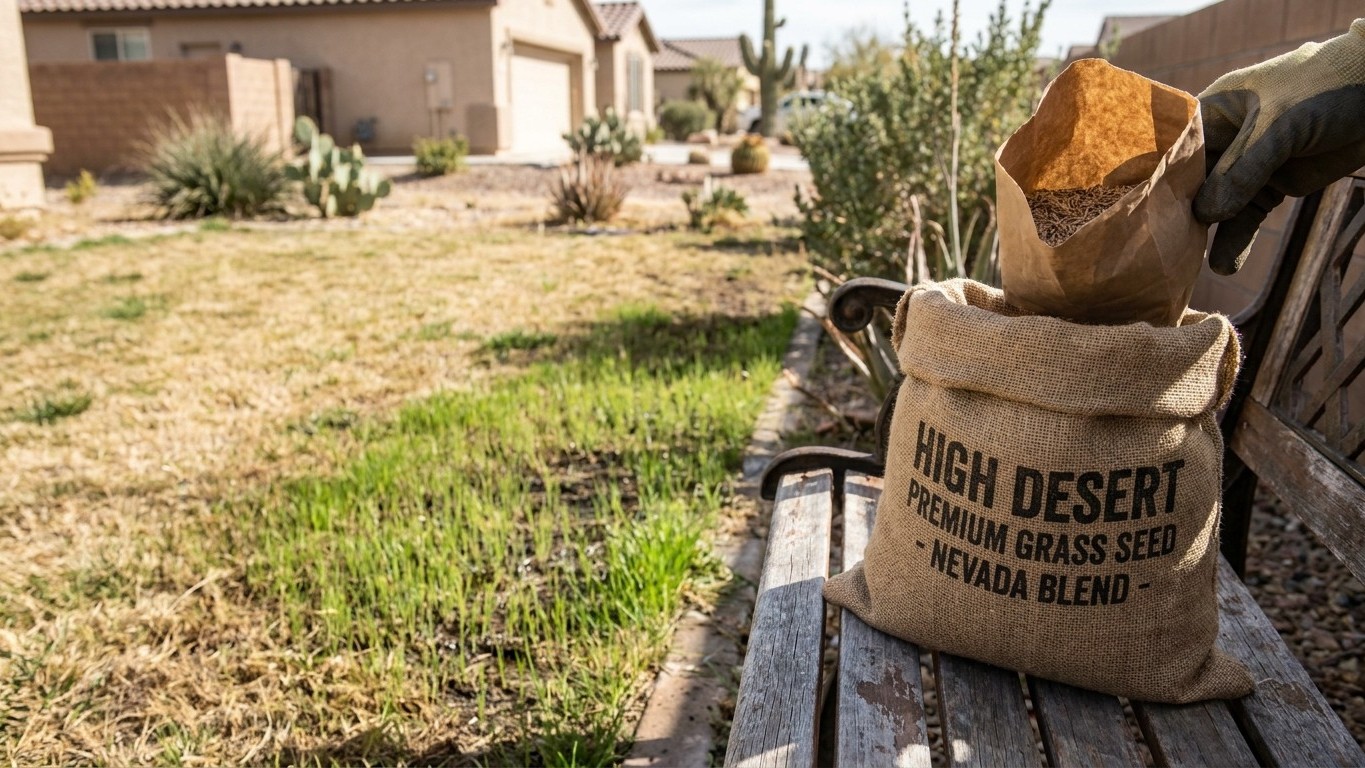

For Nevada’s low desert cities like Las Vegas, the best grass seed is a warm-season type, and Bermudagrass tops the list for full sun and heat tolerance. The Homestead Post places this reference city in the warm turf zone, based on days at or above 90°F and the coldest month’s mean low, read against Clemson Cooperative Extension’s HGIC 1214 tolerance chart for lawn grasses. That placement holds for the low desert valleys. It says nothing about Reno, Carson City, or any lawn sitting at real elevation. Before you buy seed, match your species to your actual sun exposure and check your county against Nevada Lawn Care basics first.
The short answer for Nevada
If your yard is baking in Las Vegas heat and full sun, Bermudagrass is your grass. It handles the summers, shrugs off foot traffic, and will simply go tan and dormant at the first frost, which is normal, not death. Zoysiagrass is the backup if you want a denser lawn and don’t mind a slower start. Before you buy a single bag, walk your yard and check how many hours of direct sun it actually gets, because that one detail decides which of these species is worth planting.
Which of the seven fits your yard depends on three things: how much direct sun the lawn gets, how much water you can commit to it once established, and whether your irrigation water carries any salinity. St. Augustinegrass and Seashore Paspalum tolerate more shade and salt respectively, but both ask more of you in exchange, covered below. Cool-season grass is not on this list for a reason: species like tall fescue and Kentucky bluegrass are built to grow through cool, wet winters and struggle through a low-desert summer, so naming one here would be setting a lawn up to fail rather than helping it succeed.
None of this applies uniformly to the whole state. The warm-zone placement above describes the Las Vegas valley specifically. Nevada’s higher, cooler ground runs on a different clock entirely, which the next section covers in detail.
Working through the year

Ranking the seven warm-season species
Clemson Cooperative Extension’s HGIC 1214 names seven warm-season species suited to hot, sunny lawns: Bahiagrass, Bermudagrass, Carpetgrass, Centipedegrass, Seashore Paspalum, St. Augustinegrass, and Zoysiagrass. Not all seven are a realistic pick for Nevada’s dry, alkaline low desert soils, and each one trades something for what it delivers.
| Species | Where it excels | What it costs you |
|---|---|---|
| Bermudagrass | Full sun, high heat, heavy foot traffic | Goes fully dormant and tan at first frost; spreads aggressively into beds |
| Zoysiagrass | Dense, fine-textured turf with moderate shade tolerance | Slow to fill in from seed; often sold as sod or plugs instead |
| St. Augustinegrass | The most shade tolerance of the group | Least cold-hardy; thins fastest at the edge of the warm zone |
| Seashore Paspalum | Tolerates saline irrigation water | Needs more upkeep to stay dense; seed less widely stocked |
| Bahiagrass | Deep roots, tolerates poor, dry soil | Coarse texture, open habit, tall seed heads need frequent mowing |
| Centipedegrass | Low fertility needs, low mowing frequency | Poor cold tolerance; thins in the high-pH soils common in Nevada |
| Carpetgrass | Tolerates wet, poorly drained, shaded ground | Needs steady moisture; does poorly in dry desert conditions |
For most low-desert yards, that ranking puts Bermudagrass first and Zoysiagrass second, with St. Augustinegrass reserved for shadier corners and Seashore Paspalum reserved for lawns irrigated with brackish or reclaimed water. Centipedegrass and Carpetgrass are harder to justify here. Both are built for humid, acidic Southeastern soils, and Nevada’s dry, alkaline ground works against them from the start regardless of how carefully you water.
Once it’s established
Each of these species has its own Clemson Cooperative Extension maintenance calendar covering mowing height, nitrogen rate, and irrigation timing: HGIC 1216 for Bermudagrass, HGIC 1217 for Zoysiagrass, HGIC 1215 for Centipedegrass, and HGIC 1218 for St. Augustinegrass. Use the one that matches the species you actually planted, not a neighboring one, since a Bermudagrass schedule applied to Zoysiagrass will overfeed a slower-growing lawn. Those calendars are written on the Southeast’s frost dates, so shift the timing to your own spring and fall using the month-by-month adjustments in The Nevada Lawn Care Calendar, Month by Month.
What changes across Nevada
Elevation is the real dividing line
Nevada is mostly mountains and high desert basins, and elevation is what separates a warm-zone lawn from a cool-zone one far more than latitude does. The Las Vegas valley, at low elevation, supports the warm-season species above. Reno and Carson City sit at real elevation, with winters cold enough that the same warm-season turf would struggle to survive dormancy, let alone thrive. A lawn at that elevation is generally better served by cool-season species, which is a different planting calendar entirely and not one covered by the warm-season maintenance schedules named above.
Frost timing shifts by months, not weeks
NOAA’s 1991-2020 climate normals put the first fall freeze at Las Vegas’s airport station somewhere between December 8 and December 23. That figure is a genuine outlier even within Nevada: Las Vegas’s paved, built-up surroundings hold heat longer than open desert, so treat this date range as specific to that one station, not as a statewide planting cue. Reno, Carson City, and any lawn at elevation freeze months earlier in fall and thaw months later in spring than that Las Vegas figure suggests, which compresses the growing season for warm-season grass considerably the further north or higher you go.
Irrigation water quality shifts too. Where a well or municipal supply carries more dissolved salt, Seashore Paspalum’s salt tolerance becomes a genuine advantage rather than a nice-to-have, while species like Carpetgrass that expect steady, low-salinity moisture fall further behind.
The mistakes this climate punishes
Nevada’s dry heat and wide elevation range turn ordinary lawn-care habits into visible damage faster than a milder climate would.
- Feeding warm-season grass in autumn pushes soft new growth that has no time to harden off before frost, and the damage shows up as dead patches when the lawn tries to green up the following spring.
- Seeding cool-season grass into low-desert summer heat kills seedlings outright, since species like tall fescue germinate best in cool, moist soil that simply does not exist in a low-desert summer.
- Mowing too short during peak summer heat scalps the crown and exposes bare soil to direct sun, and the browning that follows shows up within days, not as the gradual, even tan of normal dormancy.
- Planting Centipedegrass or Carpetgrass on unamended desert soil sets both species up to thin regardless of watering, since neither tolerates Nevada’s alkaline, low-organic-matter ground well.
None of these mistakes announce themselves right away. A lawn fed the wrong way in September often looks fine until the following March, which is exactly why the timing matters more than the amount.
Checking this against your county
Everything above is a starting point, not a substitute for a local check. Soil pH, water hardness, and the exact week your ground freezes or thaws all vary within Nevada by more than a state-level guide can responsibly cover. The University of Nevada Reno Extension is the office that can confirm your county’s actual frost dates, soil test recommendations, and whether your address falls on the warm or cool side of the state’s turf line. A five-minute call before buying seed is cheaper than a lawn that has to be redone.
Common questions
Can I mix Bermudagrass seed with a cool-season grass for a green winter lawn?
Yes, overseeding dormant Bermudagrass with a cool-season species for winter color is a common practice in warm zones, but it adds a second planting and mowing schedule on top of the summer lawn. Check with UNR Extension before doing this at elevation, where the base lawn may already be cool-season and have no dormancy period to overseed into.
Why did my new grass seed germinate and then die within a week?
The most common cause is sowing warm-season seed before the soil has warmed enough, or sowing cool-season seed into ground that’s already too hot, both of which let the seed germinate on surface moisture and then scorch. It can also happen if the seedbed dried out for even a day during the two-week germination window.
Is Bermudagrass considered invasive in Nevada?
It spreads aggressively by both seed and runners and will move into flower beds, gravel, and neighboring lawns if left unedged, which is a maintenance cost rather than a legal restriction. Check with your local extension office or HOA before planting near shared property lines.
How much water does a new lawn actually need in the desert compared to an established one?
A newly seeded warm-season lawn needs the surface kept consistently damp, which usually means light, frequent watering several times a day for the first couple of weeks. Once it’s established and mowed a few times, that shifts to deep, infrequent watering that trains roots downward instead of keeping them at the surface.