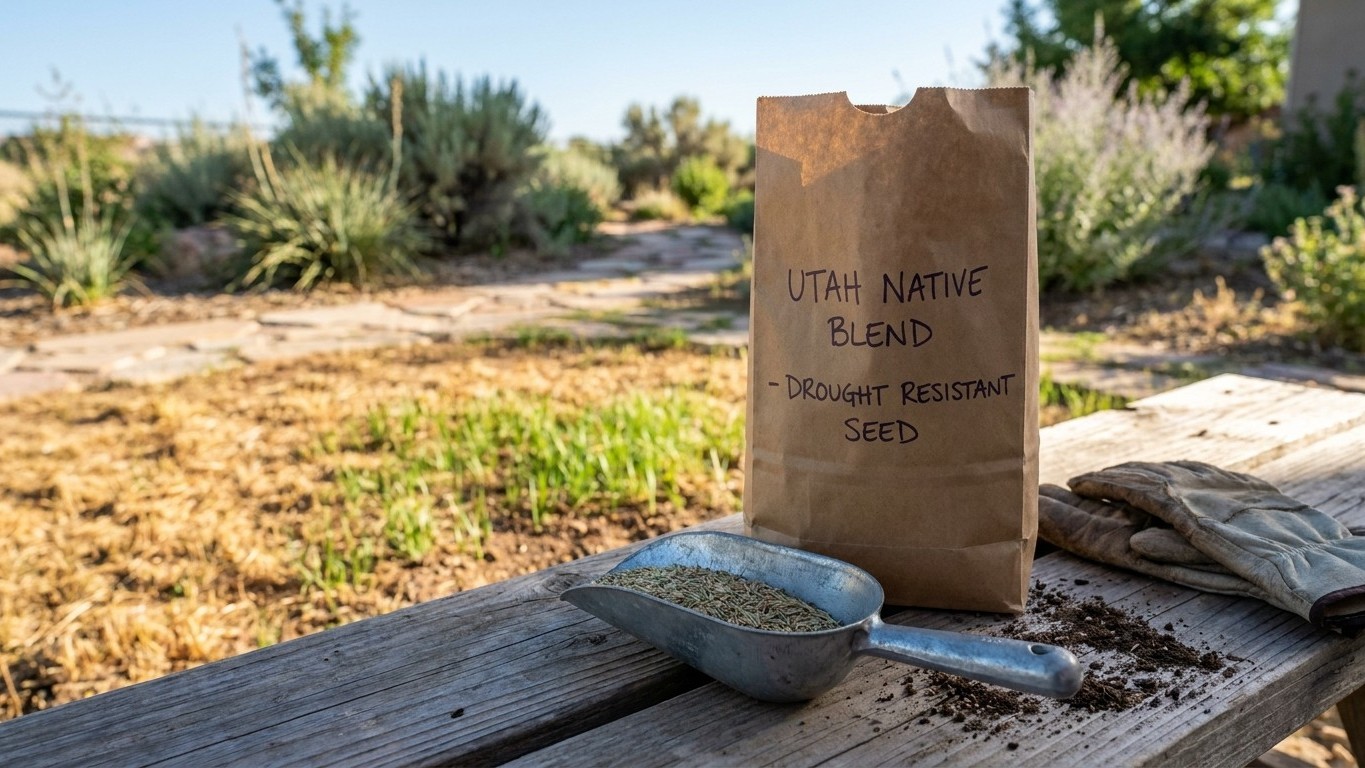

A Utah lawn splits into two honest choices: cool-season grass that stays green most of the year but sulks in July heat, or warm-season grass that shrugs off summer and goes brown the day frost hits. Neither one is the “best” seed, whatever the bag says — it’s whichever ugly phase you’d rather look at, months of dormant brown or weeks of thinning green. So before you buy anything, pick your season of tolerance first, then let that decision choose the grass for you.
The short answer for Utah
A cool-season lawn made of Tall Fescue, Kentucky Bluegrass, or Perennial Ryegrass stays green through spring and fall but slows and can thin during the hottest stretch of summer unless you keep up with irrigation. A warm-season lawn made of Zoysiagrass or Bermudagrass holds its color and traffic tolerance through the heat but turns brown at the first fall frost and stays that way until the soil warms again in spring. Clemson Cooperative Extension’s HGIC 1214 fact sheet lists all five species as realistic choices for a transition-zone lawn like Utah’s, and none of them is flagged as the outright winner.
What the answer depends on
Your decision comes down to what you’re willing to look at in the off season and how much water you’re willing to run. If a lawn that’s brown for months bothers you, cool-season turf is the safer bet even though it needs supplemental water in July and August. If a patchy, drought-stressed lawn in mid-summer bothers you more, a warm-season grass earns its keep by shrugging off heat that would thin fescue or bluegrass. Elevation matters too: the classification above is built from data measured at Salt Lake City, and a lot of Utah sits higher and colder than that valley floor, which pushes the practical choice further toward cool-season turf the higher you go.
Before choosing, treat this as one step in a longer program rather than a one-time seed purchase. Utah Lawn Care covers the soil prep, watering schedule, and mowing routine that determine whether either type of seed actually establishes.
Working through the year

Ranked roughly by how forgiving each species is in a transition-zone climate, the five run like this:
- Tall Fescue: deepest roots of the three cool-season species, but bare spots need reseeding since it won’t spread on its own.
- Kentucky Bluegrass: thickest, most self-repairing cool-season turf, and the thirstiest in a dry summer.
- Perennial Ryegrass: germinates fastest of the five, good for quick patching, weak in prolonged heat.
- Zoysiagrass: toughest warm-season turf under foot traffic, slow to fill in from seed or plugs.
- Bermudagrass: fastest warm-season spread and quickest recovery from wear, needs firm edging to stay contained.
Cool-season choices
Tall Fescue is the most forgiving of the three cool-season grasses recommended by Penn State Extension for this climate band. It has a deeper root system than bluegrass, which buys it more drought tolerance during a dry Utah summer, and it tolerates part shade better than the other two. The cost is that it doesn’t spread by rhizome, so a damaged patch has to be reseeded rather than filled in by the grass itself.
Kentucky Bluegrass spreads aggressively by rhizome and self-repairs bare spots, and it produces the dense, fine-textured lawn most people picture when they think of a green lawn. The cost is a shallower root system than fescue, which makes it thirstier and quicker to go off-color in a hot, dry stretch.
Perennial Ryegrass germinates faster than either of the above, which makes it useful for overseeding a thin lawn or patching a bare spot in a hurry. It’s rarely grown alone here because it doesn’t tolerate summer heat as well as tall fescue and tends to thin out over a few seasons.
Clemson’s Tall Fescue Maintenance Calendar, HGIC 1219, lays out the mowing height, feeding schedule, and overseeding window for a cool-season lawn across the whole year. The month-by-month version of that schedule adapted for this state is in The Utah Lawn Care Calendar, Month by Month.
Warm-season choices
Zoysiagrass forms a dense, wear-tolerant turf and holds up to foot traffic better than any of the cool-season species once established, but it’s slow to fill in from seed or plugs, often taking a full season or two to close gaps. Clemson’s Zoysiagrass Maintenance Calendar, HGIC 1217, is built around that slow establishment and a long dormant season.
Bermudagrass spreads faster than Zoysiagrass and recovers from wear quickly, which suits a lawn that gets heavy summer use, but it’s also the most aggressive of the five species and will invade a flower bed or a neighboring cool-season lawn if it isn’t edged. Clemson’s Bermudagrass Maintenance Calendar, HGIC 1216, covers its feeding and mowing schedule during the warm months when it’s actively growing.
Both warm-season grasses go dormant at the first hard freeze, and in the Salt Lake City area that arrives sometime between October 18 and October 29, according to NOAA’s 1991-2020 climate normals. From that point until the soil warms again in spring, a warm-season lawn is brown by design, not dying.
What changes across Utah
Every figure above is measured at or near Salt Lake City, and Utah’s terrain swings far enough in elevation that the same seed can behave differently forty miles away. Elevation is the biggest variable: mountain valleys like Cache Valley, Heber Valley, and the Park City area sit well above the Salt Lake benchline, and the colder nights and shorter growing season at that height push the practical choice further toward cool-season grasses, since a warm-season lawn there gets even less of the year to look green.
Where warm-season grass gets more from the deal
Southern Utah, around St. George and the lower Virgin River valley, runs warmer and holds heat later into the fall than the Salt Lake bench does. A warm-season lawn there loses fewer months to dormancy than the same lawn would in the Salt Lake valley, which shortens the brown season that’s the main trade-off of choosing Bermudagrass or Zoysiagrass in the first place.
The Great Salt Lake also has a local moderating effect on the immediate valley around Salt Lake City, holding nighttime temperatures a little higher near the water than they run on the open bench farther from the lake. That effect fades quickly with distance, and it doesn’t extend to the mountain valleys or to the southern part of the state, so treat the NOAA frost figures cited here as a starting point for the Salt Lake City area specifically, not a number that applies statewide.
The Uinta Basin and the high desert benches in the eastern part of the state see colder winter lows than the Salt Lake valley floor, on top of a shorter frost-free season, which narrows the workable window for either grass type and makes a cool-season lawn the more forgiving default there, even though it still won’t look its best in the hottest weeks of summer.
The mistakes this climate punishes
Feeding a warm-season lawn nitrogen in early fall is one of the most common mistakes in this climate. Bermudagrass and Zoysiagrass are shutting down for dormancy as the first fall frost approaches, and the Salt Lake City area sees that freeze arrive between October 18 and October 29 in a typical year, according to NOAA’s 1991-2020 climate normals. Nitrogen applied close to that window pushes soft new growth that has no time to harden off, and the damage shows up the following spring as dead patches where the lawn should be greening up.
Seeding cool-season grass in the wrong window
Tall Fescue, Kentucky Bluegrass, and Perennial Ryegrass seed germinates best in cool soil, and sowing it during the peak of summer heat wastes both seed and water. The young grass cooks before its roots go deep enough to survive the afternoon sun. The fix is timing seeding around the cooler shoulders of the growing season rather than mid-summer, and The Utah Lawn Care Calendar, Month by Month lays out those windows in more detail.
Mowing a cool-season lawn too short during a hot, dry stretch is the other common error. A short cut removes the leaf area the grass needs to shade its own root zone, and the damage doesn’t show immediately. It shows up a week or two later as scattered brown patches that look like disease but are really heat and drought stress compounding a bad mow, so a lawn that looked fine on Monday can show a checkerboard of brown by the following weekend.
On the warm-season side, the mistake runs the other direction: watering heavily in early spring hoping to force Bermudagrass or Zoysiagrass out of dormancy early. Both grasses green up on their own schedule once the soil itself warms, and the extra water mostly feeds weeds that are awake before the lawn is.
Checking this against your county
Everything above is anchored to conditions measured at or near Salt Lake City, and Utah’s counties differ enough in elevation and exposure that your own frost dates and growing season can run noticeably different from that reference point. Utah State University Extension maintains county-level offices that can confirm local frost timing, soil test results, and which of the five species above actually performs best on your specific site. Start at USU Extension before buying seed in bulk, especially if you’re above the Salt Lake benchline or in the southern part of the state, where the figures cited in this article run less accurately.
Common questions
Can I overseed a warm-season lawn with ryegrass for winter color?
Yes, dormant overseeding with Perennial Ryegrass is a common way to keep a Bermudagrass or Zoysiagrass lawn green through the brown months, and plenty of Utah homeowners do it for the look alone. It’s extra work and extra seed cost every year, since the ryegrass dies out on its own once summer heat returns and the warm-season grass takes back over.
Will Kentucky Bluegrass survive a Utah summer without irrigation?
Not reliably. Kentucky Bluegrass has a shallower root system than Tall Fescue, and without regular watering through the hottest weeks it will go off-color and thin faster than fescue would in the same spot. If you can’t commit to consistent summer irrigation, Tall Fescue is the more forgiving cool-season choice of the two.
My lawn is brown right now. Is it dead?
Probably not. A cool-season lawn browns under summer drought stress and a warm-season lawn browns after the first fall frost, and both are dormancy, not death. Pull on a handful of grass: if the roots hold and the crown at the base is still pale rather than black and mushy, the lawn will green back up when its season returns.
Can I plant Bermudagrass and Tall Fescue in the same lawn?
You can, but it’s not a stable mix. The two grasses are on opposite growth schedules, so one is always trying to dominate while the other is dormant, and the result over a few years tends to be patchy rather than blended. Most lawns in this climate settle on one type as the majority grass and treat the other as an unwanted encroachment to manage rather than an intentional mix.