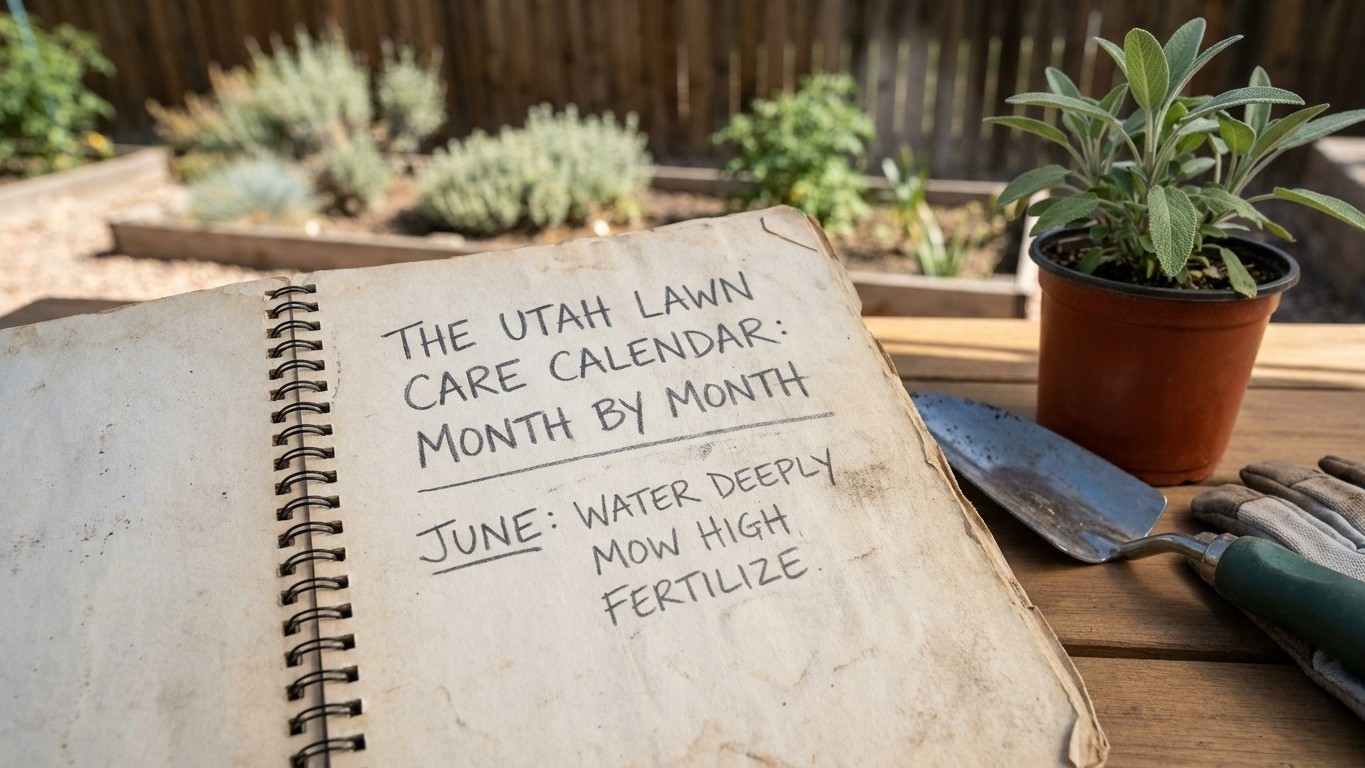

Utah doesn’t get one lawn calendar. It sits in what turf scientists call the transition zone, placed there by climate normals read against tolerances published by Clemson Cooperative Extension (HGIC 1214), meaning cool-season grasses like tall fescue and warm-season grasses like bermudagrass both grow here, just not at the same time or under the same rules. NOAA’s 1991-2020 climate normals put the first fall freeze at Salt Lake City between October 18 and October 29. Check which grass type is already growing in your yard before you follow a single date below.
The short answer for Utah
Green grass in the dead of January means a cool-season lawn; brown and dormant until the soil warms means bermudagrass or zoysiagrass. That one look settles which calendar applies, because Utah lawns actually run on two opposite schedules, not one. Cool-season grass pushes hardest in spring and fall and just survives summer heat. Warm-season grass sleeps through winter, wakes slowly, then does most of its growing between June and August — mowing, feeding, and watering all shift depending on which one is rooted in your yard.
Neither failure means the grass is dying. It means the calendar has to match the grass actually planted, not the one growing two states over. A cool-season lawn does its real work in spring and fall, slows in summer heat, and needs deeper watering or shade to get through July without thinning. A warm-season lawn does the opposite: it sleeps through winter, wakes slowly in spring, and does most of its growing between roughly June and August. If you haven’t settled which of the five species suits your yard and your water budget, The Best Grass Seed for Utah Lawns walks through that choice before you commit to a maintenance schedule.
Everything below assumes you already know which type is in the ground. If you’re not sure, look at it in January: green in the dead of winter means cool-season; straw-brown until soil warms means bermudagrass or zoysiagrass.
Working through the year

The two grass families grown in Utah are worked on opposite calendars. The table below pulls the working figures from Clemson’s species-specific maintenance calendars, plus Penn State Extension for the cool-season species Clemson doesn’t cover.
| Grass | Mowing height | Nitrogen rate | Peak growth |
|---|---|---|---|
| Tall Fescue | 2.5 to 3.5 in | ~3 to 4 lb N/1,000 sq ft/year, fall-weighted (HGIC 1219) | Spring and fall |
| Kentucky Bluegrass | 2 to 3 in | similar fall-weighted split (Penn State Extension) | Spring and fall |
| Perennial Ryegrass | 1.5 to 2.5 in | light, split feedings (Penn State Extension) | Spring and fall |
| Bermudagrass | 1 to 2 in | ~1 lb N/1,000 sq ft monthly in summer, none in fall (HGIC 1216) | June through August |
| Zoysiagrass | 1 to 2 in | ~1 to 2 lb N/1,000 sq ft/year total (HGIC 1217) | June through August, slower than bermuda |
Cool-season lawns: tall fescue, Kentucky bluegrass, perennial ryegrass
These three green up in early spring and do their heaviest growing before summer heat arrives. Clemson’s HGIC 1219 tall fescue calendar, the same schedule that applies to bluegrass and ryegrass since all three are cool-season species, calls for a pre-emergent herbicide once soil starts warming in spring, ahead of crabgrass germination, and a light nitrogen feeding in mid-spring rather than a heavy one. Mow high through summer, toward the top of the 2.5 to 3.5 inch range for fescue, to shade the crown and slow moisture loss; a lawn scalped short in July browns fast and takes weeks to recover. Water deeply and less often than a daily sprinkler default asks for. Consistent light watering builds shallow roots, and shallow roots fail first when a July heat wave hits.
Fall is when this lawn earns its keep. Aerate once the worst heat has passed, then overseed thin spots and put down the bulk of the year’s nitrogen, following HGIC 1219’s fall-weighted schedule. Clemson’s calendar wants fescue seed down roughly six weeks ahead of the first hard frost so seedlings can root before cold sets in. NOAA’s 1991-2020 normals put that frost at Salt Lake City between October 18 and October 29, which puts the seeding window for valley lawns at early to mid September. Lawns higher in elevation should move that window earlier, since their frost arrives sooner.
Warm-season lawns: bermudagrass and zoysiagrass
Bermudagrass and zoysiagrass stay brown through winter and wake up slowly, often not fully green until late spring. Clemson’s HGIC 1216 bermudagrass calendar holds off on nitrogen until the lawn has completely greened up, then feeds roughly monthly through the growing season at about a pound of nitrogen per 1,000 square feet, tapering off by late summer. HGIC 1217’s zoysiagrass calendar asks for far less, around 1 to 2 pounds of nitrogen per 1,000 square feet across the whole year, since zoysia grows slowly and burns easily on excess feeding. Once established, both species need less frequent irrigation than a cool-season lawn, since their deeper summer root systems reach moisture a shallow-rooted fescue lawn can’t.
Aerate and dethatch these lawns in late spring or early summer, after green-up is complete, never in fall. The last nitrogen application should go down well before the first fall freeze window at Salt Lake City, October 18 to October 29 per NOAA, because late-season nitrogen pushes tender new growth into a freeze it can’t survive. Once the lawn browns after that first frost, mowing and feeding stop until green-up returns in spring.
What changes across Utah
Every date in this calendar is anchored to a weather station at Salt Lake City, and Salt Lake City is not typical of the state around it. The city sits in a valley moderated by the Great Salt Lake, which keeps both extremes softened compared with ground just a few hundred feet higher.
Higher and colder
NOAA’s 1991-2020 normals put the first fall freeze at Salt Lake City between October 18 and October 29. Ground on the benches above the valley, in canyon mouths, and across the state’s higher mountain valleys typically freezes earlier than that window. A cool-season lawn there should be seeded and aerated on the early side of any range given above, and a warm-season lawn planted at elevation has less summer to establish before its first freeze sends it back into dormancy, sometimes before it has rooted deeply enough to survive the winter at all.
Lower and warmer
Southern Utah’s lower, warmer basins run the opposite direction. Their first fall freeze typically lands later than the Salt Lake City window, and spring warms up earlier. That stretches the growing season for bermudagrass and zoysiagrass and shortens the months either grass spends brown. A cool-season lawn planted in that same warmer ground pays for the trade in July and August instead, carrying more weeks of heat stress and a thinner, more water-hungry lawn than the same species would show at Salt Lake City’s milder elevation.
The mistakes this climate punishes
Utah’s swing between hot, dry summers and cold winters turns a few common lawn habits into real damage rather than cosmetic setbacks.
- Feeding a warm-season lawn nitrogen in early fall, which pushes soft new growth right before the first freeze kills it back.
- Seeding cool-season fescue or bluegrass in late spring or summer, when soil temperatures already favor weeds over seedlings and there’s no time to root before heat stress hits.
- Mowing a cool-season lawn short going into July, which removes the leaf shade the crown needs and shows up as a thinned, tan lawn within two or three weeks.
- Aerating a warm-season lawn in fall instead of late spring, opening the turf to cold injury right when it should be hardening off.
- Watering on a fixed daily schedule instead of watching the grass, which wastes water on an established bermudagrass lawn while starving a shallow-rooted new fescue seeding at the same time.
The nitrogen mistake is the most expensive because it shows up months later. A bermudagrass lawn fed in September looks fine through the month, since the damage is invisible until the freeze actually hits. By the time the lawn fails to green up the following May, the cause is long forgotten and often blamed on a bad seed lot or a hard winter instead.
The mowing mistake shows up fastest. A fescue lawn cut to an inch and a half in the second week of a hot July will visibly thin within the month, well before fall aeration and feeding get any chance to help it recover.
Checking this against your county
Every figure above comes from a station at Salt Lake City, and Utah’s terrain covers a wider range of elevation and microclimate than any single station can speak for. Before you commit to a seeding date or a fall feeding, check your county’s numbers against Utah State University Extension at extension.usu.edu, which publishes county-level guidance and can confirm local frost dates and soil conditions. If you’re still working out the basics of a Utah lawn, from soil testing to irrigation setup, Utah Lawn Care is the place to start before building a month-by-month schedule on top of it.
Common questions
Can I have both cool-season and warm-season grass in the same yard?
Not blended in the same patch of turf. Mixing tall fescue with bermudagrass in one area produces an uneven mess, since one goes dormant while the other is actively growing. Some Utah yards run cool-season grass on shaded north sides and warm-season on sun-baked south sides, but that means maintaining two separate mowing heights and feeding schedules in the same yard.
My bermudagrass lawn is still brown in April, did it die over winter?
Probably not. Bermudagrass and zoysiagrass green up later than most people expect and can stay brown well into spring even in a normal year. Give it until the soil has warmed and other warm-season lawns nearby are greening before assuming it’s dead. Scratch a stem near the crown and look for white or cream tissue underneath, which means it’s alive.
Do I need to fertilize my lawn in winter?
No, for either type. A dormant warm-season lawn isn’t growing and can’t use nitrogen, and a cool-season lawn’s main feedings are already finished by early winter under HGIC 1219’s fall-weighted schedule. Fertilizer applied to frozen or snow-covered ground is more likely to wash into a storm drain than into the grass.
How do I know if I have Kentucky bluegrass or tall fescue?
Look at the blade width and how it spreads. Kentucky bluegrass has narrower blades and spreads by rhizomes to fill in bare patches on its own, while tall fescue has wider, coarser blades and grows in clumps that don’t fill gaps without reseeding. A county Utah State University Extension office can identify a sample if you’re not sure.