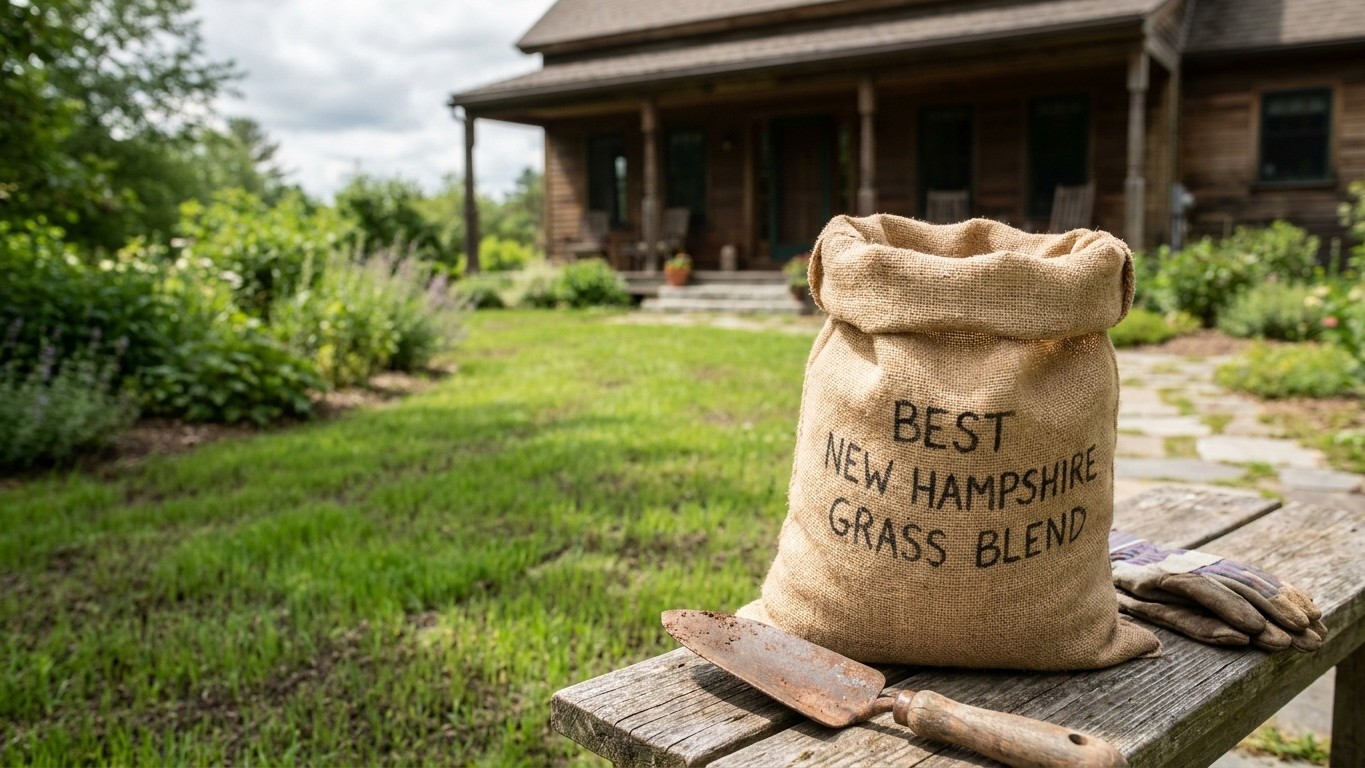

New Hampshire is cool-season grass country, and the seed that survives here has to come from that group: Kentucky bluegrass, perennial ryegrass, fine fescue, tall fescue, or rough bluegrass. Which one belongs in your yard comes down to sun and foot traffic more than anything else — a shady spot under a maple wants fine fescue, a sunny stretch the kids run across wants a bluegrass-ryegrass blend. Start by walking your yard and noting where the sun actually hits it through the day, because that one observation narrows five choices down to one or two before you ever open a seed bag.
The short answer for New Hampshire
The direct answer: New Hampshire sits in the cool-season zone, and the seed bag that survives the state’s winters and summers has to come from that group, not from the warm-season shelf at the garden store. Clemson Cooperative Extension’s HGIC 1214 factsheet and Penn State Extension name five species for cool-season lawns: Kentucky bluegrass, perennial ryegrass, fine fescue, tall fescue and rough bluegrass. Every recommendation on this page starts from that list, because a warm-season grass such as zoysia or bermuda will not survive a New Hampshire winter no matter how well it’s marketed.
Which of the five actually belongs on your lawn depends on three things: how much sun the yard gets, how much foot traffic it takes, and how much time you want to spend watering in a dry August. Kentucky bluegrass and perennial ryegrass are the workhorses for a full-sun, high-traffic lawn, usually sold together in a blend because ryegrass germinates fast and holds the soil while the slower bluegrass fills in underneath. Fine fescue takes over where a maple canopy blocks the sun, tall fescue holds up best if you’d rather water less, and rough bluegrass is a specialist for wet, shaded corners that stay damp most of the season.
This zone assignment is built from climate data recorded at Manchester, and it describes the reference city, not the whole state. A lawn in the White Mountains or along the Seacoast works on a different clock, a point the next section covers in detail. Before you settle on a bag of seed, read that section against your own town rather than assuming Manchester’s numbers apply directly.
Working through the year

Cool-season grass does almost all of its growing in spring and fall, when soil temperatures are moderate, and it slows down or browns off in the heat of summer no matter which of the five species you planted. The New Hampshire Lawn Care Calendar, Month by Month lays out the full year task by task, but the timing below is what matters most for choosing and planting seed specifically.
Spring (March through May)
Existing cool-season lawns green up fast once soil warms, and this is when most homeowners are tempted to reseed bare patches. Resist it if you can. Spring seeding races against summer heat: a seedling that germinates in April has only a few weeks of cool weather to build a root system before July sun tests it, and thin spots seeded now often thin right back out by August.
Summer (June through August)
This is a holding pattern, not a growing season, for every one of the five species. Raise the mower deck rather than lower it, since taller grass shades its own root zone and slows moisture loss. Skip seeding entirely. A cool-season lawn that browns in a dry August is dormant, not dead, and it will green back up with cooler weather and rain.
Fall (August through October)
This is the seeding window that actually works, and the arithmetic is straightforward. A new cool-season lawn needs roughly six to eight weeks of growing time before the ground shuts down for winter. Counting back that far from Manchester’s first fall frost, which NOAA’s 1991-2020 climate normals put at October 13 to October 26, lands the seeding window in the second half of August through mid-September for that area. Clemson’s tall fescue maintenance calendar (HGIC 1219) uses this same six-to-eight-week logic, though it was written for a longer South Carolina season, so treat its calendar dates as a framework to shift earlier, not a schedule to copy directly.
Winter (November through February)
Nothing to seed, nothing to mow. Skip a heavy nitrogen feeding late in fall if you didn’t already work it in during September, since pushing soft new growth right before the ground freezes leaves the lawn more open to snow mold under a long-lasting snowpack.
The table below lines up the five species on the trade-offs that actually decide a purchase.
| Species | Establishes | Shade tolerance | Drought tolerance | What it costs you |
|---|---|---|---|---|
| Kentucky bluegrass | Slow (2-4 weeks) | Low | Moderate | Patience while it fills in; needs full sun |
| Perennial ryegrass | Fast (5-10 days) | Low | Low | No self-repair; thins under heavy wear |
| Fine fescue | Moderate | High | Moderate | Poor traffic tolerance |
| Tall fescue | Moderate | Moderate | High | Coarser texture, clumping habit |
| Rough bluegrass | Moderate | High (wet shade) | Low | Struggles anywhere dry or sunny |
What changes across New Hampshire
Every figure on this page is measured at or near Manchester, and the state is not that flat. Elevation, a large lake, and forty miles of coastline all push the growing season in different directions, sometimes by weeks.
Elevation and the north
The White Mountains and the Great North Woods sit at much higher elevation and considerably farther north than Manchester, and frost arrives there well before Manchester’s own October window closes. NOAA’s data cited here comes from the Manchester airport station only. If you garden in Coos or northern Grafton county, treat every date in this article as a starting point to shift earlier, not a number to copy.
Lake Winnipesaukee and other large water bodies
Large bodies of water hold summer heat into fall and release it slowly, which tends to soften both the first fall frost and the last spring one for towns right on the shoreline. A lawn a mile inland from the lake can see a noticeably different frost date than one on the water, even within the same town.
The Seacoast
Portsmouth and the rest of the short New Hampshire coastline sit under a milder maritime influence than inland towns at the same latitude. That generally buys a longer window on both ends of the growing season, though the difference from Manchester isn’t quantified in the NOAA dataset cited here.
None of this changes which species belong on the lawn. The cool-season list from HGIC 1214 holds for the entire state, since New Hampshire has no region warm enough to carry a warm-season lawn through winter. What shifts is only the calendar: when to seed, when to expect the first killing frost, and how much buffer to build into a fall planting date.
The mistakes this climate punishes
Some errors just make a thin lawn. In a cool-season climate like New Hampshire’s, a few specific ones show up as a dead lawn, and not until months after the mistake was made.
Seeding in late spring
Seed sold everywhere from grocery stores to big-box garden centers doesn’t come with a warning that May is the wrong month, but it is. A cool-season seedling planted in May has to build a root system fast enough to survive July and August heat with almost no cushion, and a lawn seeded in late spring often looks fine in June and is gone by Labor Day. Fall seeding within the six-to-eight-week window described above gives roots an entire cool season to establish before that first heat test.
Buying a warm-season grass because it was cheap or fast-spreading
Zoysia, bermuda and centipede grass are marketed nationally, sometimes with claims about drought tolerance or low maintenance that sound appealing next to a cool-season bag. None of them are built to survive a New Hampshire winter. A warm-season lawn goes dormant and brown at the first hard frost the way any grass does, but unlike a cool-season lawn’s summer dormancy, it doesn’t reliably green back up here, because the plant itself isn’t cold-hardy enough for the state’s winters.
Scalping the mower deck in summer
Cutting a cool-season lawn short right as a dry stretch sets in removes the leaf area the plant needs to shade its own root zone, and the stress shows up as a lawn that browns faster and takes longer to recover once rain returns. Raising the mower deck, not lowering it, is the correct move heading into a hot dry August, exactly the opposite instinct most people have when the grass looks like it needs a serious trim.
Checking this against your county
Every date and figure above comes from Manchester’s weather station and a set of national extension factsheets, and your own county is the final word, not this page. The University of New Hampshire Cooperative Extension publishes local guidance and can be reached at UNH Extension for a frost date or soil test specific to your town rather than the airport-based average cited here.
If you’re just starting on lawn basics before worrying about seed timing, New Hampshire Lawn Care covers the groundwork this page assumes: soil testing, grading, and the first mow. Confirm your local frost window with UNH before you commit to a fall seeding date.
Common questions
Can I overseed in spring if I missed the fall window?
You can, but expect a harder job. Spring-seeded cool-season grass has to establish roots fast before summer heat sets in, so plan on watering it more consistently through July and August than you would fall-seeded grass, and accept that some thinning by late summer is normal even with good care.
What’s the difference between a seed blend and a single-species bag?
A blend mixes two or more species, most often Kentucky bluegrass and perennial ryegrass, so the lawn hedges against different stresses across the yard. A single-species bag makes sense when the whole lawn shares one condition, such as deep shade calling for straight fine fescue.
Can I mix in a little warm-season grass for variety?
No. Species like zoysia and bermuda aren’t cold-hardy enough to survive a New Hampshire winter, so any seed of that type in the mix is wasted money the first hard freeze it hits. Stick to the five cool-season species covered on this page.
Why does my new grass look patchy or dead after the first winter?
The most common cause is a seeding date too close to the first fall frost, which leaves seedlings without enough root development to survive winter. Check the seeding date against your own county’s frost window through UNH Extension rather than assuming last year’s calendar applies again this year.