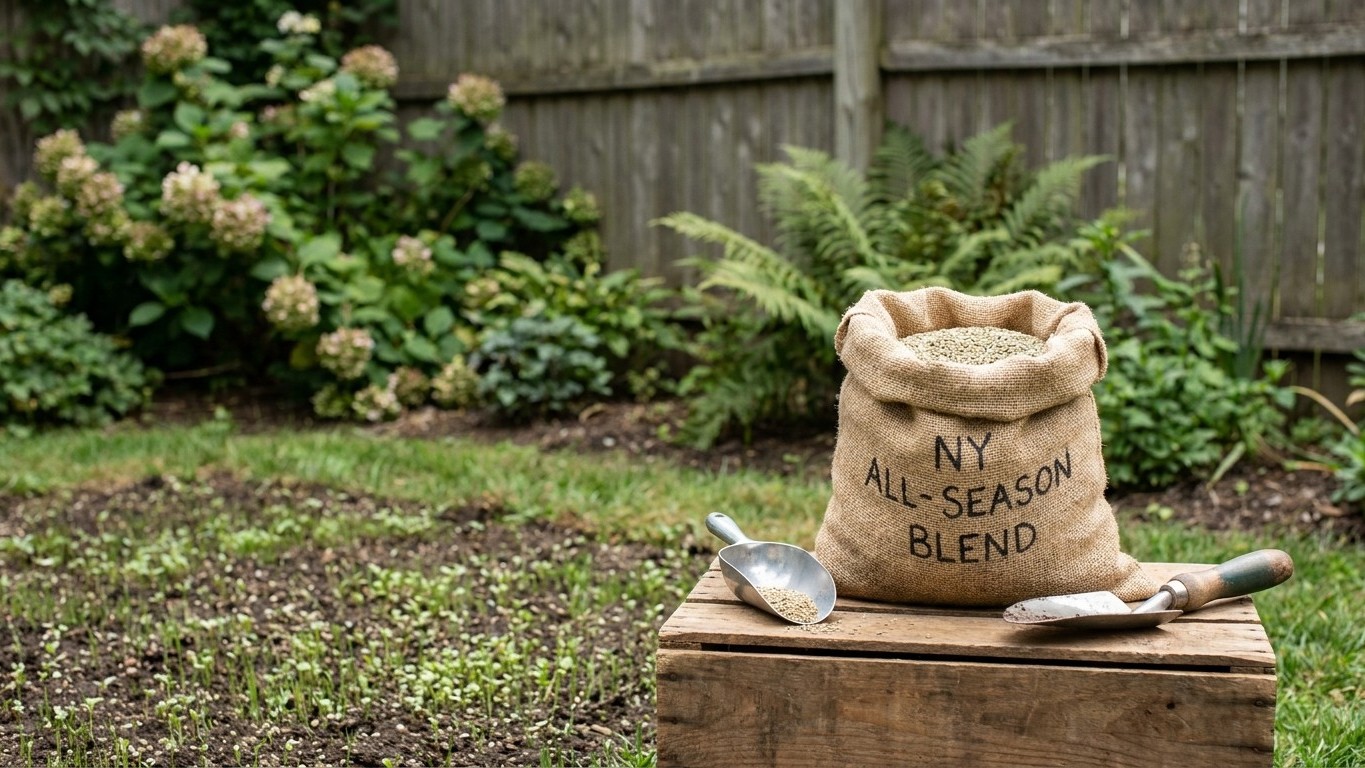

There is no single best grass seed for a New York lawn — the right one depends on how much sun your yard actually gets. For full sun, a blend of Kentucky bluegrass and perennial ryegrass is your best bet; for shaded ground under trees, look for a fine fescue blend instead. Start by walking your yard and honestly clocking how many hours of direct sun each section gets, because that one detail decides which bag you should be reaching for.
The short answer for New York
For most New York lawns, a blend built around Kentucky bluegrass and perennial ryegrass works in full sun, and a fine fescue blend takes over where trees shade the ground. Tall fescue splits the difference: it tolerates more drought and light shade than bluegrass, and it’s the species Clemson Cooperative Extension built its HGIC 1219 maintenance calendar around, useful reading even for a New York yard because tall fescue behaves the same cool-season way wherever it’s grown. Rough bluegrass is the specialist of the group, reserved for wet, shaded spots where nothing else will hold turf.
Which one you actually want depends on three things: how much direct sun the lawn gets, how much foot and pet traffic it takes, and how much time you’re willing to spend watering through a dry August. None of the five recommended species is a warm-season grass, and that’s deliberate. Bermudagrass and zoysia need a long hot season to perform and won’t survive a New York winter, so they don’t belong on this list at all.
Timing matters as much as species. NOAA’s 1991-2020 climate normals put New York City’s first fall freeze between November 14 and November 27. Cool-season grass seed needs roughly six to eight weeks of growing time before that freeze to knit a root system strong enough to survive winter, which works out to a seeding window running from late September through mid-October for the city itself. If you’re building a lawn from scratch, the groundwork in New York Lawn Care covers soil prep and grading before you ever open a seed bag.
Working through the year

Rank the five recommended species by what each one costs you, not by which sounds best on the label.
| Species | Wear tolerance | Shade tolerance | Establishment speed | What you give up |
|---|---|---|---|---|
| Kentucky bluegrass | High once mature | Low | Slow, spreads by rhizome | Needs full sun and patience; thin the first year |
| Tall fescue | High | Moderate | Fast | Coarser blade; doesn’t self-repair bare patches |
| Fine fescues | Low | High | Fast | Wears out under regular foot traffic |
| Perennial ryegrass | Moderate | Low | Fastest | Weaker cold tolerance, can winterkill |
| Rough bluegrass | Very low | High in wet shade | Fast | Only useful in damp, shaded, low-traffic ground |
Kentucky bluegrass
This is the species most people picture when they think of a New York lawn. It spreads by rhizome, so it heals its own bare spots over a season or two, but it’s slow to establish from seed and needs full sun to do it well. Blending it with perennial ryegrass, which germinates in days rather than weeks, gives you quicker cover while the bluegrass fills in underneath.
Tall fescue
Tall fescue roots deeper than bluegrass and shrugs off a dry August better than any of the other four species. Clemson’s HGIC 1219 maintenance calendar, built specifically for tall fescue lawns, lays out mowing height and feeding timing in a sequence that holds true for cool-season tall fescue wherever it’s planted, including New York. The trade-off is that it grows in bunches rather than spreading, so bare patches need reseeding rather than filling in on their own.
Fine fescues and rough bluegrass
Fine fescues are the shade specialists: they tolerate low light and thin soil better than any other species on this list, but a path worn across a fine fescue lawn stays worn. Rough bluegrass goes a step further, tolerating standing moisture and deep shade where even fine fescue struggles, at the cost of almost no wear tolerance at all. Once seed is in the ground, the month-by-month mowing and feeding routine in The New York Lawn Care Calendar, Month by Month picks up from here.
What changes across New York
The frost figures above come from NOAA’s station in New York City, and they describe the city and its immediate surroundings, not the whole state. New York covers a lot of elevation and terrain, and each region shifts the calendar in its own direction.
- Adirondacks and the Tug Hill Plateau: highest elevation in the state, frost arrives well ahead of the NYC dates in fall and lingers later in spring, shortening the whole growing season.
- Great Lakes shoreline near Buffalo and Rochester: lake-effect moisture moderates temperature swings but also buries turf under snow cover longer into spring than the coast sees.
- Hudson Valley: cold air pools in the low ground overnight, so valley floors can see frost on nights when a ridge two miles away stays clear.
- Long Island and New York City: closest to the ocean, mildest winters in the state, and the closest match to the NOAA figures actually cited here.
If you garden upstate or at elevation, treat the November frost window as a rough guide and push your own seeding date earlier rather than later. A seedling that needs six to eight weeks to root doesn’t get a grace period just because the calendar says October.
The mistakes this climate punishes
Seeding too late
Pushing fall seeding into November, close to New York City’s own frost window of November 14 to 27, leaves seedlings without enough root growth to survive freezing soil. The damage doesn’t show up until spring thaw, when what looked like a decent fall lawn turns out to be mostly dead seedlings and bare dirt.
Seeding cool-season grass in late spring
Cool-season species germinate best in cool soil. Seed put down in May fights rising heat just as it’s trying to establish, and by July the seedlings that survived the heat lose again to crabgrass, which germinates faster in warm soil than any of the five recommended species. The failure shows up as a thin, weedy lawn by midsummer, not as an obvious seeding mistake.
Scalping in summer heat
Cutting cool-season turf too short during a hot, dry stretch strips the shade the grass casts on its own crown and soil. The lawn browns out faster and takes longer to recover once rain returns. That brown is dormancy, not death, but a lawn scalped repeatedly through a dry summer can lose enough crown tissue that some of it doesn’t come back.
Planting a warm-season species out of hope
Bermudagrass and zoysia are sometimes sold as low-maintenance options, and they are, in states with a long hot season. In New York they simply die at the first hard freeze because they have no winter dormancy strategy built for this climate. This isn’t a maintenance mistake to fix next year. It’s a species that never belonged here.
Checking this against your county
Every figure above comes from a New York City reference point, and county conditions upstate, on the coast, or at elevation will move the numbers in one direction or the other. Cornell Cooperative Extension runs a local office in nearly every county, and its staff can confirm frost timing and species performance for your specific ground rather than the city-wide figures used as the baseline here. That’s worth a call before you commit to a seeding date, especially if you’re above a few hundred feet or north of the Catskills.
Common questions
Can I seed in spring instead of waiting for fall?
You can, but it’s the harder path. Spring-seeded cool-season grass has to establish roots while heading straight into summer heat and crabgrass pressure, instead of settling in during cool fall weather with a full dormant winter to finish rooting. Fall seeding within the six-to-eight-week window ahead of frost gives seedlings an easier run.
Does Kentucky bluegrass fill in bare spots by itself?
Yes, because it spreads by underground rhizomes, unlike tall fescue and perennial ryegrass, which grow in bunches and stay wherever you seeded them. That’s why a bluegrass-heavy blend recovers from dog paths and thin patches better over a few seasons than a pure tall fescue lawn does.
Is there any situation where Bermuda or zoysia works in New York?
Not as a lawn grass here. Both are warm-season species without the cold tolerance to survive a New York winter, and neither appears on the list of species Clemson Cooperative Extension and Penn State Extension recommend for a cool-season climate. Stick to the five cool-season species and pick among them by sun and traffic, not by a warm-season grass’s drought reputation.
What’s the best grass for a mostly shaded yard?
Fine fescues handle shade better than any of the other four recommended species, and they need less fertility to do it. If the shaded area also stays damp, rough bluegrass is worth trying in that specific patch, though it won’t hold up if the same ground gets regular foot traffic.