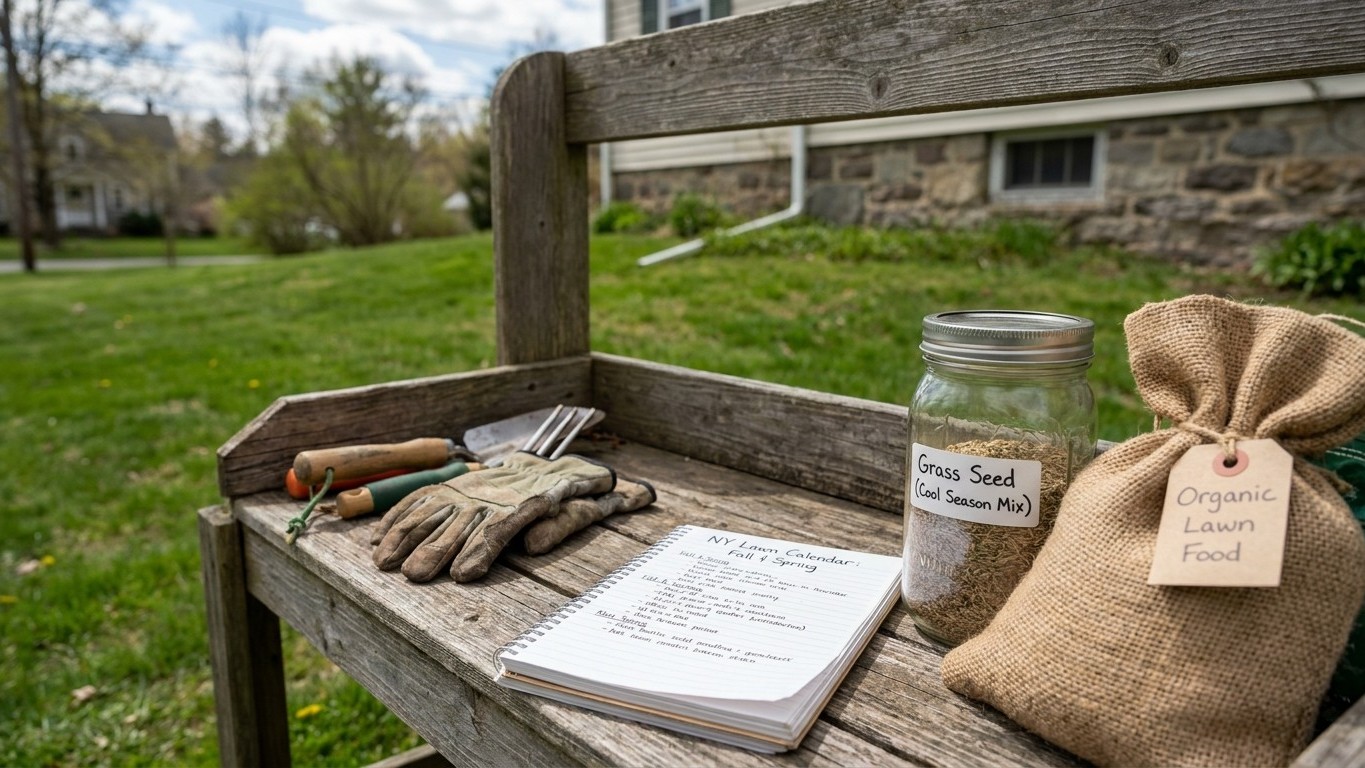

Bermuda seed scattered across a Long Island lawn in May greens up fine through August, then goes to straw the first hard frost — and the homeowner reseeds the same mistake next spring, out another two hundred dollars, because nobody told them a warm-season grass bred for Georgia summers can’t survive a New York coldest-month mean minimum near 27°F. The failure isn’t the seed. It’s picking it before checking what the winter actually does.
Which grass belongs in New York

The number that decides your grass isn’t the average summer temperature. It’s how often the mercury tips past 90°F, set against how cold the coldest month runs. At the New York City reference station, NOAA’s NCEI 1991-2020 climate normals put both figures on record: 12.2 days a year at or above 90°F, and a coldest-month mean minimum of 26.9°F. That’s a short hot stretch paired with a real winter, and it’s exactly the combination cool-season turf is bred for, not Bermuda, not St. Augustine, not zoysia.
Clemson Cooperative Extension’s HGIC 1214 guide, Selecting a Lawn Grass, and Penn State Extension both name the same species for this profile: Tall Fescue, Kentucky Bluegrass, Perennial Ryegrass, Fine Fescues, and Rough Bluegrass. Kentucky Bluegrass spreads by underground rhizomes and knits into the densest sod of the group, but it establishes slowly from seed and prefers full sun. Tall Fescue germinates faster, tolerates the odd dry week better than bluegrass, and holds up under foot traffic, which is why it dominates seed mixes sold for New York yards. Perennial Ryegrass germinates fastest of all and is often blended in as a nurse grass while slower species fill in. Fine Fescues and Rough Bluegrass take the shade a lawn under mature trees actually gets, where the other three thin out. For a closer look at how to weigh these species against each other, see The Best Grass Seed for New York Lawns.
New York City’s reference figures are an urban-site reading. Upstate counties and the Adirondacks run colder in winter and shorter in growing season than the numbers above suggest, which shifts the balance further toward Kentucky Bluegrass and Tall Fescue blends bred for hardiness over the ryegrass-heavy mixes that suit the milder city and coastal counties. For how these regional differences translate into month-by-month tasks, see The New York Lawn Care Calendar, Month by Month. Pennsylvania sits in a nearly identical cool-season band and faces the same species call. See Pennsylvania Lawn Care: What to Plant and When to Feed It for how that state’s own numbers compare.
When to seed or sod here
The September window
Grass seed goes in on two different calendars depending on species, and New York only needs one of them. Clemson Cooperative Extension’s HGIC 1203 guide sets warm-season seeding around May and cool-season seeding in mid-to-late September. Since New York grows cool-season turf, the September window is the one that matters here, not the May date built for Bermuda and zoysia country.
Anchor that window against your own frost date rather than a generic month. NOAA’s NCEI 1991-2020 climate normals put the New York City area’s first fall freeze between November 14 and November 27. Seed sown in mid-to-late September gets roughly eight to nine weeks of mild soil and lower weed pressure before that freeze window arrives, counting forward from mid-September to the earliest date in that range. That’s enough time for a cool-season seedling to root in before winter dormancy shuts growth down, but it isn’t a wide margin: seed sown in the first half of October is racing the clock, and seed sown after that is better held for spring.
Spring as the fallback, not the plan
Spring seeding is possible on a cool-season lawn, but it fights two things fall doesn’t: crabgrass germinating in the same warming soil, and New York’s summer heat arriving before roots have gone deep. With 12.2 days a year averaging 90°F or hotter at the New York City reference station, a spring-seeded lawn can hit its first real heat stress before it has built the root system fall seeding gets almost for free. Sod avoids the germination risk entirely and can go down whenever the ground isn’t frozen, but the same logic still favors laying it in early fall so roots establish before either winter or the next summer tests it.
Remember that November 14 to 27 window is a Central Park reading. Upstate counties and higher elevations freeze earlier in fall and thaw later in spring, which pulls the whole seeding calendar earlier for those lawns and shortens the safe window further.
The feeding calendar that fits this climate
Nitrogen goes down when the grass is actively building roots and shoots, not on a fixed date. For a cool-season lawn, that means the heaviest feeding falls in September, when soil is still warm and top growth has slowed enough that the plant channels nitrogen into roots instead of leaf. Feeding a cool-season lawn in July, while air temperatures push toward the season’s 90°F stretch, mostly feeds fungus and thatch instead of the grass.
Clemson Cooperative Extension’s HGIC 1219 Tall Fescue Maintenance Calendar breaks the season into month-by-month nitrogen rates in pounds of actual nitrogen per 1,000 square feet, tuned to what Tall Fescue can use without pushing excess top growth it then has to mow off. Since Tall Fescue is one of New York’s recommended cool-season species, that same calendar logic applies here directly: follow the Tall Fescue Maintenance Calendar month by month rather than guessing at a single number, and stop feeding once the lawn stops actively growing in early winter.
- Early fall, once nights cool off: the main nitrogen application of the year.
- Late fall, a few weeks before the ground freezes: a lighter follow-up feed, sometimes called a winterizer.
- Spring, only if the lawn looks thin coming out of dormancy: a light feed, never the heaviest one of the year.
Kentucky Bluegrass and Perennial Ryegrass lawns run on the same seasonal logic even though the exact rate on the bag differs slightly from Tall Fescue’s. The season drives the schedule, not the month printed on a fertilizer label. A light spring application supports the flush of growth after winter dormancy breaks, and the main feeding of the year still follows in early fall, once the heat is behind the lawn rather than ahead of it.
Mowing height and watering here
Mowing height
Cool-season turf performs best mowed tall. Tall Fescue and Kentucky Bluegrass, the two species most New York lawns are built from, hold color and crowd out weeds best kept in the 2.5 to 3.5 inch range, with Fine Fescue mixes able to run a touch shorter in the shaded lawns they’re usually planted into. Never remove more than one-third of the blade in a single mowing: scalping a Tall Fescue lawn from four inches down to two in one pass stresses the crown and opens the canopy to weeds and disease.
Watering
An inch of water a week, counting rain and the hose together, is the standard cool-season baseline. New York’s own numbers push that figure around at both ends. NOAA’s 1991-2020 normals for the New York City area log 12.2 days a year at 90°F or hotter, and a lawn loses water faster on those days than a flat weekly average accounts for, so water deeper and less often rather than adding small daily doses through a heat stretch. Sandy soil, common on Long Island’s outwash plains, drains that same inch of water through the root zone in days rather than a week, which calls for splitting the weekly total into two shorter waterings instead of one long one.
What goes wrong on lawns in New York

Three failures show up on New York lawns more than any other, and each one starts as a normal response to the local climate before it turns into a real problem.
Humid summer stretches turn Tall Fescue and Kentucky Bluegrass lawns patchy with brown patch fungus, circular tan-to-brown rings that spread fastest when nights stay warm and humid and the lawn goes into evening wet rather than drying off by afternoon. Watering early in the day so the blades dry out before dusk cuts that risk more than any fungicide schedule does.
A hot, dry August stretch, even one well short of the year’s average 12.2 days at 90°F or above, can push a cool-season lawn into dormancy. The grass turns straw brown and stops growing, but the crown stays alive underground. Brown is not dead. Resist reseeding a dormant lawn in August. It will green back up once cooler, wetter weather returns in fall.
A mild winter, meanwhile, means the hard freeze that would normally knock back winter annual weeds like chickweed and henbit arrives late, if the year’s version of it falls late within that November 14 to 27 window NOAA logs for the city, or barely arrives at all in a warm year. Those weeds keep germinating through stretches that should have been dormant for both weed and lawn alike. Virginia’s lawns sit in a genuine transition zone and fight a related problem from the opposite direction, with warm-season and cool-season weeds both finding a foothold in a climate that never fully commits to one season. See Virginia Lawn Care: What to Plant and When to Feed It for how that plays out further south.
Lawns bordering sidewalks and driveways take a separate hit each winter from de-icing salt, showing up as dead strips along the pavement edge every spring. Flushing the area with water once the ground thaws and reseeding the thin strip is the standard fix, not any special treatment for the salt itself.
Local help
A soil test, not a guess off the fertilizer bag, should set your actual nitrogen rate every fall. Cornell Cooperative Extension runs the county offices that handle both soil testing and county-level advice on which cool-season blend suits a particular yard and elevation. Find the local office through Cornell Cooperative Extension before buying a full season’s worth of fertilizer.
Common questions
Can I plant Bermuda grass or zoysia in New York?
Not with any reliability. NOAA’s 1991-2020 normals put the New York City area’s coldest-month minimum at 26.9°F, well below what those warm-season species survive without thinning out or dying back over winter.
What happens if I miss the fall seeding window?
Wait for spring rather than forcing an October seeding. Grass sown too close to the November 14 to 27 first-freeze window rarely roots deep enough to survive winter, and a thin, half-rooted lawn is harder to fix than one seeded fresh the following spring.
Should I fertilize my lawn in summer if it turns brown?
No. A cool-season lawn browning in summer heat is usually dormant, not dying, and nitrogen applied during dormancy mostly feeds disease rather than the grass. Wait for fall, when the lawn is actively growing again.
Do I need to aerate before overseeding in fall?
Core aeration right before or during overseeding helps seed reach soil contact in a lawn with compacted or thatch-heavy turf, which is common on older Kentucky Bluegrass lawns. A thin, newer lawn without much thatch doesn’t need it every year.
How do I know which cool-season grass is right for my yard?
Match the species to the site, not to what the neighbor planted. A full-sun, high-traffic yard suits Tall Fescue or Kentucky Bluegrass, while a yard shaded by mature trees does better with Fine Fescue or Rough Bluegrass, both named by Clemson Cooperative Extension as shade-tolerant cool-season options.