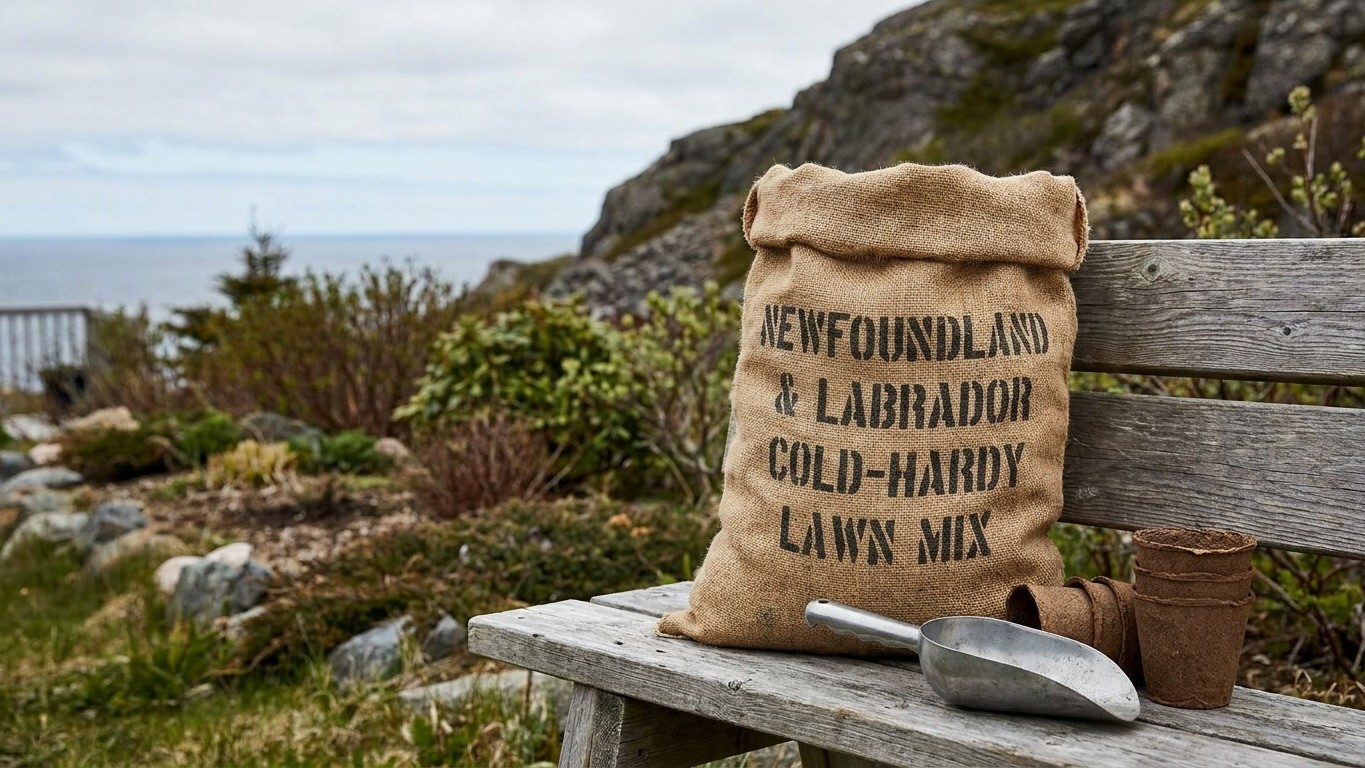

The best grass seed for a Newfoundland and Labrador lawn is a blend of fine fescues and Kentucky bluegrass, with a smaller share of perennial ryegrass mixed in for faster cover. All three are cool-season grasses, the only kind that holds up under this province’s short, cool summers, per Clemson Cooperative Extension’s HGIC 1214 species guide. Environment and Climate Change Canada’s 1981-2010 climate normals put the mean first fall frost at St. John’s at October 17, so seed early enough that new grass has real time to root before then. Buy a bagged mix labeled for cool, coastal climates rather than a single species.
The short answer for Newfoundland and Labrador
October 17 is the date that decides more than any bag label ever will — the average first fall frost at St. John’s, and the deadline seed needs to beat to root before winter. Beyond that, no single grass wins every yard here. Fine fescue carries shade under spruce and fir, perennial ryegrass and tall fescue shoulder foot traffic from kids and dogs, and ryegrass alone races to cover bare, newly graded soil fastest.
Which of the five cool-season options actually earns a place in the mix depends on how much sun the yard gets, how much foot traffic it takes, and how fast you need it to fill in. A shaded yard under spruce or fir does better on fine fescue, which tolerates low light far better than bluegrass does. A yard that takes a beating from kids, a trampoline, or a dog does better with more perennial ryegrass and tall fescue worked in, since both wear better than fine fescue’s thin blades. A newly graded lot with bare soil everywhere benefits from ryegrass’s fast start, even though it is not the toughest grass over the long haul.
The single date that matters more than anything printed on the seed bag is the first fall frost. Environment and Climate Change Canada’s 1981-2010 normals put the mean first fall frost at St. John’s at October 17, and that figure is a midpoint, not a guarantee. In roughly half the years on record, frost arrives later than that date, and in the other half it arrives earlier. Seed sown too close to that window will not have rooted enough to make it through winter.
Working through the year

Here is how the five cool-season species stack up for a Newfoundland and Labrador lawn, ranked by what most homeowners here actually need: a lawn that survives the winter, tolerates coastal fog and shade, and does not demand constant babying.
Kentucky Bluegrass

Kentucky bluegrass forms the densest, most self-repairing sod of the group because it spreads by underground rhizomes rather than growing only where it was seeded. That makes it the backbone of most mixes sold for this climate. Its cost is patience: bluegrass germinates slowly, sometimes taking three weeks or more to show green, and it wants more direct sun than fine fescue tolerates.
Fine Fescues

Fine fescues, usually sold as a blend of creeping red, Chewings, and hard fescue, handle shade and thin, acidic soil better than any other cool-season grass on this list. That is a real advantage on lots ringed by spruce and fir. The trade-off is wear tolerance: fine fescue’s narrow blades do not bounce back from heavy foot traffic the way bluegrass or ryegrass does.
Perennial Ryegrass

Perennial ryegrass germinates faster than anything else on this list, often within a week, which makes it useful for patching bare spots or holding soil on a slope while slower species catch up. It does not spread once established, so a thin stand stays thin, and it holds up less well through an exposed, wind-scoured winter than bluegrass or fescue.
Tall Fescue

Tall fescue’s deep root system makes it the most drought-tolerant grass on the list, though drought is rarely the limiting factor in this province’s summers. Clemson Cooperative Extension’s HGIC 1219 Tall Fescue Maintenance Calendar lays out a full year of mowing and feeding timing for the species, but that calendar is built around South Carolina’s much longer, hotter growing season and needs to be shifted later and compressed for a Newfoundland summer, so treat its dates as a rough shape rather than an exact schedule here. Tall fescue’s coarser leaf texture is the main reason it gets used alone less often than blended with fine fescue.
Rough Bluegrass

Rough bluegrass, also sold as Poa trivialis, is a specialist grass for constantly damp, shaded ground where almost nothing else will hold, such as under a downspout or beside a north-facing foundation. It has almost no drought tolerance and thins out fast anywhere the soil dries between rains, so it belongs in a small patch of a problem lawn, not spread over a whole yard.
| Species | Shade tolerance | Wear tolerance | Germination speed | Spread habit |
|---|---|---|---|---|
| Kentucky Bluegrass | Low to moderate | High, self-repairing | Slow, three weeks or more | Rhizomes, forms sod |
| Fine Fescues | High | Low to moderate | Moderate | Bunching to slow-spreading |
| Perennial Ryegrass | Low | Moderate | Fast, about a week | Bunching, does not spread |
| Tall Fescue | Moderate | High | Moderate | Bunching, deep-rooted |
| Rough Bluegrass | High in moist shade | Low | Moderate | Surface stolons |
What changes across Newfoundland and Labrador
Every figure in this guide is measured at or near St. John’s, on the Avalon Peninsula, where Environment and Climate Change Canada keeps its long-running climate station. The rest of the province does not share St. John’s weather, and a seed mix chosen for the capital’s coastal fog is not automatically right everywhere else.
Labrador’s interior runs on a continental pattern rather than a coastal one: winters bite harder and the frost-free window is shorter than the Avalon’s, which pushes a safe seeding date earlier in late summer and leaves less room for a late-planted lawn to root before winter sets in. On the island’s west coast, around Corner Brook and the Bay of Islands, higher terrain and heavier snowfall change how a lawn spends the winter under cover. Snow mold is a bigger risk there than in a milder, wetter St. John’s winter, and a lawn buried under a deep, slow-melting snowpack needs less late fall nitrogen going into it, not more.
Central Newfoundland, away from either coast, loses the ocean’s moderating effect on both ends of the season: it warms up later in spring and cools down faster in fall than the Avalon does. That shortens the effective growing season for a bluegrass lawn even though province-wide averages might suggest otherwise. Along the outer coast anywhere in the province, salt spray and constant wind favor the tougher, narrower-bladed fine fescues over a thirsty stand of straight Kentucky bluegrass, since fescue tolerates both salt and drying wind better.
The mistakes this climate punishes
Seeding too late in the season is the single most common mistake in this climate. Cool-season grass seed needs several weeks of real root growth before the ground freezes hard, and counting backward from Environment and Climate Change Canada’s October 17 mean frost date at St. John’s leaves less margin than it looks like on paper, since frost arrives later than average in half of all years and earlier in the other half. A lawn seeded in late September is gambling on landing in the good half of that split.
Mowing too short through the peak of summer is the second mistake this climate punishes. Cool-season grasses like fine fescue and bluegrass slow down and can scorch when cut too tight during a warm, dry stretch, and the damage shows up as a bleached, straw-colored lawn two or three weeks later rather than immediately, which is why the cause so often gets missed. Raising the mower deck during any stretch without rain is the simplest fix, and it costs nothing.
Buying a bag of warm-season seed, Bermudagrass or zoysia, because it was on sale or recommended for a lawn somewhere else in the country, is a mistake that shows up fast: warm-season grass does not simply grow slowly here, it fails to establish at all and leaves bare, muddy patches through the exact months a lawn most needs cover. Cool-season species are not optional in this climate. They are the only category that survives it, per Clemson Cooperative Extension’s HGIC 1214.
Skipping fall overseeding on a thin lawn compounds every other mistake, because it hands next summer’s bare ground straight to weeds and moss instead of grass. Overseeding fits into the same narrow late-summer window as new seeding, and a lawn that missed it this year should not wait for spring, when cool, wet soil and slower growth make thin turf harder to thicken up. The full sequence of when to feed, seed, and mow through the year is laid out on the Newfoundland and Labrador Lawn Care Calendar, Month by Month.
Checking this against your county
Every date and species note above comes from a station at St. John’s, and the province runs from the Avalon’s moderate coastline to Labrador’s much colder interior, so treat this page as a starting point rather than the final word for your own yard. The Newfoundland and Labrador Department of Fisheries, Forestry and Agriculture keeps provincial extension resources that can narrow this guidance down to your district, and it is worth checking before locking in a seeding date if you garden outside the Avalon Peninsula. For the step that comes right after choosing seed, the Newfoundland and Labrador Lawn Care guide covers site preparation and seeding technique in more depth.
Common questions
Can I just use one grass type instead of a mix?
You can, but a blend spreads the risk. A straight stand of one species has no backup if disease, shade, or a hard winter hits that species particularly hard, while a mix of fine fescue, bluegrass, and ryegrass usually has at least one component that shrugs off whatever the year throws at it.
How much grass seed do I need per square foot?
Check the rate printed on the specific bag you buy, since it varies by species and blend and differs between a bare new lawn and overseeding an existing one. No single rate applies across every product, so the packaging is the more reliable number here.
Will grass seed sprout if I sow it in spring instead of fall?
It can, but spring seeding fights cooler, wetter soil that slows germination, plus a shorter runway before the next winter arrives compared with a late-summer seeding. Fall seeding generally gives cool-season grass more time to build root mass before dormancy, but either season can work if you water consistently while the seed is establishing.
Does leftover grass seed go bad in storage?
It loses germination rate over time rather than going bad outright. Seed stored somewhere cool and dry, away from humidity, keeps reasonably well for a year or two, but older seed should be sown a bit heavier to make up for the drop in how much of it actually sprouts.