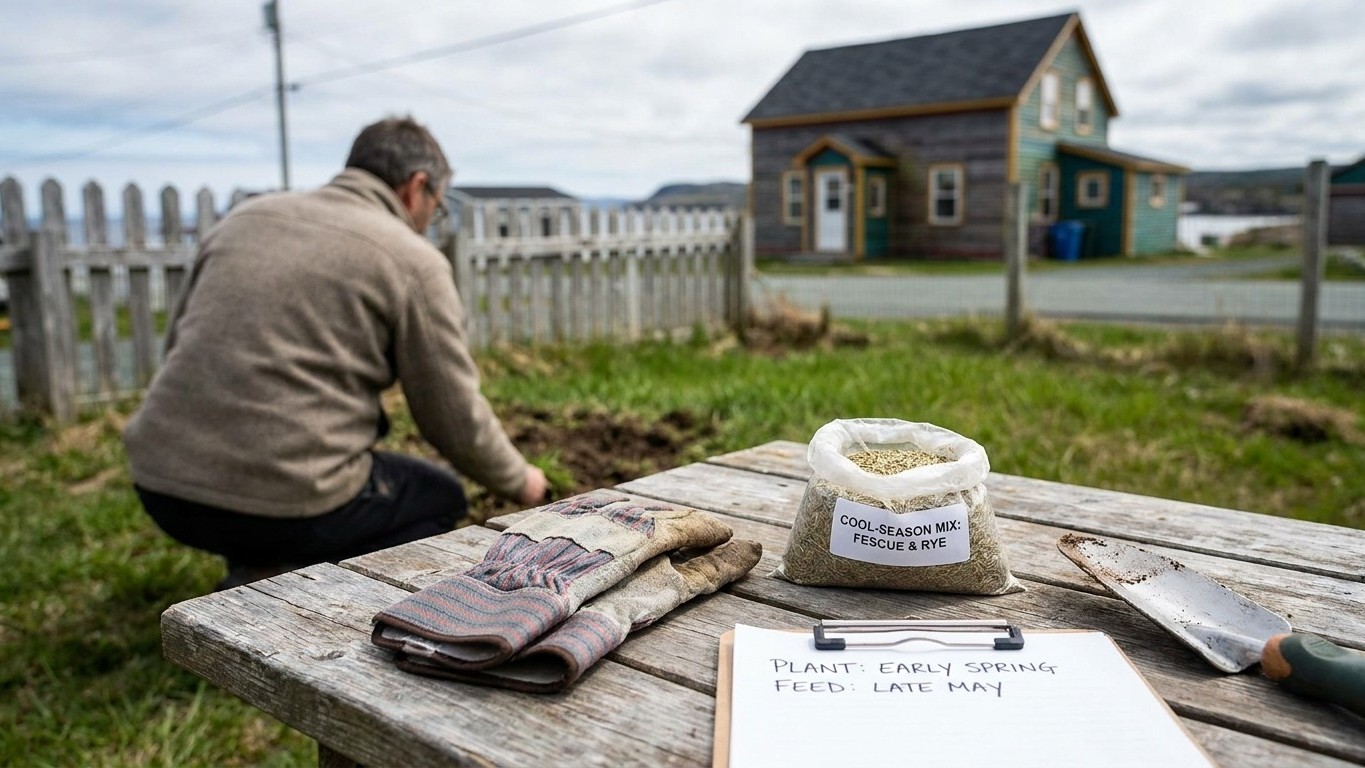

Zero days a year above 90°F is the number that quietly rules this whole lawn. St. John’s summers never build enough heat for bermudagrass or zoysia to take hold, while winters that dip to a -8.7 °C average low are exactly what cool-season turf is built to shrug off. That gap between what warm-season grass needs and what this coast actually delivers is why the seed bag matters more than the fertilizer schedule — and why one family of grasses quietly wins here every time.
Which grass belongs in Newfoundland and Labrador

The two figures that decide this are temperature extremes, not average conditions. Environment and Climate Change Canada’s 1981-2010 climate normals for the St. John’s station show 0.0 days a year at or above 90°F and a coldest-month mean minimum of -8.7 °C. The first figure rules out warm-season turf outright, since species like bermudagrass and zoysiagrass need real summer heat to thrive and St. John’s essentially never delivers it. The second figure confirms the fit from the other direction, because cool-season grasses are built to shrug off winters colder than a -8.7 °C mean minimum.
The species that fit
That makes the choice for this territory unambiguous in a way it isn’t everywhere. Clemson Cooperative Extension’s HGIC 1214 fact sheet and Penn State Extension both list the cool-season species suited to this kind of climate: Kentucky bluegrass, tall fescue, perennial ryegrass, fine fescues and rough bluegrass. Any one of these will hold up here, and The Best Grass Seed for Newfoundland and Labrador Lawns along with a month-by-month Newfoundland and Labrador lawn Calendar can help time seeding and care to the local climate. None of the warm-season options, from bermudagrass to zoysiagrass to St. Augustinegrass, belongs on a lawn in this climate at all, whatever a bag at the hardware store might promise.
Trade-offs among the cool-season species
The species differ from each other mainly in what they trade off, not in whether they survive. Kentucky bluegrass spreads by rhizome and heals its own bare spots, but it establishes more slowly from seed than the others. Tall fescue tolerates more foot traffic and holds green colour longer into a dry stretch. Fine fescues take shade better than any of the others on this list, which matters under the spruce and birch that shade a lot of yards on the Avalon Peninsula. Perennial ryegrass germinates fast, so it’s the usual choice mixed into a seed blend to hold soil while the slower species establish.
| Species | Shade tolerance | Wear tolerance | Establishment speed |
|---|---|---|---|
| Kentucky bluegrass | Low to moderate | Moderate | Slow |
| Tall fescue | Moderate | High | Moderate |
| Fine fescues | High | Low | Moderate |
| Perennial ryegrass | Low | High | Fast |
| Rough bluegrass | High | Low | Moderate |
Other cool-climate territories face the same one-way choice. Northwest Territories, covered in our Northwest Territories lawn care guide, sits under the same cool-season-only ceiling but with a shorter growing season still. Contrast that with a place like Idaho, where our Idaho lawn care guide walks through a genuine transition zone, where neither cool nor warm-season grass is clearly right and the choice really is a trade-off. Newfoundland and Labrador doesn’t have that problem. The climate settles the species question before you even get to the lawn.
When to seed or sod here
Since this territory grows only cool-season grass, the planting calendar has one window, not two. Clemson Cooperative Extension’s HGIC 1203 guidance splits seeding season by grass type: warm-season lawns go in around May, and cool-season lawns go in during mid to late September. Only the second half of that guidance applies here.
Why fall works better than spring
September planting works because cool-season grass germinates and roots best in soil that’s still warm from summer while air temperatures are dropping. That gives seedlings weeks to establish before growth slows for winter. A spring-sown cool-season lawn has to establish fast enough to survive whatever dry or hot stretch turns up before its first winter, and it’s competing with weed germination the whole time.
Working back from the frost date
The fall window closes at the average first fall frost, which Environment and Climate Change Canada’s 1981-2010 climate normals put at October 17 for the St. John’s A station. Seed needs roughly four to six weeks of growth before a hard frost to root well, so counting back from mid-October points to a seeding window of late August through mid-September for the St. John’s area.
Treat October 17 as a midpoint, not a guarantee. ECCC’s figure is a mean date, which means frost arrives later than that in about half of all years and earlier in the other half. The further you are from St. John’s, especially inland or at higher elevation in Labrador, the earlier frost typically arrives, so gardeners outside the immediate St. John’s area should plan for that window to close sooner rather than later.
The feeding calendar that fits this climate
Nitrogen timing follows the grass’s growing season, not the calendar month. A cool-season lawn stores most of its energy for next year’s growth in September and October, so that’s when feeding does the most good. Feeding a cool-season lawn heavily in June or July, when it’s naturally slowing down for summer, pushes soft top growth right when the lawn is least able to use it.
Clemson Cooperative Extension’s tall fescue maintenance calendar, HGIC 1219, lays out a full season of feeding, mowing and weed control built around that species specifically. It calls for the bulk of nitrogen to go down in early fall, with a lighter feeding held back for late fall once growth has mostly stopped. A typical program applies around 1 pound of actual nitrogen per 1,000 square feet at each of those two applications, for a modest total over the year rather than one heavy dose. Read the full Clemson tall fescue maintenance calendar before you buy fertilizer, since it also covers pre-emergent timing and mowing through the same season.
Why September, not May
Feeding in spring feels intuitive because that’s when the lawn visibly greens up, but the growth spurt is already happening on nitrogen the plant stored the previous fall. A spring feeding mostly grows leaf blades you then have to mow off. A September feeding builds root mass and carbohydrate reserves that carry the lawn through winter and into next year’s green-up, which is a better return on the same bag of fertilizer.
Skip nitrogen altogether in the hottest, driest stretch of summer even in a climate like this one, since St. John’s records zero days a year above 90°F according to ECCC’s normals but can still run dry enough in July and August to put a cool-season lawn under stress. Feeding a stressed lawn does not help it recover. Watering and mowing height, covered next, do more for a lawn in that state than fertilizer will.
Mowing height and watering here
Cut a tall fescue or Kentucky bluegrass lawn to somewhere between 2.5 and 3.5 inches, and fine fescues can run a touch higher since they tolerate shade better at that height. Whatever the species, follow the one-third rule: never remove more than a third of the blade in a single mow. Cutting a 3-inch lawn down to 1.5 inches in one pass shocks the grass and opens the door to the same stress problems covered in the next section.
Watering
An inch of water a week, from rain and irrigation combined, is the standard figure used across cool-season turf regions. What changes that figure here is the climate itself. St. John’s summers run cool by American standards, with zero days a year reaching 90°F according to ECCC’s normals, so evaporation and plant water use are both lower than they’d be on a lawn further south. That means a lawn in this climate often needs less supplemental watering than the generic inch-a-week figure assumes, and overwatering into already damp, humid conditions is the more common mistake.
Water early in the day rather than in the evening, so the grass blades dry before nightfall. Wet grass sitting overnight is exactly the condition that lets fungal disease take hold, which matters more in a humid coastal climate like this one than it does somewhere drier. Check soil moisture with a screwdriver or trowel before watering on schedule. If it slides into the soil easily to a few inches down, the lawn likely doesn’t need water yet regardless of what the calendar says.
What goes wrong on lawns in Newfoundland and Labrador

The failures here follow directly from the climate that makes cool-season grass the right choice in the first place. Humid, damp summers favor fungal disease over drought stress. Brown patch and other fungal diseases show up on cool-season lawns during warm, wet, humid stretches, especially where grass is cut too short, watered in the evening, or fed heavily right before a warm spell. A lawn with a fungal problem thins out in roughly circular patches rather than browning evenly.
Long, mild, wet stretches also mean weeds that never get the hard freeze they’d need to be knocked back for a season. Where a colder inland climate kills back some winter annual weeds outright, a milder coastal winter around St. John’s lets them keep germinating on and off through the cooler months, so weed control here is more of a year-round low-level task than a single spring blitz.
Reading a brown or thin lawn correctly
Not every discoloured lawn is dying. A cool-season lawn under summer drought stress can go straight brown and still be alive at the crown, ready to green up again once rain returns, so a dry August is not automatically a dead lawn. The distinction that matters is between a uniform tan colour across the whole yard, which usually points to drought or heat stress and recovers with water, and patchy, irregular thinning, which points to disease, grubs, or compacted soil and needs a different fix. Pulling a small plug of turf and checking whether the roots are still white and firm tells you which one you’re dealing with faster than guessing from the surface colour alone.
Local help
A soil test is the fastest way to find out whether a struggling lawn needs fertilizer at all, or something else entirely like pH correction or better drainage. The Department of Fisheries, Forestry and Agriculture runs the province’s agriculture extension services, and its provincial extension office is the right first call for soil testing and for advice specific to your part of the province, since conditions on the Avalon Peninsula and inland or in Labrador can differ substantially from the St. John’s figures used throughout this guide.
Common questions
Can I grow a warm-season grass like zoysia in a sheltered spot?
Not reliably. Warm-season grasses need sustained heat to grow at all, and St. John’s records zero days a year at or above 90°F under ECCC’s climate normals, so even a warm microclimate rarely provides enough heat for the season to matter. A sheltered spot might survive a mild winter, but it won’t grow.
Why is my new grass seed not coming up in spring?
Cool-season seed germinates slowly in cold soil, and a spring sowing in this climate is competing against weed seeds that germinate just as readily. Fall seeding, timed to root before the average October 17 frost recorded at the St. John’s A station, generally establishes faster and thicker than a spring attempt.
Do I need to dethatch every year?
Most cool-season lawns don’t build up thatch fast enough to need annual dethatching. Check by pulling back the grass at the soil line: if the spongy brown layer between the green blades and the soil is thicker than about half an inch, dethatch in early fall alongside overseeding rather than in spring.
Is it too late to seed if I missed the September window?
It’s not ideal, but a light overseeding can still go down into early fall as long as there are a few weeks of growing weather left before frost. Past that, wait for the following September rather than seeding into cold soil that won’t germinate.
Why does my lawn stay green longer than my neighbour’s in a dry summer?
That’s usually a difference in grass species or root depth rather than watering. Tall fescue holds colour longer into dry weather than perennial ryegrass or Kentucky bluegrass because it roots more deeply, so two lawns getting identical rainfall can still look different by August.