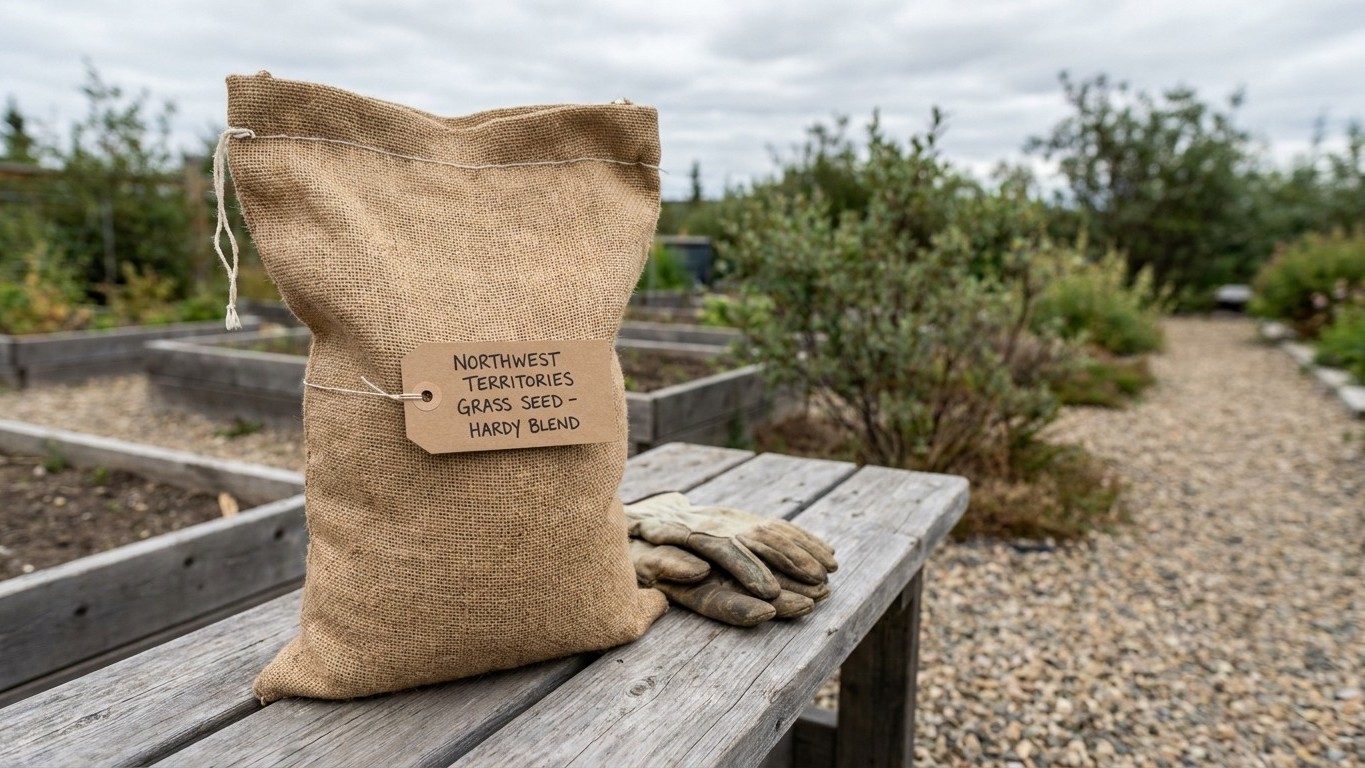

Cool-season grass is the only real option for a Northwest Territories lawn — specifically Fine Fescues, Kentucky Bluegrass, Perennial Ryegrass, Rough Bluegrass, or Tall Fescue. Long winters and a short summer rule out anything warm-season like Bermuda or Zoysia before it ever gets a foothold. Which of the five suits your yard best comes down to use: kids and dogs favor Kentucky Bluegrass or Tall Fescue, while shade leans toward Fine Fescue. Timing follows Yellowknife’s frost record, and that date is a midpoint, not a guarantee.
The short answer for Northwest Territories
The short answer: plant a cool-season lawn built from Fine Fescues, Kentucky Bluegrass, Perennial Ryegrass, Rough Bluegrass or Tall Fescue. Clemson Cooperative Extension’s HGIC 1214 guide and Penn State Extension list these five as the standard cool-season species, and the Northwest Territories fits squarely in that camp: long, cold winters and a summer too short to carry a warm-season grass like Bermuda or Zoysia through to survival. The Homestead Post assigns that cool-season label by reading local climate patterns against the season tolerances published in HGIC 1214, and for a territory this far north, cool is the only category that applies.
Which of the five you lean on depends on what the yard has to survive. A yard with kids and a dog gets more out of the wear tolerance and self-repair of Kentucky Bluegrass or a Tall Fescue blend than out of the shade tolerance of Fine Fescue. Timing depends on the frost record for Yellowknife A, the only Northwest Territories station in the climate normals cited here, and that mean September 18 date is exactly that, a mean. In one year out of two the real frost lands later, and in the other it lands earlier, so treat it as the middle of a window rather than a date to circle on the calendar.
This is also a big-territory caution worth stating plainly. Yellowknife’s frost record does not speak for every community in the Northwest Territories. Places at higher latitude, higher elevation, or farther from the moderating bulk of Great Slave Lake run a shorter, colder season than the numbers above describe. Treat the September 18 mean as a starting reference for the southern part of the territory, then adjust toward more caution, not less, the farther north you garden.
Working through the year

Whichever species you start from, the seedbed prep covered in Northwest Territories Lawn Care matters as much as the seed itself, since none of these grasses forgive compacted or poorly drained soil in a season this short.
None of the five cool-season species comes free of a trade-off, and in a growing season this short, that trade-off usually shows up before the grass even finishes germinating.
| Species | Germination Speed | Cold Tolerance | Best Use |
|---|---|---|---|
| Kentucky Bluegrass | Slow, 2 to 4 weeks | Excellent | Self-repairing lawn given a couple of seasons to fill in |
| Perennial Ryegrass | Fast, 7 to 14 days | Good | Quick cover, nurse grass in a blend |
| Fine Fescues | Moderate | Excellent | Shade, poor soil, low-input lawns |
| Tall Fescue | Moderate to slow | Good | Deep-rooted drought resistance in full sun |
| Rough Bluegrass | Fast in cool, wet soil | Fair | Shaded, consistently damp ground only |
Kentucky Bluegrass

Kentucky Bluegrass gives the closest thing to a classic dense, self-healing lawn, spreading by underground rhizomes to fill in wear and thin spots on its own. The cost is time: it germinates slowly, often two to four weeks, and a stand seeded alone can look thin through its first short summer before the rhizome network has had a chance to spread.
Perennial Ryegrass

Perennial Ryegrass germinates fastest of the five, often inside two weeks, which matters when the growing season itself runs only a few months. The cost is longevity. It is shorter-lived than the other cool-season species and does not spread by rhizome, so any bare patch it can’t reach on its own stays bare until reseeded.
Fine Fescues

Fine Fescues tolerate shade, poor soil and low fertility better than anything else on this list, and hold up to cold as well as Kentucky Bluegrass does. The cost is wear tolerance. A Fine Fescue lawn thins under heavy foot traffic faster than a bluegrass or tall fescue stand does.
Tall Fescue

Tall Fescue roots deeper than the others, which helps it ride out a dry stretch once it’s established. The cost is establishment risk itself: it grows in clumps rather than spreading, so a lawn seeded late has no way to fill its own gaps before frost shuts growth down for the year.
Rough Bluegrass

Rough Bluegrass earns its place in one situation only: a shaded, consistently damp corner where nothing else will hold turf. It cannot take heat or drought, which rules it out for anything but that narrow niche.
Most Northwest Territories lawns do better on a blend than on any one of these species alone. Pairing a fast-germinating Perennial Ryegrass with a slower Kentucky Bluegrass gives quick cover the first season while the bluegrass fills in behind it over the next one or two, a standard cool-season strategy rather than a Northwest Territories-specific one.
Clemson Cooperative Extension’s HGIC 1219 tall fescue maintenance calendar lays out the pattern every cool-season lawn follows somewhere: a spring push, a summer holding pattern, and a fall push that matters more than the spring one. That calendar is written for South Carolina and its dates do not travel north, but the order of operations does. In the Northwest Territories the fall push has almost no room to work with, since the Yellowknife A normals put the mean frost at September 18, so most of the seeding and heavy feeding has to move into late spring and early summer instead. For the month-by-month version of that shifted schedule, The Northwest Territories Lawn Care Calendar, Month by Month lays out the tasks in order.
What changes across Northwest Territories
The Northwest Territories climate figures all trace back to one place, the Yellowknife A weather station on the north shore of Great Slave Lake, and that lake changes things locally. A large body of water like Great Slave Lake holds heat late into the season and releases it slowly, which softens the swing into fall frost for communities close to its shore compared with places at the same latitude but away from open water.
Move north toward the Arctic coast, or up in elevation, and the frost-free window that Yellowknife’s normals describe gets shorter, not the same. Communities beyond the treeline lose the moderating effect of forest cover as well as any lake, so both the last spring frost and the first fall frost arrive with less cushion. Treat the September 18 mean fall frost as the most optimistic end of what the far north of the territory can expect, not the standard.
South and west along the Mackenzie River valley, lower elevation and the river’s own moderating effect generally push the frost-free season a little longer than at Yellowknife. Confirm the actual local pattern with growers or the territorial extension service before you bank on that difference.
The mistakes this climate punishes
Seeding too late is the single most common way a new Northwest Territories lawn fails. Cool-season grass seed needs several weeks of active root growth before the first hard freeze locks the soil, and waiting until August to get seed down leaves it racing a clock most years it loses, given the mean fall frost of September 18 for the Yellowknife area. The damage doesn’t show right away. It shows the following spring, as bare or thin patches where seedlings never built enough root to survive winter.
Ordering a warm-season species because a catalog calls it low-maintenance is the second mistake. Bermuda grass, Zoysia and other warm-season turf need a long hot season to grow at all, and no meaningful cold tolerance, so a lawn seeded with one of these dies outright at the first hard freeze rather than going dormant and coming back. If a bag of seed doesn’t name one of the five cool-season species covered above, it has no place in a Northwest Territories yard.
Heavy fall nitrogen is the third mistake, and it’s a timing error rather than a wrong ingredient. Pushing a lawn to grow fast and lush right before frost leaves soft new blade tissue with no time to harden off, and that tissue takes the worst of the damage when the cold hits. The lawn usually survives, but shows a rough, uneven green-up the following spring where the late growth got hit hardest.
Mowing too short during the brief hot stretch of a Northwest Territories summer is the fourth. A short growing season already limits how much root reserve the grass can bank, and scalping it during the one stretch of real heat strips leaf area the plant needs to keep making food. The effect shows up as thin, weak turf by late summer, exactly when there’s the least time left to recover before frost.
Checking this against your county
Everything above is anchored to one weather station and one climate label, and the Northwest Territories is too large a place for a single page to speak for every yard in it. Before you commit to a species mix or a seeding date, check your conditions against the Government of Northwest Territories agriculture services, run by the Department of Industry, Tourism and Investment, which is the right first stop for anything specific to your community rather than to Yellowknife alone.
If you’ve gardened a lawn here before, the small adjustments you’ve already made, an earlier seeding date, a shadier species mix, a different mowing height, are worth more than any general advice. Confirm before you buy seed, not after.
Common questions
Is it too late to seed if I missed the spring window?
Probably, but not always a lost cause. Dormant seeding, laying seed on frozen or near-frozen ground late in the season so it germinates the following spring, is a legitimate cool-season technique, though it asks for patience over instant results. Check with a local grower or the territorial extension service before relying on it as your main plan.
My new grass turned brown right after the first frost. Is it dead?
No. Cool-season turf goes dormant when frost hits. It does not die outright provided it was established going into winter. Kentucky Bluegrass, Fine Fescue and Tall Fescue all green back up the following spring once soil temperatures rise, so hold off on reseeding a browned lawn until you’ve seen how it looks after one full growing season.
Can I grow Zoysia or another warm-season grass in a sheltered, sunny spot?
No, and shelter doesn’t change the outcome. Warm-season grasses like Zoysia and Bermuda need consistent summer heat to grow at all, not just protection from wind, and neither develops the cold tolerance to survive a Northwest Territories winter regardless of how sunny or sheltered the yard is. Stick to the five cool-season species covered above.
Do I need to water new grass seed every day?
Keep the top inch of soil consistently moist rather than watering on a fixed daily schedule, since long summer daylight hours here can dry a seedbed faster than a calendar suggests. Once the seedlings are up and mowed a couple of times, cut back to less frequent, deeper watering so roots grow down instead of staying near the surface.