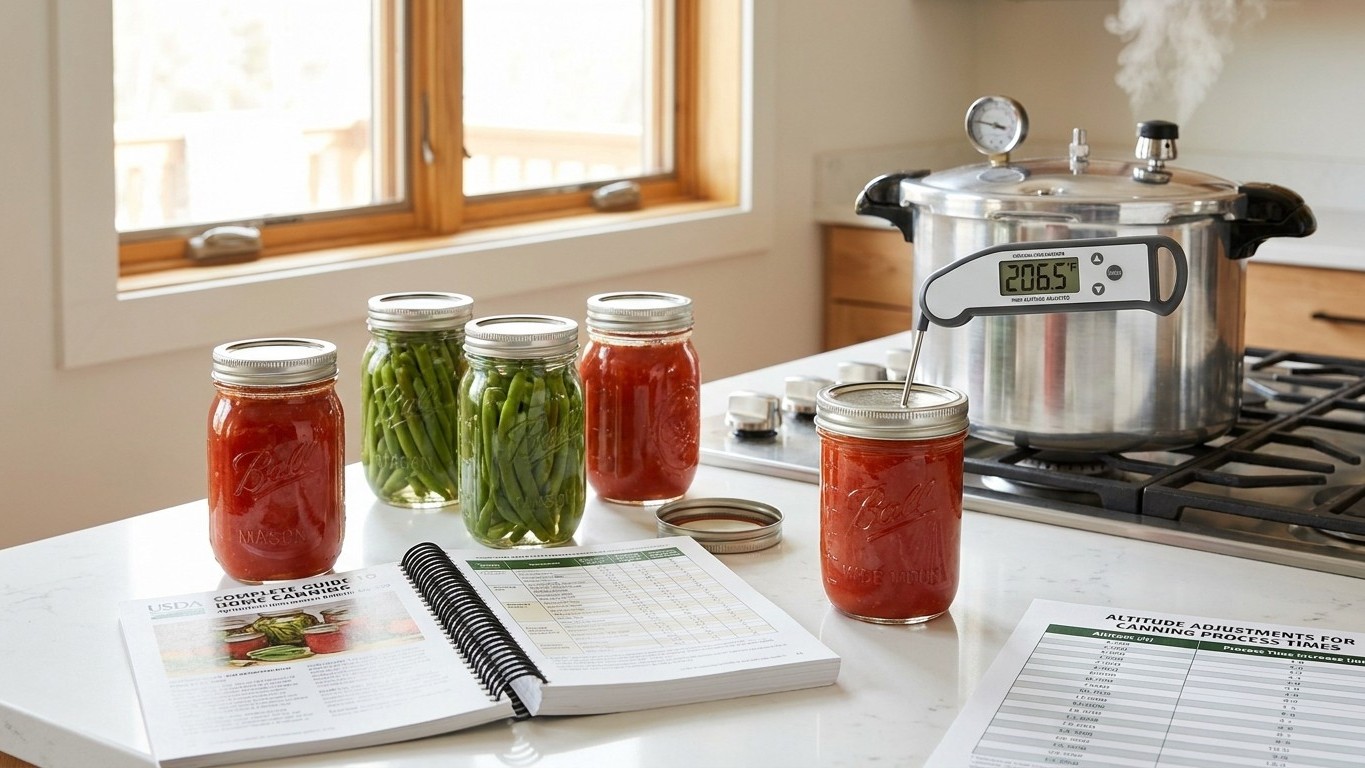

Most of Alberta sits high enough that canning adjustments aren’t optional. Whether you’re processing a boiling-water batch of tomatoes or running a pressure canner full of green beans, the altitude under your kitchen changes how long or how hard that jar needs to process. The exact number depends on your own elevation, not the province’s average, but the short version is: if you live in or near Calgary, Edmonton, Lethbridge, or anywhere across the southern and central prairie-to-foothills stretch, you almost certainly need to adjust.
The short answer

Calgary sits at 3,438 feet. At that elevation, water boils somewhere between 204°F and 208°F, according to the USDA’s Complete Guide to Home Canning, as published by the National Center for Home Food Preservation. That’s a meaningful drop from the 212°F boil most canning recipes assume. It falls squarely inside the 2,000 to 4,000-foot band that triggers an altitude adjustment for both boiling-water and pressure canning. If you’re canning from a kitchen at or near that elevation, this changes your process. It’s not a marginal case.
To be clear about what that number represents: 3,438 feet is Calgary’s elevation, not Alberta’s. A province doesn’t have a single altitude any more than a state does. Alberta stretches from prairie flatland in the east, some of it under 2,000 feet, to Rocky Mountain terrain in the west where peaks exceed 11,000 feet. Canmore, Banff, and the foothills communities sit noticeably higher than Calgary itself; Medicine Hat and much of the eastern prairie sit lower. The figure above is a reference point for one city, useful for illustrating how the physics plays out, not a stand-in for wherever you happen to live.
Why the band matters more than the exact foot count
Canning guidelines don’t ask for your elevation down to the foot. They work in bands, typically starting near sea level and stepping up every 1,000 or 2,000 feet, because the boiling point drops in a predictable, gradual curve rather than a sharp cliff. Calgary’s 3,438 feet lands in the 2,000 to 4,000-foot band, which is enough to require a longer boiling-water process or added pressure in a pressure canner, depending on which method a given recipe calls for. Someone canning at 1,800 feet nearby might fall into a lower band with a smaller adjustment. Someone up in the foothills at 5,000 feet moves into a higher band still. The band, not the raw number, is what a tested recipe actually references.
None of this means guesswork. It means the adjustment is tied to a specific, known relationship between elevation and boiling temperature, one that’s been measured and published, not estimated. The next section gets into why that lower boiling point actually matters for food safety, not just cooking time.
Why a lower boil is a weaker process
Here’s the physics, stripped down: as elevation increases, atmospheric pressure drops, and water boils at a lower temperature. At sea level, water boils at 212°F. At 10,000 feet, it boils at 194°F. That’s an 18-degree difference, and in a canning context, every degree matters because heat, sustained over time, is what destroys the microorganisms and enzymes that spoil food or make it dangerous. A cooler boil delivers less heat energy to the jar’s contents over the same span of time. Less heat means a weaker process, full stop.
This is where a lot of home canners get tripped up. A rolling boil at 3,438 feet feels just as vigorous, just as loud, just as “done” as a rolling boil at sea level. The water is bubbling hard, steam is pouring off the pot, everything looks exactly like it’s supposed to. But boiling water does not get hotter once it’s boiling. It doesn’t matter how high the flame is turned up or how aggressively the pot rattles. Once water reaches its boiling point for that elevation, additional heat just makes it boil faster or harder. The temperature is capped. At 3,438 feet, that cap sits somewhere between 204°F and 208°F, not 212°F, no matter how the burner is set.
That cap is the whole problem. A boiling-water canner relies on sustained heat at the boiling point to destroy molds, yeasts, and the enzymes responsible for spoilage in high-acid foods like most fruits, pickles, and tomatoes (with added acid). If that boiling point is a few degrees cooler than the recipe assumes, the process delivers less lethality than intended, even though the clock ran the exact time listed on the jar.
The fix isn’t a hotter boil, since that’s not achievable. The fix is compensation elsewhere. For boiling-water canning, that means more time in the canner, extending the process to make up for the lower temperature. For pressure canning, used for low-acid foods like meats, vegetables, and stock, the compensation works differently: instead of adding time, tested guidance adds pressure, since a pressure canner’s job is to push the internal temperature above what atmospheric boiling alone can reach, and it needs more added pressure at altitude to hit that same target temperature. Both approaches solve the same problem: not enough heat, corrected by adjusting the one variable that’s actually adjustable.
Finding your own elevation
Calgary’s 3,438 feet doesn’t help much if you live in Red Deer, Grande Prairie, or a rural property outside Lethbridge. Before any recipe adjustment makes sense, you need your own number, not a nearby city’s, not a rough guess.
- Start with the National Center for Home Food Preservation’s “Find Your Elevation” page, built specifically for canners who don’t know their local altitude offhand.
- Enter your city, town, or the nearest recognizable location to your kitchen, since most tools work off named places rather than exact coordinates.
- Note the elevation in feet, and round to the nearest figure the tool provides rather than estimating further.
- Match that number to the altitude band listed in your specific tested recipe, whether it’s a boiling-water process from a trusted guide or a pressure canning chart tied to your recipe’s food type.
- If you live somewhere with real elevation variation nearby, like a foothills acreage well above the closest town’s official reading, lean toward the higher band rather than the lower one, since overprocessing costs a bit of time or pressure while underprocessing costs food safety.
This isn’t a one-time chore that changes every canning season. Elevation doesn’t shift. Once you’ve confirmed the number for your kitchen, it applies to every batch, every recipe, every year, whether you’re canning salsa in September or pressure-canning stock in January.
What goes wrong
- An under-processed jar that looks completely normal. A jar that sealed, sits on the shelf looking fine, and shows no sign of spoilage can still have been processed at the wrong time or pressure for its actual elevation. Sealing is a vacuum event, not a safety confirmation. The remedy is verifying the elevation adjustment before processing, not after, since there’s no visual test that catches this later.
- A recipe pulled from a sea-level source without checking for an altitude note. Many online recipes, family recipe cards, and even some older cookbooks were written by or for canners at or near sea level and simply don’t mention adjustment at all. Using those times as-is at 3,438 feet or higher means running a process built for a hotter boil than the kitchen can actually produce. The remedy is cross-checking any recipe against a current, tested source that explicitly addresses altitude, such as NCHFP guidance for that specific food.
- A pressure gauge read as if elevation didn’t exist. Pressure canners have their own altitude-based adjustments, separate from boiling-water timing, and a dial or weighted gauge set to a sea-level pressure won’t deliver the internal temperature a higher-elevation kitchen actually needs. The remedy is matching the gauge type (weighted or dial) and the canner’s specific pressure setting to the elevation band listed in the tested recipe for that food, not to a number remembered from a different location or a different canner.
- Assuming a longer boil fixes everything. Extending time helps in boiling-water canning, but it doesn’t substitute for a pressure adjustment in a pressure canner, and it doesn’t help at all if the underlying recipe or process type wasn’t right for the food in question. The remedy is treating time and pressure as separate levers, each tied to its own method, rather than interchangeable fixes.
Where the exact adjustment comes from
This page won’t hand you a processing time or a pressure setting, and that’s intentional. The correct adjustment depends on the specific food, the recipe’s acidity, the jar size, and the canning method, all combined with your elevation. That combination belongs to a tested recipe, not a general explainer.
The National Center for Home Food Preservation, based at the University of Georgia, publishes tested recipes and their altitude adjustment charts for exactly this purpose. Once you know your elevation from the steps above, match it against the chart for the specific food you’re canning on the NCHFP site.
The stakes are why this matters more than most kitchen shortcuts. Botulinum toxin, the danger in improperly processed low-acid canned food, has no taste and no smell. A jar can look, smell, and taste completely normal and still be unsafe. Guessing at an adjustment isn’t a risk worth taking when the tested number is a search away.
Common questions
Does higher altitude mean I need a pressure canner instead of boiling-water canning?
No. The canning method depends on the food’s acidity, not on elevation. High-acid foods still use boiling-water Canning at Altitude; low-acid foods still require pressure canning at any elevation. Altitude changes the adjustment within each method, not which method applies.
If I live in Banff or Canmore, is Calgary’s elevation close enough to use?
No. Those communities sit at higher elevations than Calgary, likely in a different altitude band with a different required adjustment. Look up your own town’s elevation rather than borrowing a nearby city’s figure.
Does altitude affect how long jars need to sit for cooling or sealing checks?
No published guidance ties altitude to cooling time or seal-checking procedure. Altitude adjustments apply specifically to the active processing step, boiling-water time or pressure canner pressure, not to what happens after the canner is turned off.
Can I just add extra time or pressure “to be safe” without checking a chart?
Adding time when a pressure adjustment is called for, or vice versa, doesn’t reliably compensate, since the two methods work through different mechanisms. Matching your elevation to the specific chart for your food and method, through NCHFP, is the only way to know the adjustment is actually correct.