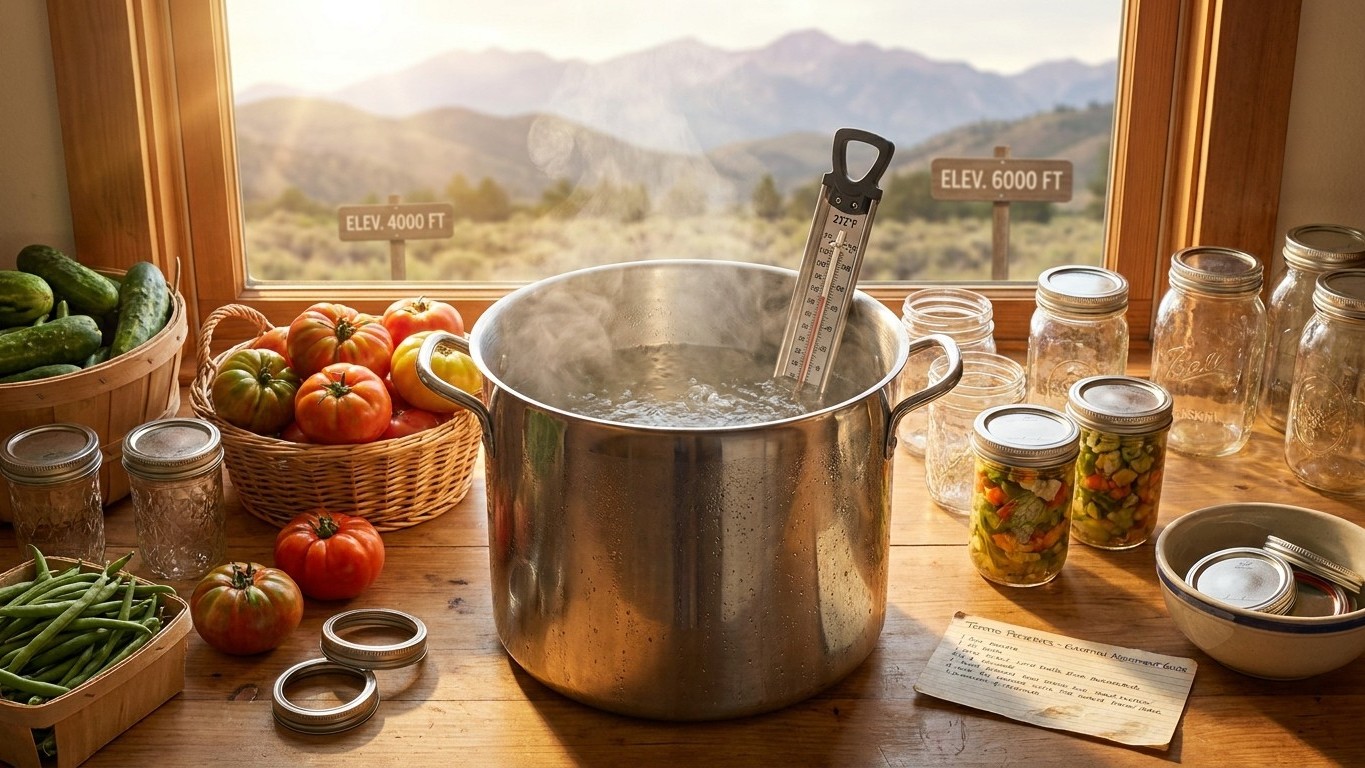

California runs from sea level to over 14,000 feet, so the answer to “does altitude matter for my canner” depends entirely on your address, not on the state as a whole. Los Angeles, a common reference point, sits at 292 feet, where water boils between 208°F and 212°F, close enough to sea level that no adjustment applies there. Climb into the Sierra foothills or the high desert, and that changes fast.
The short answer

Los Angeles sits at 292 feet above sea level. At that elevation, published boiling temperatures for water run between 208°F and 212°F, essentially the sea-level range home canners grew up with. If your kitchen sits anywhere near that band, roughly under 1,000 feet, standard processing guidance written for sea level applies to you without modification. That’s the case for a large share of California’s coastal population, from San Diego to much of the Bay Area’s lower neighborhoods.
But California is not one elevation, and Los Angeles is only the reference city used here, not a stand-in for the whole state. Redding sits higher than the coast. Lake Tahoe communities sit above 6,000 feet. The Owens Valley and the eastern Sierra towns climb well past that. Each of those places boils water at a measurably lower temperature than Los Angeles does, and that lower temperature is the entire reason altitude shows up in canning instructions at all.
Why the gap widens as you climb
Atmospheric pressure drops as elevation increases, and water boils whenever its vapor pressure matches the surrounding air pressure. Less air pressing down means water reaches that match point sooner, at a lower temperature. At sea level, water boils at 212°F. By 10,000 feet, it boils at roughly 194°F, a drop of about 18 degrees. That’s not a rounding error in a recipe. It’s the difference between a process that reliably destroys harmful organisms and one that falls short of the tested benchmark.
For a reader in Los Angeles proper, at 292 feet, this is close to a non-issue. The boiling point there sits within a degree or two of true sea level, and canning guidance written for “0 to 1,000 feet” covers that kitchen without change. For a reader in Truckee, Mammoth Lakes, or anywhere above roughly 1,000 feet, the boiling point has already dropped enough that tested recipes call for a longer time in a boiling-water canner or added pressure in a pressure canner. The number that matters isn’t the state’s average elevation, because no such single number describes home canning risk. It’s the elevation under your own stove.
Why a lower boil is a weaker process
Canning works because heat, sustained for a specific time, destroys the organisms and enzymes that spoil food or make it dangerous. The benchmark tested recipes are built around assumes water boiling at 212°F, the sea-level standard. Every minute of processing time in a published recipe was calculated against that specific temperature doing that specific amount of destructive work.
Raise your elevation, and the water in your canner boils at a lower temperature, full stop. At 292 feet, the drop from 212°F is negligible. At 5,000 feet, water boils around 203°F. At 10,000 feet, it’s down near 194°F. That gap of up to 18 degrees means the boiling water in a high-elevation kitchen is doing measurably less destructive work per minute than the boiling water a sea-level recipe was tested against, even though both jars are, technically, “at a boil.”
This is where a common instinct leads people astray. A rolling, vigorous boil feels more intense than a gentle one, so it seems logical that boiling harder should compensate for boiling at a lower temperature. It doesn’t. Water at a full boil and water at a bare simmering boil are still boiling at exactly the same temperature, whatever the elevation. Cranking up the burner doesn’t push the water past its boiling point. It just makes the boil more vigorous and burns more fuel, without adding a single degree of extra heat to the food inside the jar.
What actually compensates is time or pressure, not intensity. In a boiling-water canner, tested recipes add processing minutes as elevation increases, giving the lower-temperature water more time to do the same job the higher-temperature water at sea level does faster. In a pressure canner, the fix works differently: raising the pressure inside the sealed canner raises the temperature the steam reaches, pushing it back up toward or past 212°F even though the surrounding air pressure outside would otherwise hold it lower. That’s the entire mechanism behind every altitude chart in a tested canning recipe. It isn’t a suggestion or a safety margin someone added for caution. It’s the arithmetic of a lower boiling point, corrected the only two ways available: more time, or more pressure.
Finding your own elevation
- Rule out the obvious. If you live within a few miles of the California coast and know your home sits at or near sea level, you’re very likely in the 0 to 1,000 foot band, the same one Los Angeles falls into at 292 feet. Many canners in this situation can confirm their elevation in a minute and move on.
- Check a topographic or elevation lookup tool. Several free online elevation finders return a figure in feet when you enter an address or drop a pin on a map. These tools pull from the same kind of geographic elevation data used to establish reference points like the 292 feet cited for Los Angeles.
- Use the National Center for Home Food Preservation’s own tool. The NCHFP publishes a page specifically titled “Find Your Elevation,” built for exactly this question, so home canners don’t have to guess which altitude band their kitchen falls into.
- Round up, not down, if you’re near a boundary. If your elevation lookup puts you close to a line between two altitude bands in a tested recipe’s chart, treat yourself as belonging to the higher band. The cost of a few extra minutes in the canner is trivial compared to the cost of an under-processed jar.
- Write the number down somewhere you’ll see it again. Elevation doesn’t change, so this is a one-time task. Keep it next to your canning recipes so you’re never re-deriving it mid-recipe with wet hands and a stove already going.
What goes wrong
- The jar that seals perfectly but wasn’t processed long enough. A good seal only proves that air was driven out and a vacuum formed. It says nothing about whether the process reached a safe internal temperature throughout the jar. At elevation, a recipe processed for sea-level time can seal just fine and still fall short of the tested benchmark, with no visible sign of the shortfall.
- A recipe pulled from a source that never mentions elevation at all. Older family recipes, informal blog posts, and recipe cards passed down for decades were often written by and for someone canning near sea level, without any altitude chart attached. Using one of those unmodified above roughly 1,000 feet carries the same risk as skipping the adjustment on a tested recipe that does include one.
- Reading a pressure gauge as if elevation weren’t part of the equation. Pressure canner gauges show the pressure inside the canner, not the temperature, and the pressure needed to reach a safe temperature rises as elevation rises. A canner run at a pressure that would be correct at sea level, but used unchanged at 5,000 feet or higher, delivers a cooler process than the food actually needs, even though the gauge needle looks exactly where it’s “supposed” to sit.
- Assuming a boiling-water canner can substitute for a pressure canner at high elevation. Some low-acid foods that already require pressure canning at sea level require it there specifically because boiling water, at any elevation, never gets hot enough to safely process them. Elevation makes the pressure requirement more demanding, not less relevant.
Where the exact adjustment comes from
This page won’t hand you a processing time or a pressure setting, and that’s deliberate. The right adjustment depends on the specific food, the jar size, and the tested recipe it came from, not on a general rule that could be printed once and applied everywhere. Two different vegetables at the same elevation can carry two different adjustments.
For the actual number, go to the tested recipe itself and the altitude chart published alongside it by the National Center for Home Food Preservation. That’s the authority built specifically to match foods, jar sizes, and elevations to a verified safe process.
The reason to be strict about this has nothing to do with taste or texture. Botulinum toxin, the danger an under-processed low-acid jar can harbor, has no taste and no smell. A jar can look, smell, and taste completely normal and still not be safe to eat. That’s what makes matching your real elevation to a tested recipe’s chart worth the extra few minutes, every time.
Common questions
Does the elevation of my nearest big city count as my canning elevation?
No. A city’s elevation, like the 292 feet cited for Los Angeles here, only describes that specific location. Neighborhoods a few miles inland or up a hillside can sit at a meaningfully different elevation, so look up your own address rather than borrowing the nearest city’s figure.
If I live at 292 feet, do I need to adjust my recipes at all?
At that elevation, boiling water reaches between 208°F and 212°F, within the 0 to 1,000 foot band that most tested recipes treat as the baseline. Home canners at that elevation generally use the standard processing times printed for sea level, without an altitude adjustment.
Why does a harder, more vigorous boil not fix a lower boiling point?
Boiling water stays at its boiling point regardless of how vigorously it’s boiling. A gentle boil and a rolling boil at the same elevation are the same temperature. Only added pressure, in a sealed pressure canner, actually raises the temperature past what open boiling water can reach at that elevation.
Where can I find the elevation adjustment for a specific food I want to can?
Look up the tested recipe for that specific food through the National Center for Home Food Preservation, which publishes altitude charts alongside its recipes matching elevation bands to the correct processing time or pressure for that food and jar size.