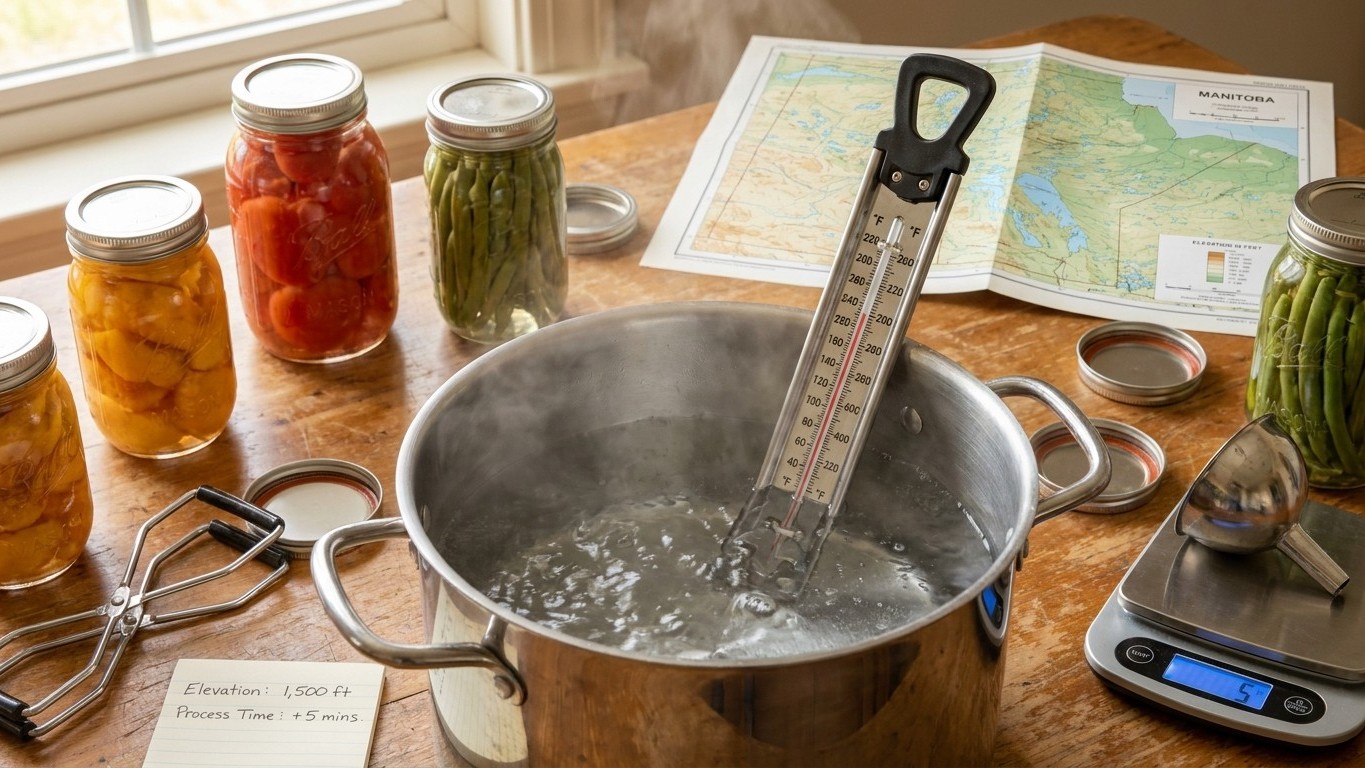

Winnipeg sits at 804 feet, and published boiling temperatures for that elevation band put water’s boiling point somewhere between 208°F and 212°F. That’s a narrow gap, close enough to sea level that many home canners in the area never think twice about it. But Manitoba stretches from lake-adjacent lowlands to higher ground toward the west and south, and the number that decides your process isn’t Winnipeg’s. It’s the one at your own address.
The short answer

Start with the figure itself: Winnipeg, Manitoba’s largest city and the reference point used here, sits at 804 feet above sea level. At that height, water boils somewhere between 208°F and 212°F, according to the USDA Complete Guide to Home Canning as published by the National Center for Home Food Preservation. Compare that to the 212°F you’d get exactly at sea level, and the gap is small, just a handful of degrees at most.
Does that gap matter for your jars? At 804 feet, the answer leans toward “not much,” but it’s not nothing, and it’s not automatic. A boiling point a few degrees below 212°F still means slightly less heat reaching the food in the same amount of time. Whether that requires a change to your process depends on which tested recipe you’re using and what altitude range that recipe was written for. Some tested recipes already build in a cushion for elevations up to 1,000 feet; others draw the line differently. That distinction lives in the recipe itself, not in this page.
What’s not in question is the general shape of the problem. Every 500 feet of elevation gain drops the boiling point of water by roughly one degree Fahrenheit, and that decline is steady and predictable, not something that varies by weather or by pot. A cook in Brandon, sitting higher than Winnipeg, boils water at a lower temperature than a cook in Winkler, which sits closer to lake level. Neither number is “Manitoba’s boiling point,” because no such single number exists for a province this size.
Why Winnipeg’s number isn’t your number
Manitoba spans an enormous range of terrain, from the flat lowlands near Lake Winnipeg to higher, rolling ground farther west. Winnipeg’s 804 feet is useful as a reference because it’s where a large share of the province’s population lives and cans, but it describes one city, not the province. If you live in Winnipeg proper, near it, or somewhere else close to that elevation band, this figure is close enough to plan around. If you live somewhere noticeably higher, you need your own number before you touch a jar.
The practical takeaway at this stage is simple: at Winnipeg’s elevation, the boiling-point drop is modest enough that many canners fall into the range where standard tested processes apply without modification, but confirming your own elevation costs you five minutes and removes all doubt.
Why a lower boil is a weaker process
Water’s boiling point isn’t fixed at 212°F everywhere on earth. It’s fixed at 212°F at sea level, where atmospheric pressure pushes down hard enough to keep water liquid until it reaches that temperature. Climb higher, and the air thins out. Less air pressing down means water molecules escape into vapor at a lower temperature. That’s the entire mechanism: less atmospheric pressure, lower boiling point, no exceptions and no local variation beyond what elevation itself dictates.
This matters for canning because heat, not motion, is what destroys the organisms and enzymes you’re trying to eliminate from a jar of food. Boiling-water canning and pressure canning both rely on sustained heat above a threshold long enough to make food safe for the shelf. When water boils at a cooler temperature, the food inside your jars never gets as hot as it would at sea level, even though the water is boiling just as hard, just as visibly, with just as many bubbles.
That’s the detail that trips people up. A rolling boil at 6,000 feet looks identical to a rolling boil at sea level. The water is still bubbling, still rattling the lid, still doing everything a boil is supposed to do visually. But it’s doing that at a lower temperature, and boiling water cannot exceed its boiling point no matter how high you crank the burner. Turning up the heat makes the water boil more vigorously, not hotter. Once water reaches its boiling point for that elevation, additional heat just speeds up evaporation. It doesn’t raise the temperature further. A canner who assumes “boiling harder” compensates for altitude is working from a misunderstanding that no amount of stove power will fix.
The real compensation comes from two directions, depending on which method you’re using. In a boiling-water canner, tested recipes add processing time as elevation increases, giving the cooler water more minutes to do the same job a hotter boil would do faster. In a pressure canner, tested recipes raise the pressure instead, because pressure is what allows the water inside the sealed canner to reach a higher temperature than an open pot ever could at any elevation. Both fixes solve the same underlying problem: a cooler boil needs either more time or more pressure to deliver an equivalent amount of heat into the food. Neither fix is optional once your elevation crosses into a new band, and neither is something to estimate by feel.
Finding your own elevation
Your address is what determines your process, not the province, and not Winnipeg. Here’s the order to work through it.
- Start with the National Center for Home Food Preservation’s “Find Your Elevation” page. It’s built specifically for canners who need an elevation figure for this purpose, and it’s the source to use rather than a general mapping tool that wasn’t designed with canning bands in mind.
- Enter your town, or the nearest one if your address doesn’t come up directly. Rural Manitoba addresses sometimes need the closest named community rather than a rural route or postal box.
- Note the elevation in feet, not meters. Canadian sources sometimes default to metric, but the canning charts you’ll use afterward are built around feet.
- Compare that number to the elevation bands listed in your tested recipe. Recipes typically list ranges like sea level to 1,000 feet, 1,001 to 3,000 feet, and so on, each with its own adjustment.
- Write your band down somewhere you’ll see it at canning time. A sticky note on the canner lid works. So does a line in the recipe itself. The point is not to rely on memory once the kitchen gets busy.
If you split time between two elevations, a lake cabin in higher country and a home closer to sea level, treat each location separately. The elevation that counts is the one where the canner is sitting when the jars go in, not the one where the recipe was written or where you usually live.
What goes wrong
- An under-processed jar that looks completely normal. A jar can seal, sound right when tapped, and sit on the shelf looking exactly like a safe one, while the food inside never reached a temperature high enough to destroy Clostridium botulinum spores. There’s no visual cue that separates a properly processed jar from an under-processed one at a lower boiling point. The remedy is upstream of the jar: match your process time or pressure to your actual elevation band before you start, not after you’re wondering about a finished batch.
- A recipe pulled from a source written for sea level. Older family recipes, printed cookbooks from decades past, and recipes shared from friends at lower elevations often carry times that assume a 212°F boil throughout. Using those times unmodified at any elevation above sea level shortchanges the process. The fix is checking the source recipe against a current tested chart from the National Center for Home Food Preservation rather than assuming a recipe’s age or popularity makes it safe as written.
- A pressure gauge read as though elevation doesn’t exist. Dial gauges and weighted gauges both need elevation-specific settings, and a canner set to a sea-level pressure at a higher elevation runs cooler than intended, even though the gauge needle looks correct. The remedy is checking your gauge’s accuracy periodically and setting pressure according to your elevation band every single time, not just the first time you used that canner.
- Treating “close to Winnipeg” as “safe to skip the check.” A location a few hundred feet higher than Winnipeg can sit in a different elevation band than the one this page describes, particularly for readers west of the city. The remedy is running the actual elevation lookup rather than assuming proximity to a major city settles the question.
Where the exact adjustment comes from
This page won’t hand you a processing time or a pressure setting, and that’s intentional. The correct adjustment depends on the specific food, the jar size, and the tested recipe you’re following, and those numbers live with the recipe, not with a general elevation guide. The National Center for Home Food Preservation publishes tested processes with built-in elevation adjustments for the food you’re actually canning, and that’s the resource to consult once you know your elevation band.
The reason for this caution isn’t bureaucratic. Botulinum toxin, the danger an under-processed low-acid food can harbor, has no taste and no smell. A jar that’s unsafe can look, smell, and taste completely normal right up until it makes someone sick. That’s why the adjustment has to come from a tested source matched to your specific food, rather than a general rule applied loosely across every recipe in your kitchen.
Common questions
Does Manitoba have one official elevation for canning purposes?
No. Manitoba spans lake-level lowlands and higher ground, and the elevation that matters is wherever your kitchen sits, not a single provincial figure. Winnipeg’s 804 feet is a useful reference point, not a province-wide standard.
If I’m close to Winnipeg’s elevation, can I skip checking my own?
It’s still worth confirming. “Close” can mean a different elevation band depending on which direction you’re measuring from, and elevation bands in tested recipes have firm cutoffs rather than gradual ranges.
Why does boiling water look the same at every elevation if the temperature is different?
Boiling is a visual sign that water has reached its boiling point for that specific atmospheric pressure, not a sign of a fixed temperature. A vigorous boil at a lower boiling point looks identical to a vigorous boil at 212°F, which is exactly why relying on appearance instead of elevation and processing time leads canners astray.
Where should I look for the actual processing time or pressure for my recipe?
The National Center for Home Food Preservation publishes tested recipes with elevation-adjusted processing times and pressures organized by food type. That’s the source to check once you know your elevation band, rather than adapting an untested recipe on your own.