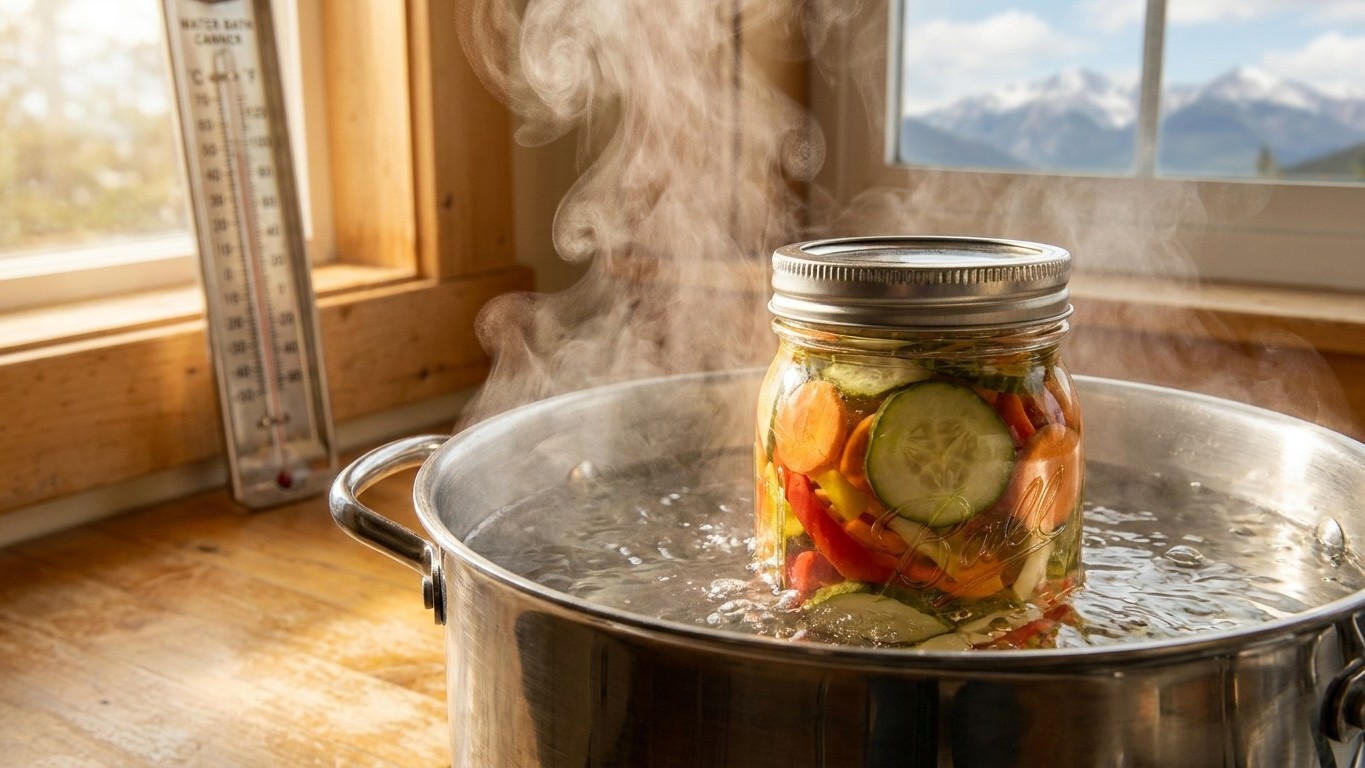

At Vancouver’s elevation of 230 feet, water boils somewhere between 208°F and 212°F, according to the USDA Complete Guide to Home Canning. That’s close enough to sea level that a standard boiling-water canner processing time, taken from a tested recipe written for sea-level conditions, still does its job. British Columbia stretches from tidewater to mountain passes, though, so your own elevation is the number that matters, not Vancouver’s.
The short answer

Vancouver sits at 230 feet above sea level, and at that height water in an open pot reaches somewhere in the 208°F to 212°F range before it boils, per the USDA Complete Guide to Home Canning as published by the National Center for Home Food Preservation. That’s the reference figure for this article, and it’s worth repeating: it describes one city, not the province. British Columbia runs from Pacific beaches near Tofino to mountain communities in the Kootenays sitting thousands of feet higher, and the canning math changes with every one of those feet.
For someone canning in Vancouver, Richmond, or another low-lying Lower Mainland community, this elevation band from 0 to 2,000 feet is the one where a boil is close enough to the full 212°F that tested recipes written for standard conditions generally apply as written. That’s the practical meaning of “it doesn’t change anything” for a home canner working near sea level: the water gets hot enough, fast enough, that the process time on the jar of pickles you’re following does what its testing said it would do.
Why the range matters more than a single number
Notice that the boiling point isn’t pinned to one exact figure, it’s a range: 208°F to 212°F. That’s because “230 feet” isn’t a laboratory constant, it’s a real-world elevation subject to small variations in atmospheric pressure from day to day, weather system to weather system. A canner in Vancouver on a high-pressure day and the same canner on a low-pressure day will see slightly different numbers on a thermometer clipped to the pot. That’s normal, and it’s exactly why the USDA’s altitude charts work in bands rather than pinpoint elevations. Somebody at 50 feet and somebody at 900 feet fall into the same adjustment category because the boiling-point difference between them is too small to matter for safety.
The moment that stops being true is the moment you climb into a different band. Someone canning in Kelowna, Kamloops, or up in the higher valleys of the interior is working with a meaningfully cooler boil, and that person’s jars need a different process than a batch put up on Vancouver Island near the water. The number that determines which category you’re in isn’t Vancouver’s elevation. It’s yours.
Why a lower boil is a weaker process
Water boils when its vapor pressure matches the surrounding air pressure. At sea level, the air pushes down harder, so water has to reach 212°F before it can turn to steam and bubble. Climb higher, and the air thins out. There’s less atmospheric weight pressing down, so water gives up and starts boiling at a lower temperature. At 10,000 feet, for instance, water boils at roughly 194°F, a full 18 degrees cooler than at sea level. It’s still boiling, rolling and bubbling exactly the way it does in a kitchen near the ocean. It’s just not as hot.
That’s the entire mechanism, and it’s the reason altitude matters for canning at all: a cooler boil kills fewer microorganisms in a given amount of time. Heat-resistant spores, including the ones that produce botulinum toxin, need both temperature and time to be destroyed. Drop the temperature and the same processing time that worked at sea level no longer delivers the same lethal effect. The jar might look identical coming out of the canner. The contents might taste fine. But the margin of safety that the tested recipe was built around has quietly eroded.
Here’s the detail that trips people up: boiling water harder doesn’t make it hotter. Turn the burner to high, watch the pot roar and churn, and the thermometer still reads the same boiling point for that elevation. Water at a full rolling boil and water at a bare simmering boil are the same temperature once both have reached their boiling point; the difference is just how fast bubbles form and rise. A vigorous boil doesn’t compensate for altitude, because temperature, not vigor, is what does the work of destroying microorganisms.
What actually compensates is built into the tested recipe itself, in one of two ways depending on the canning method. For boiling-water canning, the fix is more time. The process runs longer at altitude to make up for the lower temperature, giving the cooler boil more minutes to accomplish what a hotter boil could do faster. For pressure canning, the fix is more pressure. Adding pressure inside a sealed canner raises the boiling point of the water inside it, pushing it back up past 212°F even though the surrounding air outside the canner is thinner. Both approaches are already built into properly tested recipes and their altitude charts. Your job as the canner is simply to know which band you fall into and apply the adjustment that belongs to it.
Finding your own elevation
- Search for your town or the nearest community by name using an elevation lookup tool or topographic map, since municipal elevation isn’t always common knowledge the way a boiling point or a recipe ingredient is.
- Check the number against your city or regional district’s published data if it’s available, since some BC municipalities post elevation figures for their water systems or public works departments.
- Round to the nearest hundred feet rather than chasing exact precision, because canning altitude charts work in bands, not single-foot increments.
- Visit the National Center for Home Food Preservation’s “Find Your Elevation” page, built specifically so home canners can look up a location and get a reliable number without guesswork.
- Match your elevation band to the altitude adjustment table printed with your specific tested recipe, whether that’s a boiling-water process for jam or a pressure process for green beans, since the adjustment differs by food and by method.
- Recheck your elevation if you move, can at a relative’s house in a different part of the province, or take your canner to a cabin at a different height, since the number that matters is wherever the canner is actually sitting on the stove.
What goes wrong
- An under-processed jar that looks perfect. Sealed lid, clear liquid, no off smell, and still unsafe, because a cooler boil at altitude can fail to destroy botulinum spores without leaving any visible sign. The remedy is following the altitude-adjusted time or pressure from the start, not judging the jar after the fact by how it looks on the shelf.
- A recipe pulled from a sea-level source. Old family recipes, out-of-province cookbooks, and online recipes without an altitude chart often assume a 212°F boil throughout. Used as written by a canner at higher elevation in BC’s interior, they under-process the food. The fix is cross-checking any recipe against a current NCHFP-published altitude chart before trusting its times.
- A pressure gauge read as if elevation didn’t exist. Dial gauges and weighted gauges both need a pressure that matches the canner’s actual elevation band, not a flat number memorized from a friend’s kitchen at a different height. Reading the gauge correctly but at the wrong target pressure produces the same weak process as skipping the adjustment altogether. The remedy is confirming the pressure required for your specific elevation and food combination before the canner ever reaches temperature.
- Assuming Vancouver’s numbers travel with you. A canner who learned to can near sea level and later moves to a higher part of the province sometimes keeps using the old times out of habit. The fix is treating every new location as a reason to look up elevation again, since the adjustment belongs to the place, not the person.
Where the exact adjustment comes from
This page won’t give you a processing time or a canner pressure, and no general article about elevation should. The correct adjustment depends on the specific food, the specific recipe, and the specific canning method, and it belongs to a tested recipe published by the National Center for Home Food Preservation, not to a rule of thumb. Botulinum toxin has no taste and no smell, which means a jar that looks and smells completely normal can still carry it if the process fell short. Look up your food and your elevation band directly on the National Center for Home Food Preservation’s website, and let their tested charts, not an approximation, set your time or pressure.
Common questions
Does Vancouver’s elevation apply to my whole region of British Columbia?
No. Vancouver’s 230-foot elevation is a reference point for the Lower Mainland’s low-lying areas, not a figure for the province. Interior communities and mountain valleys sit at meaningfully higher elevations and fall into different adjustment bands.
Can I just boil my jars longer than the recipe says, to be safe?
Adding extra time beyond what the altitude chart specifies for your elevation and food is generally fine and sometimes recommended as a margin, but guessing at a number without checking the chart isn’t a substitute for knowing your actual band.
Does altitude affect canning done in a boiling-water bath differently than pressure canning?
Yes. Boiling-water canning compensates for altitude with added time, since the water inside the canner can’t get hotter than its natural boiling point. Pressure canning compensates with added pressure, which raises the internal temperature back toward or above 212°F regardless of outside elevation.
Where can I find the exact elevation for my BC town?
The National Center for Home Food Preservation publishes a “Find Your Elevation” tool designed for exactly this purpose, letting you search by location rather than estimate from memory or a general map.