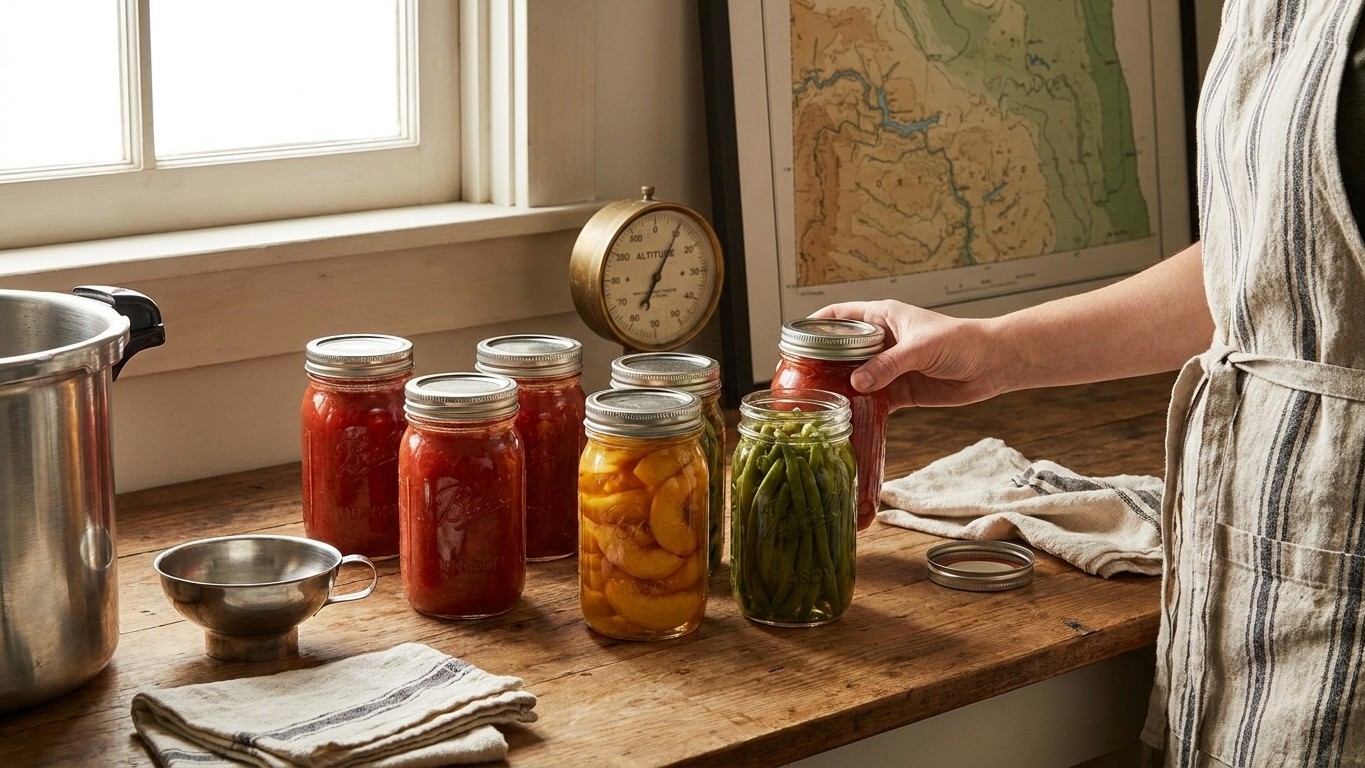

North Dakota’s elevation changes what your canner needs to do, but only if you actually live at a meaningful height above sea level. Most of the state sits low enough that canning proceeds close to sea-level rules, while pockets farther west climb into territory where every jar needs a real adjustment. The only way to know which case applies to you is to check your own ground, not the state as a whole.
The short answer

Fargo sits at 906 feet, and that number matters because it’s the reference point most elevation data for North Dakota gets built around. At that height, water boils somewhere between 208°F and 212°F, the band that the USDA’s published tables assign to elevations from sea level up to 2,000 feet. That’s a narrow spread. It tells you that a kitchen in Fargo is working with water that’s barely cooler than the classic 212°F boil most canning instructions assume.
Does that change anything? For a lot of home canners in the Fargo area, not much. The 0 to 2,000 foot band is the one tested recipes usually treat as the baseline, meaning the boiling-water or pressure canning instructions printed on a tested recipe often apply without extra adjustment at this height. But that’s a general pattern, not a guarantee for every food and every method, and it’s not the same as saying North Dakota itself sits low.
North Dakota is not one elevation. The land rises unevenly from the river valleys in the east toward higher ground farther west, and a homestead kitchen at the edge of the Badlands is working with different air pressure than one along the Red River. Fargo’s 906 feet describes Fargo. It does not describe a canner in Dickinson, in Bismarck, or on a ridge outside Williston. Each of those kitchens sits at its own elevation, and that elevation, not the state’s biggest city, is what a tested recipe needs to know.
Why the low end still deserves a check
Even inside the 0 to 2,000 foot band, elevation isn’t nothing. A property sitting near the top of that range, closer to 2,000 feet than to sea level, is boiling water measurably cooler than one down near river level. The safest habit is to stop guessing based on “North Dakota is pretty flat” and instead pull your actual number before you can anything, especially high-risk low-acid foods that go through a pressure canner.
Why a lower boil is a weaker process
Boiling point drops as elevation rises, and that single fact is the entire reason altitude matters for canning. At sea level, water boils at 212°F. Climb to 10,000 feet and it boils at 194°F. Nothing exotic is happening chemically, air pressure is just lower up there, so water needs less energy to turn to vapor and it does so at a cooler temperature.
Here’s the part that trips people up: boiling harder does not fix this. Once water is at a full rolling boil, it has reached its maximum temperature for that elevation and that pressure. Cranking the burner higher makes the water boil more violently, splashing and using more fuel, but it does not push the temperature past that ceiling. A hard boil in Bismarck and a gentle boil in Bismarck are boiling at the exact same temperature. Only elevation, or a pressure canner sealing in higher pressure, changes that ceiling.
That matters because heat, sustained at the right temperature for the right time, is what destroys the organisms and spores that make canned food dangerous. A cooler boil delivers less lethal heat per minute than a hotter one. Something that gets fully neutralized in a given number of minutes at 212°F may survive the same number of minutes at 208°F, simply because the process is weaker at that temperature. The food isn’t safer just because the jars looked like they were boiling just as hard.
The compensation is straightforward in principle, even though the exact numbers are never something to guess at home. In a boiling-water canner, the fix is more time, letting the weaker heat work longer to reach the same lethal effect. In a pressure canner, the fix is more pressure, because raising the pressure inside the sealed canner raises the internal temperature past what a simple boil could reach on its own, restoring the heat that elevation took away.
| Elevation | Boiling point of water |
|---|---|
| Sea level (0 ft) | 212°F |
| 10,000 ft | 194°F |
That’s an 18-degree swing across 10,000 feet of climb, and it’s why the tested tables build in adjustments in stages rather than treating all elevations the same.
Finding your own elevation
Fargo’s 906 feet is a reference point, not a stand-in for your kitchen. Before adjusting any recipe, find the number that actually applies to where your stove sits.
- Start by admitting the state figure doesn’t apply to you directly; a number for Fargo, Bismarck, or any single city is only useful if you happen to live there.
- Check a topographic reference or a reliable elevation lookup tool for your own address, not your county seat or nearest large town.
- Use the National Center for Home Food Preservation’s Find Your Elevation page, built specifically so home canners can pin down the number that matters for their kitchen.
- Round to the nearest elevation band listed in your tested recipe’s adjustment table, since tables step up in ranges rather than giving a unique instruction for every single foot of elevation.
- Write that number down somewhere you’ll see it every canning season, since it doesn’t change year to year and doesn’t need to be looked up twice.
What goes wrong
- An under-processed jar that looks perfect. A jar canned at the wrong process for its elevation can seal, seal tight, and sit on a shelf looking exactly like a safe jar. There’s no visual cue that the heat inside fell short. The remedy is procedural, not visual: confirm the process time or pressure was matched to your actual elevation before the jar ever went into the canner, because there’s nothing to check after the fact.
- A recipe pulled from a sea-level source. Family recipes passed down from a relative near the coast, or canning instructions from a blog written by someone at a low elevation, often carry processing times that assume little to no altitude adjustment. Using them unchanged at any elevation above the band they were tested for weakens the process. The fix is to match the food to a tested recipe from the National Center for Home Food Preservation or the USDA guide, then apply the adjustment for your own elevation band, not the source’s.
- A pressure gauge read as if elevation didn’t exist. Reading a dial gauge or setting a weighted gauge at the pressure printed for sea level, when your kitchen sits well above it, delivers less effective heat than the recipe intended. The remedy is checking the elevation-specific pressure for your exact band before you start, and having a dial gauge tested for accuracy periodically, since a gauge that reads even slightly low compounds the elevation problem instead of correcting it.
Where the exact adjustment comes from
This page won’t give you a processing time or a canner pressure, and no article should. The right adjustment depends on the specific food, the jar size, and the exact elevation band you fall into, and that information lives in tested recipes, not in general explanations of why altitude matters. The National Center for Home Food Preservation publishes those tested times and pressures for individual foods, broken out by elevation band, and that’s the source to use once you know your own elevation.
The reason to take this seriously isn’t abstract. Botulinum toxin, the danger an under-processed low-acid jar can harbor, has no taste and no smell. A jar that’s unsafe looks, smells, and tastes exactly like one that’s fine. The only protection is getting the process right before the lid ever goes on, which means starting from your real elevation and a tested recipe, every time.
Common questions
Does all of North Dakota need the same canning adjustment?
No. Elevation varies across the state, and the adjustment follows your own ground, not a single statewide number.
Is Fargo’s elevation high enough to worry about?
At 906 feet, Fargo sits in the lowest published elevation band, where many tested recipes need little to no adjustment, but the exact answer still depends on the specific food and method.
Can I just boil jars longer to be safe, regardless of elevation?
Guessing at extra time isn’t a substitute for the correct tested adjustment for your elevation and food, since under- and over-processing both cause problems.
Where do I find the exact time or pressure for my elevation?
The National Center for Home Food Preservation publishes tested times and pressures by food and elevation band; that’s the source to check once you know your own elevation.