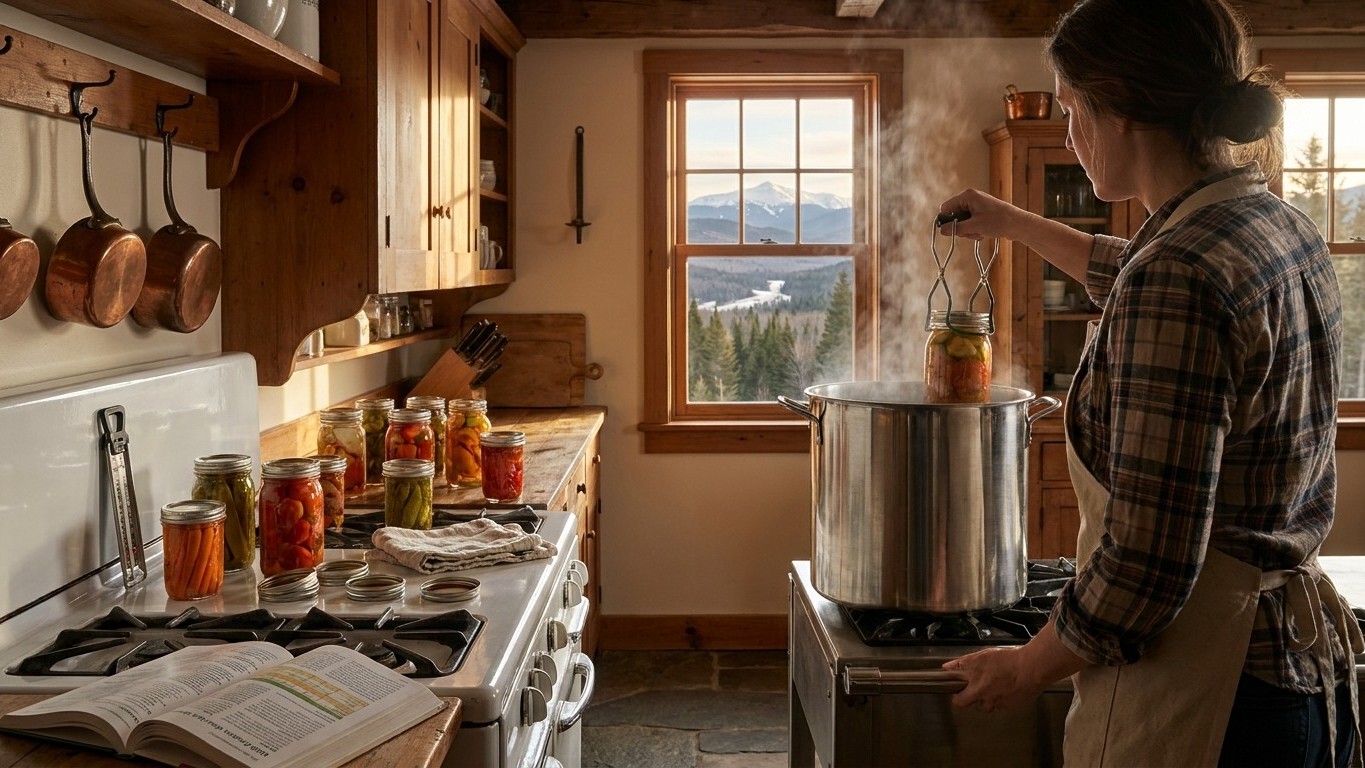

In Burlington, Vermont’s reference point at 200 feet above sea level, water boils somewhere between 208°F and 212°F. That’s close enough to true sea level that most tested canning recipes need no adjustment there at all. But Vermont’s landscape runs from lake shore to mountain summit, and a canner working a kitchen in the Green Mountains isn’t canning at Burlington’s elevation. Your own elevation is what decides whether you adjust.
The short answer

Burlington’s elevation, 200 feet, comes from geographic data, not from any canning authority, and it places the city in the 0-to-2,000-foot elevation band that the USDA’s canning guidance uses as its baseline. Within that band, water boils between 208°F and 212°F, the range published in the USDA Complete Guide to Home Canning as republished by the National Center for Home Food Preservation. That’s a narrow spread. A four-degree difference in boiling temperature is not the kind of gap that forces a home canner to rethink every recipe.
That’s the answer for Burlington specifically, and it’s a fair stand-in for a lot of the Champlain Valley, where much of Vermont’s population actually lives. But Vermont is not a flat state, and the figure above describes one city, not the territory. The Green Mountains run the length of the state, and towns tucked into their valleys and slopes sit at elevations Burlington never approaches. A cabin outside Killington, a homestead near Stowe, a farm in the Northeast Kingdom’s higher country: these can sit at elevations that put a canner squarely into territory where adjustment isn’t optional.
Why the same state gives two different answers
This is the part that trips people up. Someone reads that “Vermont canning” needs no altitude adjustment, assumes that applies to their own kitchen, and skips a step that their specific elevation actually requires. The truth is that no single figure describes canning conditions for an entire state. Burlington’s 200 feet is a data point, useful as a reference and genuinely representative of the lower valleys, but it says nothing about a kitchen a few thousand feet higher up a mountainside.
The mechanism behind all of this, why elevation matters at all for something as basic as boiling water, is worth understanding on its own terms, because it explains why the fix isn’t intuitive.
Why a lower boil is a weaker process
Water’s boiling point isn’t fixed at 212°F. It’s fixed at 212°F only at sea level, where atmospheric pressure pushes down on the water’s surface with a specific, predictable force. Climb higher and that atmospheric pressure drops, because there’s less air stacked above you pressing down. With less pressure holding the water molecules in place, they escape into vapor at a lower temperature. That’s the entire mechanism: less air pressure, lower boiling point. At 10,000 feet, water boils at 194°F, a full 18 degrees below the sea-level figure.
Here’s why that matters for a jar of green beans or tomato sauce: a boiling-water canner and a pressure canner both rely on heat to destroy microorganisms, and destruction rates depend directly on temperature. A process built around a 212°F boil assumes a certain kill rate over a certain number of minutes. Run that same process at 194°F, and the kill rate drops, because the temperature driving it is lower. The jar can look perfectly processed, the water can be at a rolling boil the entire time, and the contents can still harbor organisms that a sea-level process would have destroyed.
This is where a lot of home canners get confused, because the instinct is to crank up the heat. It doesn’t work. Once water is boiling, adding more heat doesn’t raise its temperature further, it just makes it boil more vigorously and evaporate faster. A hard, violent boil at 8,000 feet is still a 197°F boil. Turning up the burner doesn’t recover the missing degrees; it only burns through your canner’s water supply faster.
What actually compensates for a cooler boil is exposure time, or in a pressure canner, pressure itself. In a boiling-water canner, the fix is processing the jars longer, giving the weaker heat more minutes to accomplish what a hotter boil would have done faster. In a pressure canner, the fix runs differently: pressure inside a sealed canner raises the temperature of the steam well above what any open pot can reach, and at higher elevations that pressure gets bumped up to compensate for the thinner atmosphere outside the canner. Either way, the adjustment exists specifically because a lower boil, on its own, is a weaker process than the tested recipe assumes.
Finding your own elevation
Before any of this becomes useful, you need one number: your own elevation, not Burlington’s, not your county seat’s, but the elevation of the kitchen where the jars will actually process.
- Start with the National Center for Home Food Preservation’s own “Find Your Elevation” page, built specifically so home canners can look up this number without guesswork.
- Enter your town or zip code rather than relying on memory or a rough guess, since even towns a few miles apart in hilly terrain can differ by hundreds of feet.
- Write the resulting number down somewhere you’ll actually see it again, a canning notebook, a card taped inside a cabinet, anywhere near your canning equipment.
- Compare that number against the elevation ranges listed in your specific tested recipe, since USDA and NCHFP recipes list adjustments by elevation band rather than by a single cutoff.
- Recheck this if you can, garden, or process food at a second location, a relative’s house, a rented cabin, a community kitchen, since the elevation figure belongs to the location, not to you as a canner.
That last step matters more than it sounds. A canner who does most of their preserving at home but occasionally processes a batch at a family cabin higher up the mountain needs two different elevation figures, not one habit carried from the lower kitchen to the higher one.
What goes wrong
- An under-processed jar that looks perfect. A jar sealed at altitude with a sea-level process can seal properly, look clear, show no spoilage signs, and still carry live spores, because a proper seal only proves the lid sealed, not that the contents reached a safe temperature for long enough. The remedy is using the elevation-adjusted time or pressure from the start, not judging safety by appearance afterward.
- A recipe pulled from a sea-level source. Recipes shared online, in old family notebooks, or in general cookbooks often assume sea-level conditions without saying so. The remedy is checking whether the recipe names an elevation-adjustment table at all; if it doesn’t, treat it as untested for your elevation and look for the same food in a tested NCHFP resource instead.
- A pressure gauge read as if elevation didn’t exist. Dial-gauge and weighted-gauge pressure canners both need their target pressure adjusted for elevation, and a canner set to a sea-level pressure figure at a higher elevation kitchen delivers a weaker process despite the gauge reading exactly as expected. The remedy is matching the gauge type and elevation band to the specific figures in the tested recipe, not assuming the canner “knows” your altitude.
Where the exact adjustment comes from
This page won’t give you a processing time or a canner pressure, and that’s deliberate. The right adjustment depends on the specific food, the jar size, and the exact processing method, and those numbers live in tested recipes, not in a general explanation of altitude. The National Center for Home Food Preservation publishes elevation-adjustment tables alongside its recipes for exactly this reason, matching your elevation band to the correct additional minutes or pounds of pressure for that particular food.
The reason this matters more than it might seem is that the failure mode is silent. Botulinum toxin, the danger an under-processed jar risks harboring, has no taste and no smell. A jar can look, smell, and taste completely normal and still be unsafe. Elevation adjustment isn’t a formality; it’s the step that keeps an invisible risk invisible for the right reason, because it was never there in the first place.
Common questions
Does Burlington’s elevation apply to all of Vermont?
No. Burlington’s 200 feet describes that city alone, drawn from geographic data. Vermont includes much higher terrain in the Green Mountains, and any elevation adjustment for canning follows the reader’s own location, not a single statewide figure.
Why does boiling water get less hot at higher elevations?
Atmospheric pressure drops as elevation rises, and water needs less energy to turn to vapor under lower pressure, so it boils at a lower temperature. At 10,000 feet, water boils at 194°F instead of 212°F.
If I boil the water harder, does that fix a low-elevation boiling point?
No. Once water is boiling, additional heat doesn’t raise its temperature further, it just increases evaporation. A vigorous boil at a high elevation kitchen is still capped at that elevation’s lower boiling temperature.
Where do I find the actual processing adjustment for my elevation?
The National Center for Home Food Preservation publishes elevation-adjustment tables tied to specific tested recipes. Find your own elevation first using their “Find Your Elevation” tool, then match it to the adjustment table for the exact food you’re canning.