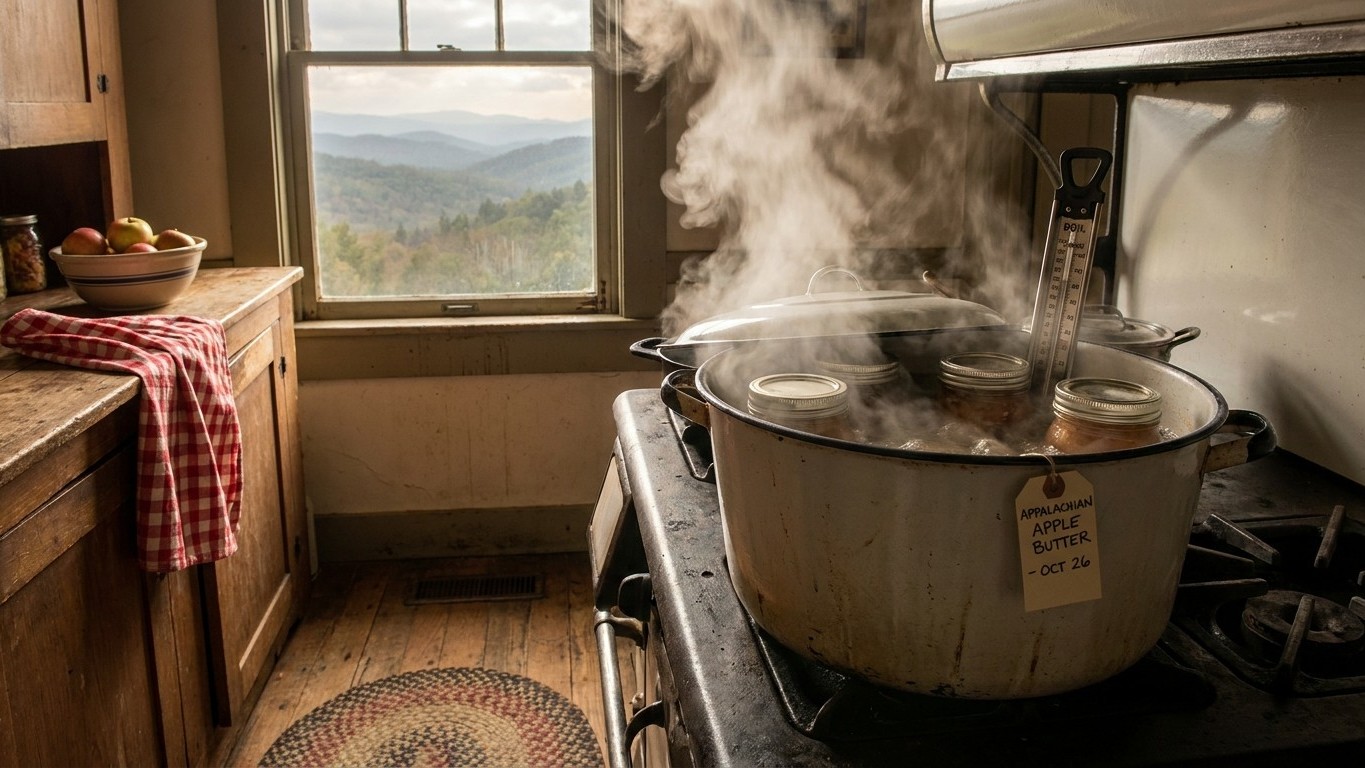

Charleston, the reference city for West Virginia’s elevation data, sits at 597 feet, where water boils somewhere between 208°F and 212°F depending on the day’s barometric pressure. That’s low enough that most home canners in the immediate Charleston area won’t need to touch a single number in a tested recipe. But West Virginia is a mountain state, and plenty of kitchens sit thousands of feet higher, where the math changes completely.
The short answer

A state doesn’t have one elevation, and neither does West Virginia. Charleston, the capital and the reference point used here, sits at 597 feet above sea level, according to geographic elevation data. At that height, published boiling temperatures for water fall between 208°F and 212°F, per the USDA Complete Guide to Home Canning as reproduced by the National Center for Home Food Preservation. That’s a narrow band, and it sits close enough to sea level that a jar processed in a boiling-water canner in Charleston proper is unlikely to need the kind of adjustment that becomes unavoidable at higher elevation.
But “unlikely to need” is not the same as “safe to assume.” Charleston is a river valley city. Drive twenty minutes in almost any direction and the elevation climbs. Head east toward the Allegheny Front or up into the eastern panhandle’s highlands, and you’re in a different world entirely, one where water simply cannot get as hot no matter how long you leave the burner on high.
This matters because canning safety isn’t about taste, texture, or how vigorously the water is bubbling. It’s about reaching and holding a temperature high enough, for long enough, to destroy the organisms that cause spoilage and, in low-acid foods, the spores that produce botulinum toxin. Boiling water at 208°F does less work than boiling water at 212°F. The gap looks small on a thermometer. It is not small in terms of what it does to bacteria and spores over the course of a standard processing time.
What 597 feet actually means for a jar of tomatoes
At Charleston’s elevation, the boiling point sits inside the range where the standard processing times printed on most tested recipes typically still apply without modification. That’s the practical upshot for anyone canning in the immediate metro area at close to sea-level height. It is not a blanket statement for the whole state, and it’s not a substitute for checking your own number, because the recipe card in a grandmother’s handwritten notebook or a cookbook printed for a flatland audience elsewhere in the country was very likely written with a different elevation in mind.
The number that actually governs your canner isn’t Charleston’s. It’s yours, measured at your own kitchen counter, and that’s the whole point of the rest of this page.
Why a lower boil is a weaker process
Water’s boiling point drops as elevation rises. At sea level it boils at 212°F. By 10,000 feet, it boils at 194°F, a full 18 degrees cooler, according to the USDA Complete Guide to Home Canning as published by the National Center for Home Food Preservation. Every foot of elevation gain nudges that number down a little further, and it happens because there’s less air pressing down on the water’s surface. Less atmospheric pressure means water molecules escape into vapor at a lower temperature. There’s no way around this with a hotter stove, a fancier pot, or a longer preheat.
That’s the part that trips people up. A rolling, aggressive boil at altitude looks identical to a rolling, aggressive boil at sea level. Steam pours off the pot, the water churns, the lid rattles. But the water itself has hit its ceiling. It cannot get any hotter than the boiling point dictated by the elevation, no matter how high the flame is turned. Boiling water does not get hotter than boiling water. That single fact is the entire mechanism behind every altitude adjustment in every canning guide ever published.
A canner running at 208°F instead of 212°F is delivering measurably less heat energy to the jars inside it over the same span of minutes. For high-acid foods processed in a boiling-water canner, that shortfall in temperature has to be made up somehow, and the only lever available is time. Tested recipes compensate by adding minutes to the processing step as elevation increases, so the food spends longer at the lower available temperature and still receives an equivalent lethal dose of heat.
Pressure canning works on a different lever entirely. Because a pressure canner traps steam and raises the internal pressure above normal atmospheric pressure, it can push water’s boiling point above 212°F even at altitude, which is exactly why low-acid vegetables, meats, and combination foods require a pressure canner rather than a boiling-water bath in the first place. At higher elevations, the canner has to run at higher pressure to reach the same internal temperature it would reach at sea level with less pressure. That’s why the pounds-per-square-inch reading, not the processing time, is the number that shifts for pressure canning as elevation climbs.
Neither fix is optional, and neither is something a cook improvises by feel. Both come from a tested source matched to the specific food being canned.
Finding your own elevation
Charleston’s 597 feet tells you nothing about the hollow, ridge, or valley where your own kitchen sits. West Virginia’s terrain shifts by hundreds or thousands of feet within short driving distances, so the only elevation that matters for your canner is the one under your own house. Here’s how to pin it down.
- Start with the National Center for Home Food Preservation’s “Find Your Elevation” page, built specifically so home canners can look up a number without guessing.
- Enter your address, town, or zip code rather than relying on memory or a rough estimate from a road sign.
- Note the figure in feet, not meters, since that’s the unit used across USDA and NCHFP canning charts.
- Round up if your result falls near a boundary between adjustment tiers, since erring toward the higher tier costs a few extra minutes of processing but never compromises safety.
- Match that elevation to the altitude chart printed alongside the specific tested recipe you’re using, not to a chart from a different food or a different source.
- Recheck if you move, garden at a relative’s house, or process food somewhere other than your usual kitchen, since the elevation you canned at last summer isn’t automatically the one you’re standing at this summer.
What goes wrong
- An under-processed jar that looks perfect. A jar can seal, look clear, and sit on a shelf for months while still carrying viable botulinum spores because the processing time didn’t account for a lower boiling point. There’s no visual or smell test that catches this; the remedy is using the elevation-adjusted time from the start, every time, for every batch.
- A recipe pulled from a sea-level source. Family recipes, older cookbooks, and recipes shared from lower-elevation regions often carry processing times calculated for conditions that don’t match a kitchen partway up a West Virginia ridge. The fix is checking the elevation chart attached to a current tested recipe rather than trusting the number as printed, no matter how reliable the source seemed decades ago.
- A pressure gauge read as if elevation didn’t exist. Dial and weighted gauges both need a pressure setting matched to elevation, and treating every batch as a flatland batch means running the canner too low to reach a safe internal temperature. The remedy is checking the pressure adjustment for the specific food and elevation before the first jar goes in, not adjusting on the fly.
- Assuming Charleston’s number applies statewide. A canner in the eastern highlands using Charleston’s 597 feet as a stand-in for their own elevation is working with a figure that may be off by thousands of feet. The remedy is the same one covered above: look up the actual number for the actual kitchen.
Where the exact adjustment comes from
This page won’t hand you a processing time or a pressure setting, and that’s deliberate. The correct adjustment depends on the specific food being canned, the jar size, the recipe’s acidity, and the elevation all together, and that combination belongs to a tested recipe, not to a general explainer. The National Center for Home Food Preservation publishes elevation-adjustment charts alongside its recipes for exactly this reason, and matching your elevation to the chart for the food you’re actually canning is the only reliable path to a safe jar.
The reason none of this is worth guessing at comes down to one uncomfortable fact: botulinum toxin has no taste and no smell. A jar can look, smell, and taste completely normal while still being unsafe. There’s no shortcut around a tested source when that’s the stake on the table.
Common questions
Does Charleston’s elevation mean I don’t need to adjust my canning times?
Charleston’s own elevation of 597 feet is low enough that many recipes may not require adjustment right in that area, but this figure describes the reference city only, not the whole state. Anyone outside the immediate Charleston area should look up their own elevation before assuming no change is needed.
Why does a harder boil not fix the problem at altitude?
Boiling water cannot exceed its boiling point regardless of how high the flame is set. A harder boil produces more steam and more visible motion, but the water temperature itself is capped by the local boiling point, which drops as elevation rises.
Is pressure canning immune to altitude the way people assume?
No. Pressure canners still need the pressure setting raised as elevation increases, because reaching the same internal temperature at a higher elevation requires more pounds of pressure than it does closer to sea level.
Where should I go to find the actual number for my food and my elevation?
The National Center for Home Food Preservation publishes elevation-adjustment charts tied to specific tested recipes, and that’s the source to check rather than a general guide, a family recipe, or a printed chart not matched to your exact food.