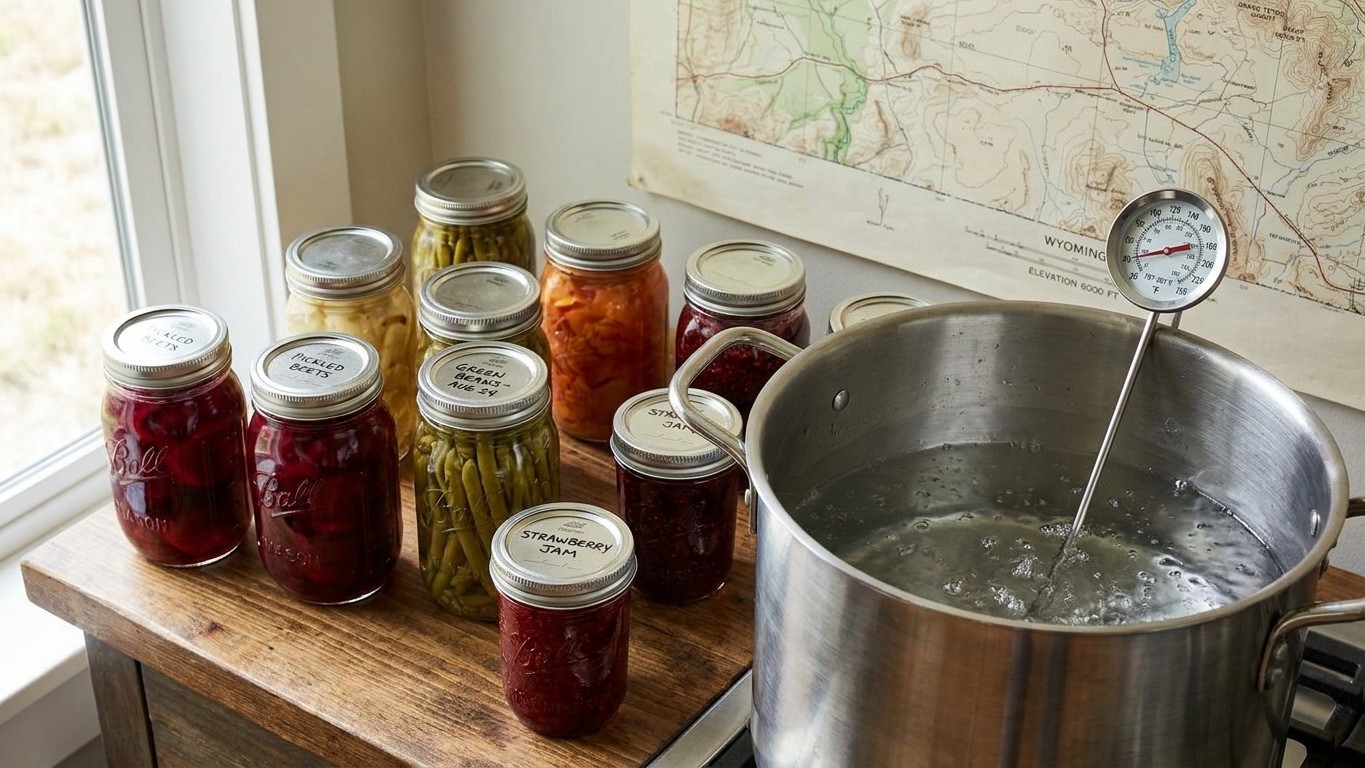

Cheyenne sits at 6,089 feet, right in the 6,000-8,000 foot band where water boils somewhere between 197°F and 201°F instead of the 212°F most canning recipes assume. That gap is the whole story: a cooler boil processes food less effectively, so every boiling-water and pressure-canning time in a standard recipe needs adjusting. Wyoming, though, is not one elevation. It’s a patchwork, and your own number is what counts.
The short answer

Cheyenne, Wyoming’s capital, sits at 6,089 feet above sea level. At that height, water reaches a rolling boil somewhere between 197°F and 201°F, not the 212°F you’d get at the coast. That range comes straight from the USDA’s published boiling-point tables, and it lands Cheyenne squarely in the 6,000 to 8,000 foot altitude band that home canning guides treat as its own category.
Does that matter for you? It depends entirely on where you actually live, not on where the state capital sits. A homesteader canning green beans at 3 feet above sea level near a river bottom in another state wouldn’t need to touch a single recipe. But at 6,000 feet, the picture flips completely. Every jar of low-acid vegetables, every batch of salsa, every quart of tomatoes needs either a longer stretch in the boiling-water canner or more pressure in the pressure canner, because the water simply isn’t getting as hot before it starts to boil.
Why the reference city matters and why it isn’t your answer
Cheyenne gets named here because it’s a fixed, well-documented point, useful for illustrating how the math works. It is not a stand-in for the whole state. Wyoming runs from river valleys in the east to mountain towns pushing past 7,000 and 8,000 feet in the west. A property in Casper sits at a different elevation than one in Jackson, and both differ from Cheyenne. The boiling-point figures above describe what happens at Cheyenne’s specific elevation band. If you live at 2,000 feet, they don’t apply to you at all. If you live at 7,500 feet, you’re in a different, more demanding altitude band than Cheyenne’s, and your adjustment will be larger.
This is the piece that trips people up most often: they read that Wyoming is a “high altitude state,” grab the nearest chart, and assume one number covers the whole map. It doesn’t. The mechanism is universal, but the specific number you plug into a recipe is tied to your own elevation, measured at your own kitchen, not at the capitol building.
Why a lower boil is a weaker process
Water’s boiling point isn’t fixed at 212°F. It’s fixed at 212°F only at sea level, where atmospheric pressure is pushing down hardest on the surface of the liquid. Climb higher and that atmospheric pressure drops, which makes it easier for water molecules to escape into vapor. The water starts boiling at a lower temperature because it takes less energy to get there. At Cheyenne’s elevation, that’s the 197°F to 201°F range instead of 212°F.
Here’s the part that surprises a lot of home canners: boiling water harder doesn’t make it hotter. Crank the burner to its highest setting, watch the pot roil and churn, and the thermometer still reads the same number. Once water is boiling, added heat just makes it boil more vigorously and evaporate faster. It cannot push the temperature past its boiling point at that elevation. So a vigorous, aggressive boil at 6,000 feet is still only around 197°F to 201°F, no matter how it looks in the pot.
That matters because the entire safety logic of home canning rests on heat killing microorganisms, including the spores that produce botulinum toxin in low-acid foods. A process built around a certain temperature held for a certain time assumes that temperature is actually being reached. Drop the temperature by even a few degrees, and the same processing time no longer delivers the same lethality. The food might look identical coming out of the canner. The bacteria inside tell a different story.
The fix isn’t a hotter fire. It’s more exposure. In a boiling-water canner, tested recipes add extra minutes at altitude, giving the lower-temperature boil more time to do the job a hotter boil would have done faster. In a pressure canner, the adjustment works differently: raising the pressure inside the sealed canner raises the temperature the steam can reach, independent of what plain boiling water does at that elevation. Either way, the compensation is built into the recipe’s tested numbers, not improvised at the stove.
Finding your own elevation
- Start with a source built for the job. The National Center for Home Food Preservation publishes a “Find Your Elevation” page specifically so home canners can get an accurate number without guessing.
- Search by your town, county, or the nearest landmark rather than relying on a statewide figure. Elevation can shift by hundreds of feet within a short drive in much of Wyoming.
- Note the number in whole feet. You don’t need decimal precision, but you do need to know which altitude band you fall into, since canning charts are organized in bands rather than exact feet.
- Double-check against a second source if the number seems surprising, such as a GPS device, a topographic map, or a local extension office that already fields this exact question during canning season.
- Write your elevation somewhere permanent, like inside the cover of your canning notebook or taped to the inside of a cupboard. You’ll need it every single time you can, not just once.
- Reassess only if you move. Elevation doesn’t change with the seasons or the weather, so once you’ve confirmed it, that number is settled for as long as you’re canning at that address.
The reason this step comes before anything else is simple: every adjustment downstream, whether it’s added minutes in a boiling-water bath or added pounds of pressure, is keyed to your elevation band, not to a general sense of “living somewhere high up.” Two households twenty miles apart in Wyoming can land in different bands and need different adjustments. Skipping this step means every other step is a guess.
What goes wrong
- An under-processed jar that looks perfectly normal. The lid seals, the liquid looks clear, the seal pops when pressed. None of that confirms the contents reached a safe temperature for long enough. The remedy is following the tested time and pressure for your actual elevation band, every time, rather than trusting appearance as a stand-in for a working thermometer and a working process.
- A recipe pulled from a sea-level source. Old family recipes, older cookbooks, and recipes shared from friends at lower elevations often carry processing times calculated for 212°F boiling water. Used unchanged at 6,000 feet or higher, they under-process the food. The remedy is checking every borrowed recipe against a current, altitude-adjusted version from a tested source before it goes anywhere near your canner.
- A pressure gauge read as if elevation didn’t exist. Pressure canning charts assume a baseline atmospheric pressure that shifts as you climb. Setting a canner to a sea-level pressure figure while canning at altitude means the interior of the canner never reaches the temperature the recipe was designed around. The remedy is using the pressure figure listed for your specific elevation band, not the figure printed for general use.
- Treating “close enough” elevation as good enough. Rounding 6,400 feet down to “about 6,000” can push a jar into the wrong band if the true number sits nearer the next threshold up. The remedy is using the exact figure from a dedicated elevation lookup rather than an estimate based on memory or a neighboring town.
Where the exact adjustment comes from
This page won’t hand you a processing time or a pressure figure, and that’s deliberate. Those numbers belong to a specific tested recipe for a specific food, and they change depending on whether you’re canning green beans, salsa, or peaches. The right place for that figure is the National Center for Home Food Preservation, which publishes tested, altitude-adjusted processing guidance for individual foods.
The reason this can’t be shortcut or estimated is that the stakes involved are invisible. Botulinum toxin, the danger at the center of low-acid home canning, has no taste and no smell. A jar that’s under-processed by even a small margin can look, smell, and taste exactly like a safely processed one. There’s no sensory check that catches the mistake before it’s on the table. That’s why the adjustment has to come from a tested source matched to your food and your elevation, not from a general rule of thumb applied across the board.
Common questions
Does my exact address matter, or is county-level elevation close enough?
Your exact address matters more than most people expect, especially in a state with as much elevation variation as Wyoming. A county can span multiple altitude bands. Use a lookup tied to your specific location rather than a countywide average.
Do I need to adjust for altitude if I only make jams and jellies?
High-acid foods like jams processed in a boiling-water canner are still affected by the lower boiling point at altitude, since the process still relies on reaching and holding a specific temperature range. Check a tested, altitude-adjusted recipe rather than assuming acid content alone makes the adjustment unnecessary.
Can I just add extra time to be safe, without checking the exact figure?
Guessing at extra time isn’t a reliable substitute for the tested figure for your food and elevation band. Too little added time leaves the risk unaddressed; the safer approach is using the specific adjustment published for your food rather than an arbitrary buffer.
Does elevation change anything about how I use a boiling-water canner versus a pressure canner?
Yes. A boiling-water canner is adjusted by adding processing time, since the water inside can’t get hotter than its altitude-limited boiling point. A pressure canner is adjusted by increasing pressure instead, which raises the internal temperature independent of how plain water behaves at your elevation.