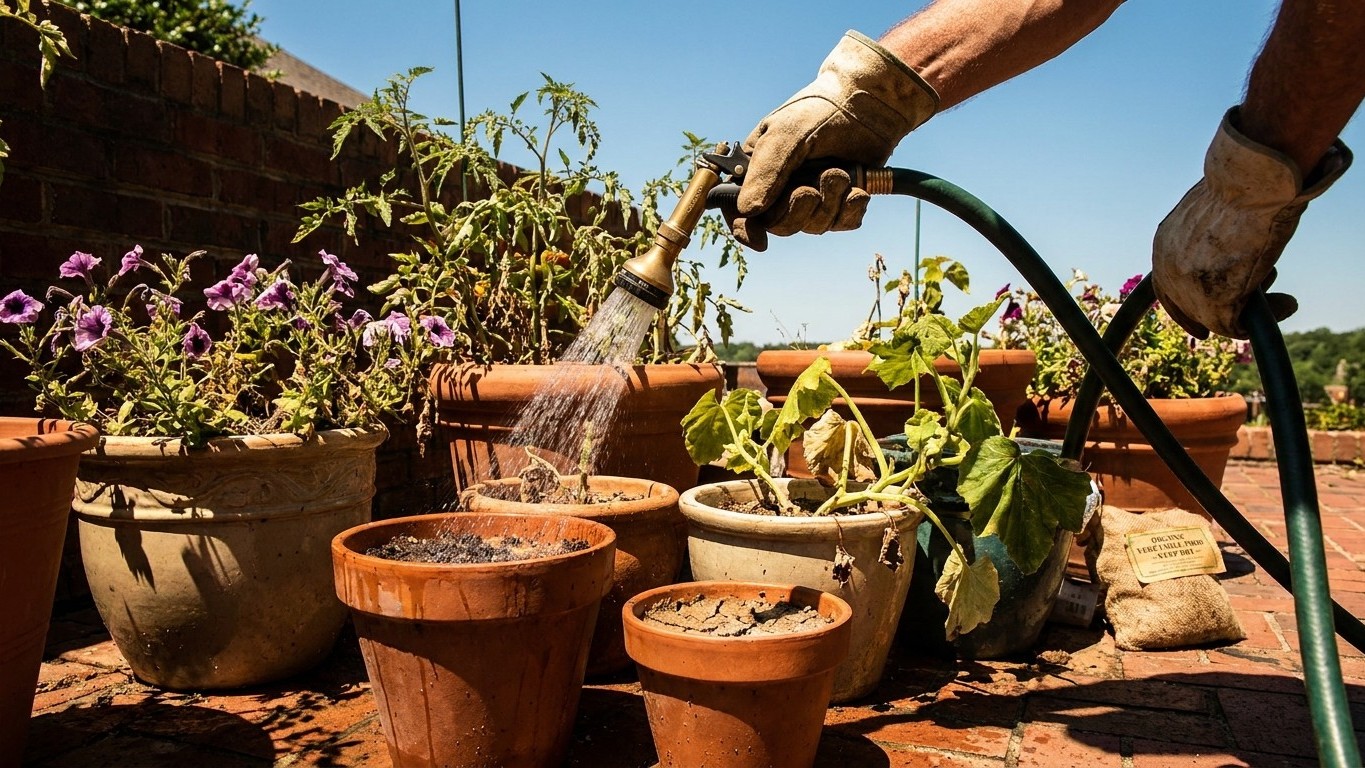

August is the driest month of an Alabama summer, delivering just 3.55 inches of rain on average, while the state logs 58.5 days a year at or above 90F. Put those two numbers side by side and the message is simple: the sky isn’t giving Alabama gardens enough water during the hottest stretch of the year, and the heat is pulling moisture out of the soil faster than most people expect.
What changes here

A vegetable bed or a young shrub border wants roughly an inch of water a week to keep growing steadily. In August, the driest summer month at the reference station, Alabama receives 3.55 inches of rain across the entire month. Spread that over the four-plus weeks of August and the sky is supplying somewhere around 0.8 inch per week, not the full inch a bed typically needs. That leaves a gap of about 0.2 inch that has to come from a hose or a drip line if the plants are going to keep pace.
June and July aren’t much better cushioned. June averages 4.06 inches and July 4.49 inches, both higher than August, but the 58.5 days a year that hit 90F or above are concentrated across those same three months. Heat this persistent drives evaporation from both soil and leaf surfaces, so even a slightly wetter month than August doesn’t necessarily translate into less watering. A thunderstorm that drops half an inch in twenty minutes often runs off a compacted or sloped bed rather than soaking down to where roots actually sit.
This is where soil texture starts to matter more than the rain gauge. The same inch of water that soaks into loose, sandy ground within a day can sit on heavy clay for the better part of a week. A gardener working sandy soil in an Alabama summer is effectively fighting on two fronts: less water held per rainfall, and more of it lost to heat before roots can use it. A gardener on clay has the opposite problem, holding on to moisture long enough that overwatering, not drought, becomes the real risk. Either way, the 3.55-inch August figure is a regional average from a single reference station over the 1991-2020 period, not a promise about what falls on any one property. A rain gauge staked in the actual garden is the only way to know what a particular bed is really getting.
How to water when it matters
The method that works in an Alabama summer isn’t complicated, but it has to account for the heat load behind that 58.5-day figure. Watering deeply and infrequently, rather than a little bit every day, pushes roots downward in search of moisture instead of letting them cluster near a surface that dries out within hours of 90F sun. Watering at the base rather than overhead keeps water where roots can use it instead of losing a chunk of it to evaporation before it ever reaches soil. Morning watering matters because it gives the plant a full day to take up moisture before the evening heat and humidity common to Alabama summers set in, and it leaves leaves dry well before nightfall.
Checking the soil rather than guessing is the part most people skip. A finger or a small trowel pushed two inches down tells the real story; the surface can look and feel bone dry while soil just below it is still holding moisture from the last watering, especially on clay-heavy ground. Skipping that check is how gardens end up overwatered on clay and underwatered on sand in the same neighborhood.
- Push a finger or trowel two inches into the soil near the root zone; if it’s dry at that depth, it’s time to water.
- Water at the base of the plant, slowly enough that it soaks in rather than runs off, aiming for roughly one inch total per week as a starting point.
- On sandy soil, split that inch into two shorter, more frequent soakings rather than one large one, since sandy ground can’t hold a full week’s worth at once.
- On heavy clay, water less often but let it run longer each time, and wait until the two-inch check comes up dry before watering again to avoid drowning roots.
- Water in the early morning, before the day’s heat builds, so moisture reaches the roots instead of evaporating off the surface.
The one-inch-a-week figure is a starting point, not a fixed rule. Alabama’s driest summer month only supplies about 0.8 inch of that from rainfall, so the finger test in a specific bed, not a calendar or a sprinkler timer, is what should decide whether that particular week needs the full inch or less.
What goes wrong
Watering a little every day
A light daily sprinkle feels responsible, but it only ever wets the top inch or so of soil. Roots follow the water, staying shallow and close to the surface, exactly where 90F afternoons bake the ground hardest. When a hot spell hits, those shallow roots have nowhere to draw from and the plant wilts fast, even though it’s been watered every single day.
Watering leaves in the evening
Wetting foliage after work, once the sun has dropped, leaves water sitting on leaves through the warm, humid Alabama night. That combination of standing moisture and heat is close to ideal for fungal disease to take hold, and by morning the damage is already starting even though the watering felt thorough.
Trusting a rain shower that didn’t really soak in
A brief summer storm can look convincing from a window and still only wet the top half-inch of soil, especially on compacted ground where most of the water runs off before it penetrates. Skipping a watering because “it rained” without checking two inches down with a finger is one of the more common ways an Alabama garden ends up drought-stressed in the middle of a wet-looking week.
Leaving mulch off in peak heat
Bare soil under 90F sun loses moisture fast, sometimes undoing a good soaking within a day or two. A two- to three-inch layer of mulch slows that loss, keeping the soil cooler and holding onto water longer, which matters most in a month like August when rainfall is already running short of what a bed needs.
Local help
The Alabama Cooperative Extension System offers county-level guidance on soil, watering schedules and plant selection suited to local conditions. Watering restrictions vary by water utility and can change with drought conditions, so check with a local water provider or municipal water department for current rules before setting up any watering schedule.
Common questions
How much should I water my garden per week in Alabama?
About one inch per week is a common starting point, but during August, when the region averages only 3.55 inches of rain for the whole month, most of that inch has to come from supplemental watering rather than rainfall.
Why does my Alabama garden wilt even after it rains?
A summer storm often only wets the top half-inch of soil before running off, especially on compacted ground. Checking two inches down with a finger shows whether the water actually reached the root zone.
Should sandy or clay soil be watered differently in Alabama?
Yes. Sandy soil drains quickly and needs shorter, more frequent watering, while clay holds moisture for days and needs longer waits between waterings to avoid drowning roots.
What time of day is best to water in Alabama’s summer heat?
Morning, before the day’s heat sets in. It gives roots time to absorb water before evaporation from 90F-plus afternoons kicks in, and keeps leaves dry well before nightfall.