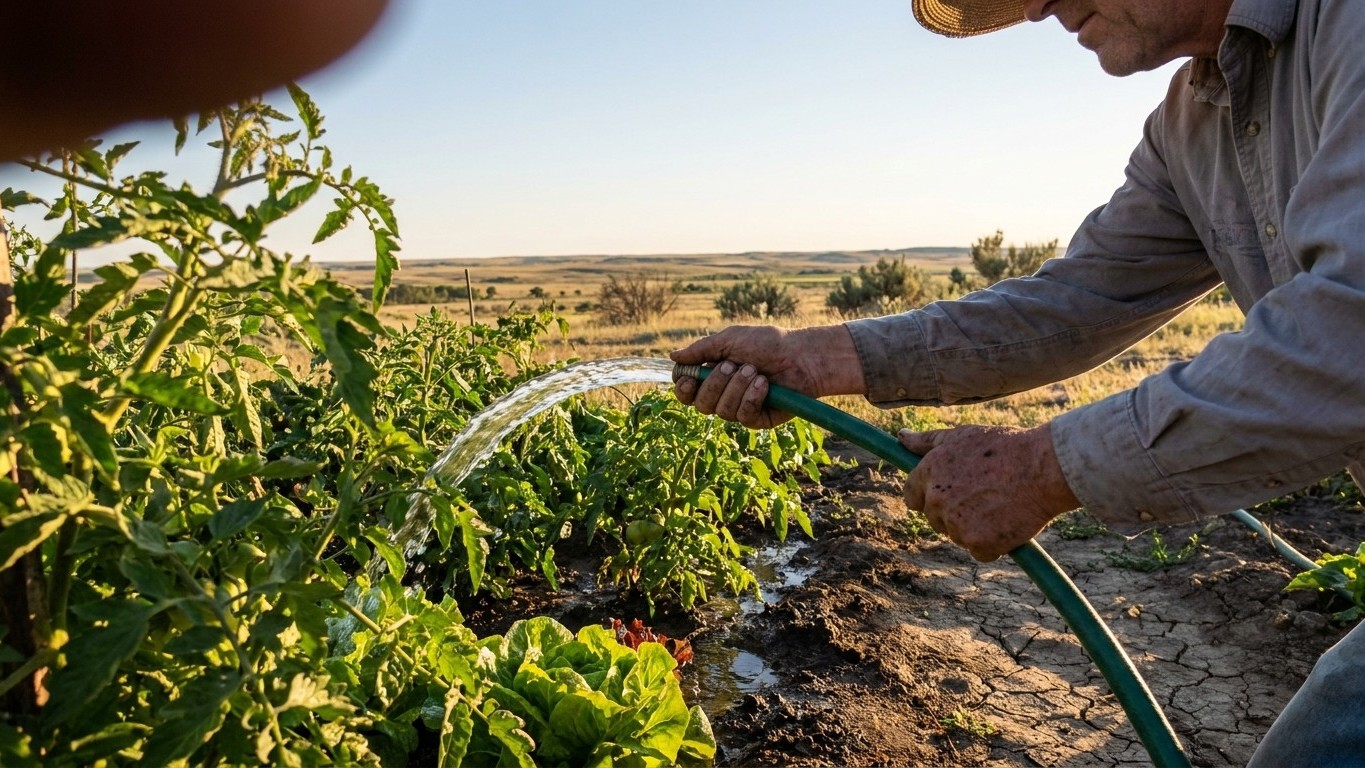

Alberta’s growing season looks generous on a map but thin in a rain gauge. The driest summer month here delivers just 2.24 inches of rain, and the heat load that usually forces gardeners into daily watering barely exists in this province. That combination changes the math on how much water a bed actually needs, and when it needs it most.
What changes here

Two numbers set the terms for every watering decision in this territory. The driest summer month, August, brings 2.24 inches of rain to the ground around the Calgary reference station. And the average number of days a year that reach 90F is 0.0 (Environment and Climate Change Canada, Canadian Climate Normals 1981-2010, Calgary Int’l A). Read together, those figures describe a dry-summer territory that isn’t a scorching one. Water demand here comes from a rainfall shortfall, not from heat driving plants to wilt by mid-afternoon.
Do the arithmetic and the gap becomes concrete. A vegetable bed or perennial border wants roughly an inch of water a week to keep growing without stress. August’s 2.24 inches, spread across a month of roughly four and a half weeks, works out to about half an inch of rain arriving from the sky in an average week of the driest stretch of summer. That leaves the gardener responsible for the other half inch, by hose or drip line, every week August runs.
June averages 3.7 inches for the month, close to a full weekly inch spread across four weeks, so June asks far less of a gardener than August does. July sits in between at 2.58 inches. The season doesn’t dry out evenly; it tightens as summer goes on, and August is when a garden left on autopilot starts to show it.
The zero days above 90F matters as much as the rainfall figure, because it changes what kind of problem this is. In a region with dozens of days over 90F, missed water shows up fast, as scorched leaves and wilted stems within hours. Here the stress builds slowly and is easy to miss: a rain shortfall of about half an inch a week compounds over July and August into a real deficit by Labor Day, even though no single day looked alarming. The plant doesn’t collapse. It just stops growing as well as it could, and a gardener watching for wilting on a 90F afternoon that never arrives can miss the signal entirely.
How to water when it matters
The rainfall figures above set the deficit; the method fills it without wasting water or inviting problems the sky isn’t causing. Three habits do the job here: water deep rather than often, aim at the soil rather than the foliage, and water in the morning rather than in the evening.
Deep watering pushes moisture several inches into the ground, which pulls roots down after it. A plant with roots four to six inches deep can ride out a dry week between waterings; a plant with roots kept at the surface by frequent shallow sprinkling has nothing to draw on the moment the top inch of soil dries out, which in an August already running at half the weekly water target can happen within a day or two. Watering at the base rather than overhead keeps leaves dry, and dry leaves don’t develop the fungal problems that start on wet foliage overnight. Morning watering gives that moisture time to soak down before the day’s evaporation picks up, and any water that does land on leaves dries within hours instead of sitting through the cool of the night.
None of that tells a gardener whether the soil is actually dry at root depth. The surface can look parched while roots two inches down are still moist, or look fine while roots are starving just below that. A finger pushed two inches into the soil, or a trowel turned to check, answers the question a glance at the surface can’t.
Soil type changes the rhythm more than any calendar rule can. Sandy soil holds water briefly and drains fast, so it needs shorter, more frequent soakings to keep pace with an August that’s already short by half an inch a week. Heavy clay holds a week’s worth of water but drowns roots if it’s watered again before that supply has drained and dried, so the same deficit gets filled with fewer, deeper sessions. Use the sequence below as a starting point, then adjust to what the finger test shows on your own ground.
- Check soil moisture two inches down before watering; skip the session if it’s still damp.
- Water at the base of the plant, early morning, until the top six inches of soil are moist.
- On sandy soil, repeat every two to three days through August; on clay, stretch to once a week.
- Add a soaking whenever a week passes with less than an inch combined from rain and irrigation.
What goes wrong
Watering a little every day
A quick sprinkle each evening feels responsible, but it wets only the top inch or two of soil. Roots follow the water and stay shallow, so the moment a hot, dry stretch hits, there’s no reserve underground to draw on. In a territory where the driest month is already covering only about half the weekly one-inch target, shallow daily watering is the mistake that costs the most, because it wastes the little natural rainfall that does arrive by never letting it reach where roots actually live.
Wetting the leaves at night
Overhead watering after dinner leaves foliage damp through the cool overnight hours, which is exactly the window fungal spores need to establish. The water never reaches evaporating conditions before morning, so it sits on the leaf surface for eight or nine hours instead of drying within an hour or two, as it would after a morning soak.
Trusting a rain shower
A ten-minute summer shower looks like it solved the problem, but it often wets only the top half inch of soil before the rest runs off or evaporates. Checking with a finger two inches down after a rain, rather than assuming the garden is covered, catches the gap before the plants show it.
Skipping the mulch
Bare soil gives back moisture to the sun almost as fast as it’s applied. A two- to three-inch layer of mulch slows that loss, which matters most in a month like August where every fraction of an inch of water has to be supplied by hand rather than by the sky.
Local help
Alberta’s provincial agriculture office, Agriculture and Irrigation, is the starting point for growing-season guidance specific to the province. Watering restrictions during dry stretches vary by municipality and by water provider, so check with your local utility for the rules in effect before setting a summer watering schedule.
Common questions
How much should I water my garden each week in Alberta?
Aim for about an inch total between rain and irrigation. In August, the driest summer month, roughly half an inch arrives as rain, so plan on supplying the other half by hose or drip line.
Does Alberta get hot enough to need daily watering?
Rarely. The reference station’s normal is 0.0 days a year above 90F, so heat-driven wilting is uncommon. The bigger issue is a steady rainfall shortfall through the summer, which calls for deep, less frequent watering rather than daily sprinkling.
How do I know if my soil is sandy or clay-heavy?
Squeeze a moist handful. Sandy soil falls apart immediately and drains within hours of watering. Clay holds its shape, feels sticky, and stays damp for days, which means it needs watering far less often than sandy ground.
Is it better to water in the morning or evening?
Morning. It gives water time to soak to root depth before the day’s evaporation and dries any moisture that lands on leaves within a few hours, instead of leaving foliage wet overnight where disease takes hold.