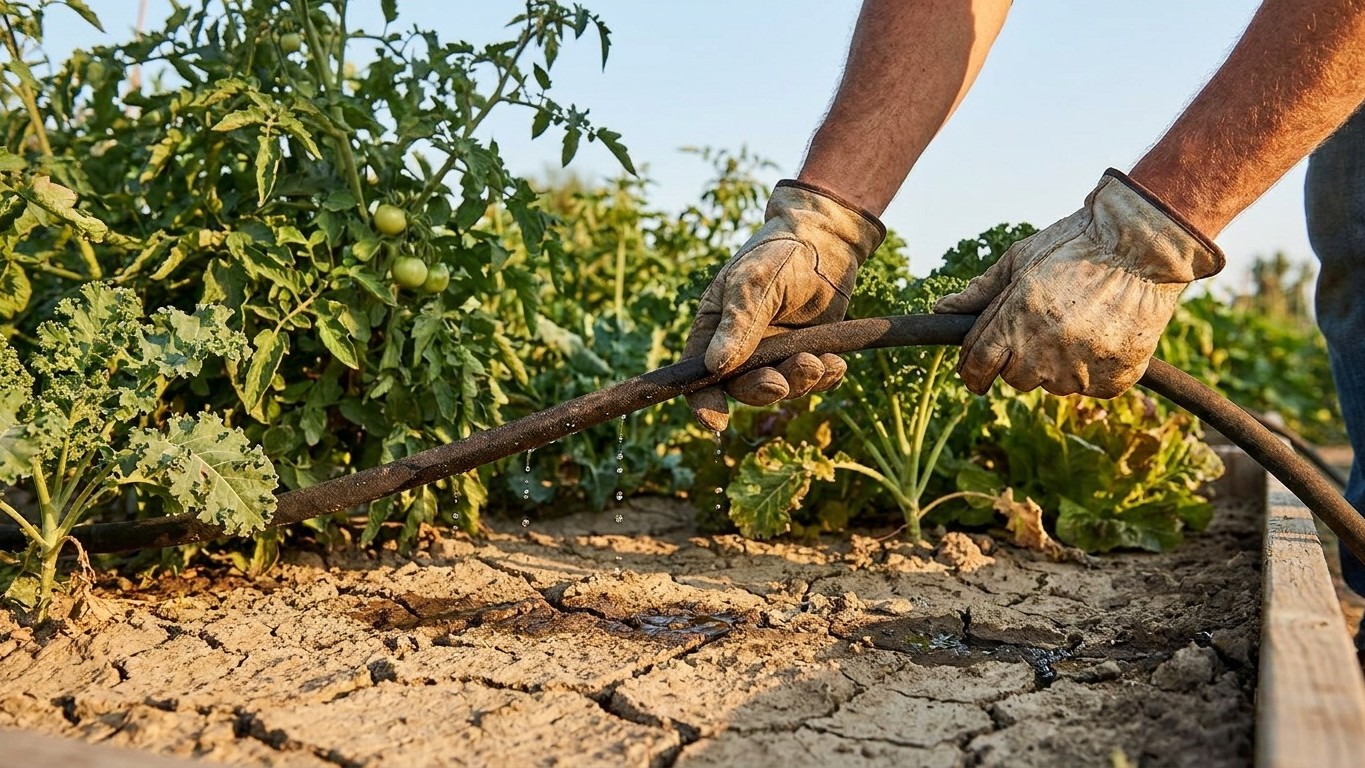

California’s driest summer month brings 0.0 inches of rain, and the reference station averages just 2.4 days a year at or above 90F. That combination means gardens here don’t fail from extreme heat waves so much as from weeks of dry ground with almost no help from the sky. Watering through a dry spell in this state is less about survival mode and more about a steady, deliberate rhythm.
What changes here

Two numbers set the terms for a California garden in summer: 0.0 inches of rain in August, the driest month, and 2.4 days a year that reach 90F or higher. Together they mean a garden bed here gets no meaningful rescue from storms during the hottest stretch of the year, even though the heat load itself, measured this way, is modest rather than punishing.
Do the arithmetic on what a typical bed actually needs. Most vegetable and flower beds want roughly an inch of water a week to keep roots supplied. In an average week of August, the sky delivers essentially none of that inch, since the whole month averages 0.0 inches. That leaves the full inch, all of it, to be carried by the gardener with a hose, a can, or a drip line. Compare that to June, where the month averages 0.08 inches, or July at 0.04 inches. Neither figure changes the picture much: across the entire summer, June through August, the region averages only about 0.1 inch of rain total, against 12.2 inches for the full year. Nearly all of California’s water for the year falls outside the growing season that matters most to a vegetable patch or a flower bed.
That inch of water, once you supply it, behaves differently depending on what it lands on. A sandy soil lets water pass through within a day, so the same inch disappears from the root zone faster and needs replacing sooner. A heavy clay soil holds that inch far longer, sometimes close to a week, but it also seals over and sheds water if it isn’t given time to soften first. No soil-texture figures are specific to every yard in this state, so treat your own ground as the deciding factor: dig a small hole after watering and see how the water moves before you settle into a schedule.
How to water when it matters
The method that works with this climate is deep, infrequent watering at the base of the plant, done in the morning. Deep watering pushes roots downward, chasing the moisture front instead of camping near the surface where the top inch dries out within hours on a summer day. Infrequent watering, rather than a daily splash, lets the soil surface dry between sessions, which discourages the fungal problems that thrive in soil that never gets a chance to breathe. Watering at the base, instead of overhead, means the water goes where roots can use it rather than evaporating off leaves in the low humidity typical of a California summer afternoon. Morning watering matters because the plant gets a full charge of moisture before the day’s heat and the modest but real 2.4 days a year of 90-plus temperatures pull moisture back out through the leaves.
Checking soil moisture at root depth, not just at the surface, is the habit that separates a garden that survives August from one that struggles. Push a finger two inches into the soil near the base of a plant, or use a small trowel if the ground has firmed up. If it feels dry at that depth, it’s time to water. If it’s still cool and slightly damp, wait another day, even if the surface looks pale and dusty.
- Check the soil two inches down with a finger or trowel before watering, rather than watering on a fixed calendar.
- Apply roughly one inch of water per week to an established bed, delivered in one or two deep sessions rather than several light ones.
- On sandy soil, split that inch into shorter, more frequent soakings, since water drains through within a day and the root zone empties quickly.
- On heavy clay soil, water less often but let each session run slowly, since the ground can hold a week’s supply but drowns roots if watered again before it has had time to dry.
- Water in the early morning so the plant enters the heat of the day already supplied, and so any water that touches leaves has hours to dry before evening.
Treat the one-inch-a-week figure as a starting point, not a rule carved in stone. A raised bed with loose, amended soil will drink faster than a compacted clay yard even two properties apart, so adjust after a season of checking the ground yourself rather than trusting the number alone.
What goes wrong
Watering a little bit, every single day
A light daily sprinkle feels responsible, but it wets only the top inch of soil and trains roots to stay shallow, right where the day’s heat bakes them hardest. With almost no summer rain to reinforce deeper moisture, on top of habitual shallow watering, that root system never develops the depth it needs to ride out even a mild dry stretch.
Watering the leaves in the evening
Wetting foliage after work feels convenient, but water left sitting on leaves overnight, without sun or wind to dry it, gives fungal spores exactly the damp window they need to take hold. In a state that already sees so little summer rain, an evening habit like this introduces the one kind of moisture problem the climate otherwise avoids.
Trusting a rain shower that barely wet the surface
A quick summer shower can look like relief, but if it only dampened the top half-inch of soil, it did nothing for roots sitting two or three inches down. Given that August here averages 0.0 inches of rain, any shower that does appear is easy to overtrust. Check with a finger before skipping a scheduled watering, rather than assuming the sky did the work.
Leaving the soil bare under the sun
Skipping mulch means the sun pulls back much of the water just applied, since bare soil loses moisture to evaporation far faster than soil with a two- to three-inch layer of mulch on top. In a region where the driest month contributes nothing at all in rainfall, that evaporation loss is the single easiest thing to prevent and the one most gardeners forget.
Local help
The University of California Agriculture and Natural Resources extension network offers region-specific guidance for gardeners across the state, including advice tailored to local soil and climate conditions. Watering restrictions vary by water district and change from year to year depending on supply, so check current rules directly with your local water provider before setting a summer schedule.
Common questions
Does California get any summer rain at all?
Very little. June averages 0.08 inches, July 0.04 inches, and August, the driest month, averages 0.0 inches at the reference station, so gardens depend almost entirely on hand or drip watering through summer.
How many extremely hot days should I plan around?
The reference station averages 2.4 days a year at or above 90F, a modest figure that means most summer watering decisions come down to dry soil and low rainfall rather than sustained extreme heat.
Is drip irrigation worth it here?
Given how little rain falls in summer, drip irrigation’s steady, low-waste delivery to the root zone suits this climate well, since almost none of a plant’s water will otherwise come from the sky between June and August.
Can I water less if I use mulch?
Mulch reduces evaporation and can stretch time between waterings, but it doesn’t replace the roughly one inch a week most beds need. Check soil moisture at root depth before assuming mulch alone has covered the gap.