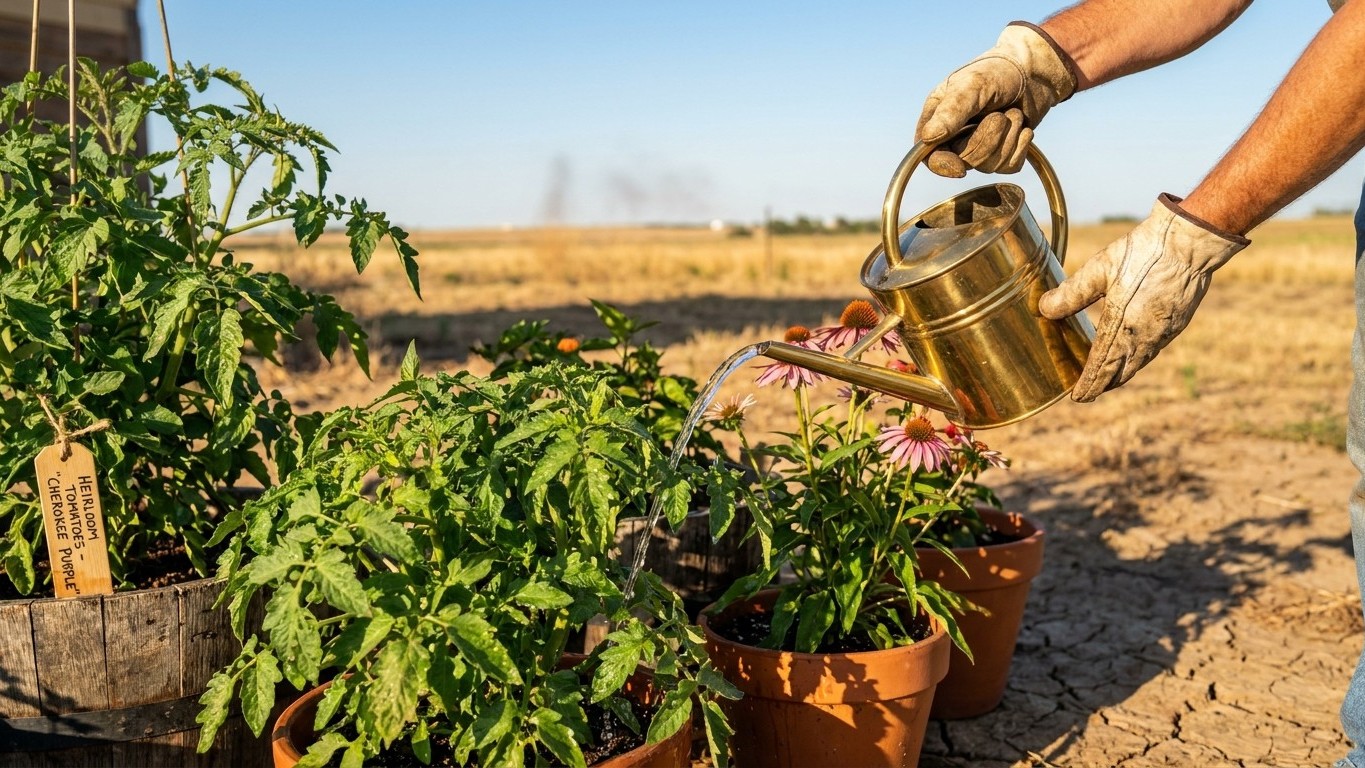

Kansas summers put a garden’s watering plan under real pressure: July, the driest month, brings only 3.98 inches of rain, while the mercury clears 90°F on 57.6 days a year at the reference station. Together those numbers mean the sky covers most of a garden’s weekly need in July, but the extra evaporation from all that heat closes the gap fast, so the watering can still does real work.
What changes here

Start with the two figures that matter most for a Kansas garden: 3.98 inches of rain in July, the driest of the summer months, and 57.6 days a year that reach 90°F or higher. Read together, they say something specific: the sky delivers a fair amount of water during the driest stretch of summer, but the heat load that comes with it pulls moisture back out of the soil faster than most gardeners expect. A bed of vegetables or perennials wants roughly an inch of water a week to keep growing without stress. Divide July’s 3.98 inches across the month, and it works out to about 0.9 inch of rain in an average week, close to the target, but not quite there, and that’s before accounting for how unevenly it falls.
That’s the arithmetic trap. Kansas rain in summer tends to arrive as thunderstorms, a heavy burst followed by days of nothing, rather than a steady drizzle spread evenly across the week. A storm that drops half an inch in twenty minutes doesn’t soak a garden bed the way half an inch over six hours would. Much of it runs off the surface or evaporates before it reaches root depth, especially with 57.6 days a year pushing past 90°F and pulling moisture out of the top few inches of soil almost as fast as it lands. So the 0.9 inch of “average” July rain is a number on paper. In practice, a gardener is often making up more of that inch-a-week target than the raw rainfall figure suggests, particularly in weeks that don’t get a storm at all.
Soil texture changes how far that shortfall goes. A sandy plot drains a rainstorm’s inch within a day, leaving the root zone dry again well before the next watering is due. A heavy clay bed holds onto that same inch for the better part of a week, but it can also drown roots if more water gets added before the clay has had a chance to dry partway down. Neither soil type changes the rainfall Kansas gets. Both change how much of it actually reaches the roots when it’s needed, and how often the gardener needs to step in with a hose.
How to water when it matters
The method that works with Kansas summers is deep, infrequent watering at the base of the plant, done in the morning. Each part of that has a reason. Deep watering pushes moisture down past the top few inches, encouraging roots to grow downward where the soil stays cooler and holds water longer, which matters directly given 57.6 days a year above 90°F baking the surface layer. Infrequent watering lets the soil dry out partway between sessions, which is what pushes those roots down in the first place. Watering at the base, rather than overhead, means the water goes where the roots are instead of evaporating off leaves in the afternoon heat. Morning watering gives the plant a full day to draw up the moisture it needs before the heat peaks, and lets any water that does land on foliage dry off quickly, rather than sitting overnight.
Checking soil moisture at root depth, not just at the surface, is the piece most gardeners skip. The top inch of Kansas soil can look and feel dry within hours of a July storm, even when there’s plenty of moisture two or three inches down. Push a finger or a trowel two inches into the bed before deciding to water. If it’s cool and slightly damp at that depth, the plant doesn’t need water yet, no matter how dry the surface looks.
Soil texture sets the rhythm from there. Sandy ground holds little water and drains fast, so it asks for shorter, more frequent soakings rather than one big weekly dose. Heavy clay holds a week’s worth of water but punishes overwatering, since roots sitting in saturated clay for days at a time can rot before the excess ever drains away.
- Check the soil two inches down before watering; if it’s still cool and damp, wait another day.
- Water at the base of the plant, not overhead, using a soaker hose, drip line, or the spout of a watering can held low.
- Water in the morning, before the heat of the day sets in, so moisture reaches the roots instead of evaporating off wet leaves.
- Aim for a deep soak, roughly one inch of water applied at once, as a starting point to adjust once you’ve seen how your own soil holds it.
- Space out sessions to let the top few inches dry between waterings, shortening the interval on sandy ground and lengthening it on clay.
What goes wrong
Watering a little every day
A light daily sprinkle feels responsible, but it only ever wets the top inch of soil. Roots follow the moisture, staying shallow and close to the surface instead of growing down where the ground stays cool. With 57.6 days a year hitting 90°F or more, that shallow root system bakes fast the moment a watering gets skipped, which is exactly the mistake that costs the most in a Kansas summer.
Watering leaves in the evening
Wetting foliage after dinner, when the temperature is dropping, leaves water sitting on the leaves overnight instead of drying off in the sun. That damp surface is an open invitation to fungal disease, which spreads fastest in warm, humid, still air, exactly the conditions a shaded evening garden provides after a summer thunderstorm.
Trusting the last rain shower
A storm that looks impressive from the porch can still leave the soil dry two inches down. Kansas summer rain tends to fall hard and fast, and a lot of it runs off before it soaks in. Rather than skipping a scheduled watering because it rained, check with a finger or trowel first. If the ground below the surface is still dry, the shower didn’t do the job the sky seemed to promise.
Skipping the mulch
Bare soil between plants gives the sun a direct line to whatever moisture was just applied. A two-to-three-inch layer of mulch slows that evaporation, keeping the soil cooler and wetter for longer between waterings, a real advantage on the days when the thermometer clears 90°F.
Local help
For planting calendars, soil testing, and region-specific advice, the Kansas State University Research and Extension service, reachable at ksre.k-state.edu, is the state’s land-grant resource for home gardeners. Watering restrictions vary by city and water district and change from year to year, so check current rules with your local water provider before setting an irrigation schedule.
Common questions
How much rain does a Kansas garden get in a typical summer?
About 13.2 inches fall across June, July and August combined, with July the driest of the three at 3.98 inches, June at 4.93 inches, and August at 4.3 inches.
How many days a year get hot enough to stress a garden?
The reference station records 57.6 days a year at or above 90°F, a heat load that drives most of the extra watering a Kansas garden needs beyond what rainfall provides.
Is July rainfall enough on its own to skip watering?
Not reliably. July’s 3.98 inches averages out to roughly 0.9 inch a week, close to the inch-a-week target, but it tends to arrive in bursts rather than evenly, so gaps between storms still need checking at root depth.
Does soil type matter more than rainfall in Kansas?
Both matter together. Rainfall sets how much water is available, but sandy soil drains it away within a day while clay holds it for a week, which changes how often a gardener needs to step in regardless of the rain total.