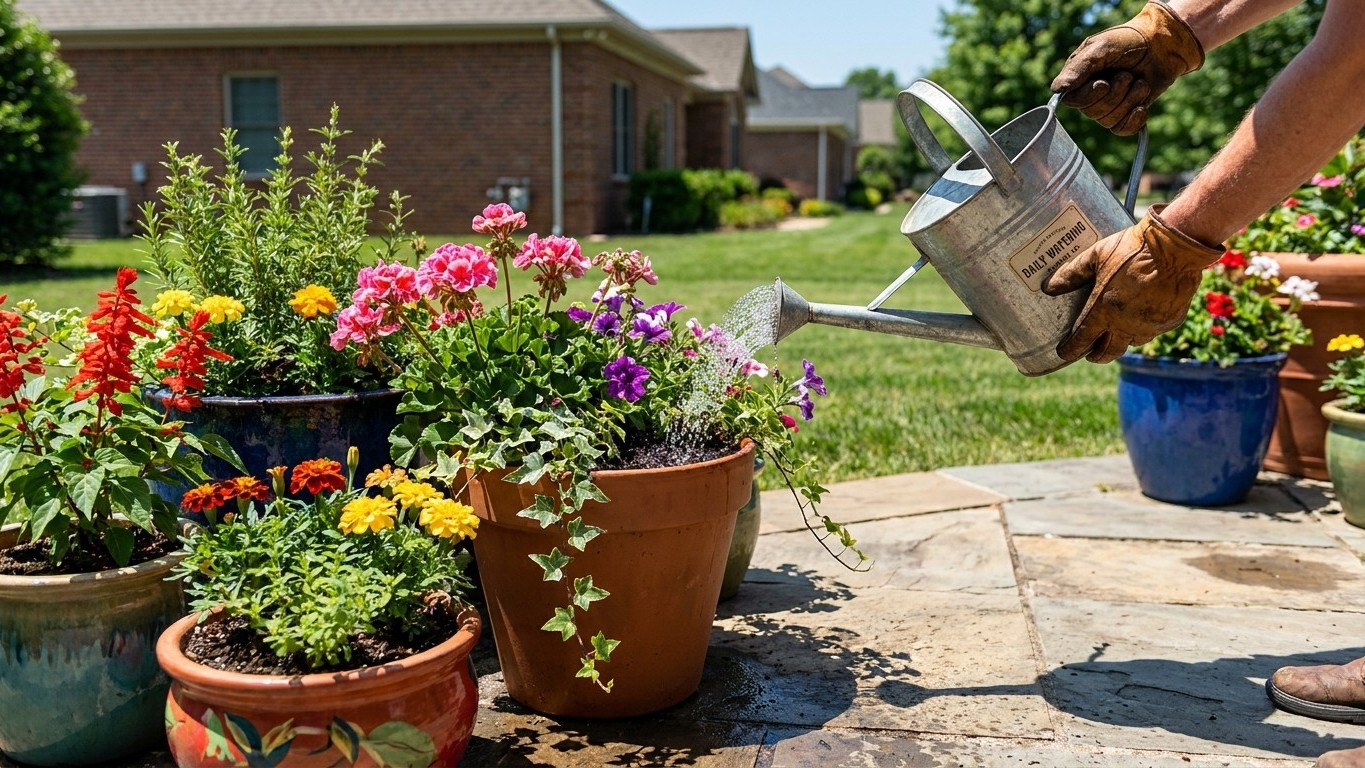

Container gardens in Maryland dry out faster than the ground around them, especially through June and July when heat pushes past 90 degrees on more than three weeks’ worth of days each year. A pot that looks fine at 8 a.m. can wilt by afternoon, so the short answer is: check the mix daily in summer, water when the top two inches feel dry, and never rely on rainfall alone to keep a container hydrated.
What changes here

Two numbers set the terms for anyone watering pots in Maryland. June, the driest summer month, averages 3.98 inches of rain. And the region logs 24.6 days a year at or above 90 degrees. Put together, that means the driest stretch of summer overlaps almost exactly with the highest evaporation demand, the worst possible timing for a container that depends on frequent moisture.
Do the arithmetic on a typical garden bed first, since it shows why containers are a different problem entirely. A bed wants roughly an inch of water a week. June has about 4.3 weeks in it, so 3.98 inches of rain spread evenly works out to roughly 0.93 inch of water arriving from the sky in an average week, close to the full inch a bed needs. That’s the in-ground story.
Containers don’t get to use that math. A pot only catches the rain that falls straight into its own footprint, and most potting mixes, built from peat, bark and perlite rather than native soil, drain within minutes of a soaking. The FACTS for this territory don’t include sand and clay percentages, but the practical takeaway holds either way: treat container mix as behaving like the sandiest end of the spectrum, holding little reserve and needing to be refilled often rather than topped off occasionally. That June rainfall figure that covers 93% of a bed’s needs might supply a 12-inch pot on a covered porch with almost nothing at all.
The heat number matters just as much. Twenty-four and a half days above 90 degrees isn’t spread evenly through the calendar, it clusters in July and August, exactly when a small volume of potting mix has the least buffer against a hot afternoon. A 10-gallon container can lose visible surface moisture within hours on those days, regardless of what the rain gauge said that morning.
How to water when it matters
The method for containers here is still deep and infrequent, watered at the base rather than overhead, and done in the morning, but each of those rules earns its place for a specific reason tied to how a plant actually works. Deep watering pushes moisture through the entire root ball instead of just wetting the surface, which trains roots to grow down and out rather than staying shallow and vulnerable. Morning watering gives leaves and the mix surface time to dry before evening, cutting the window fungal spores need to take hold overnight.
Checking moisture at root depth rather than trusting the surface is the habit that saves the most plants. A finger pushed two inches into the mix, or a wooden dowel pulled out and inspected, tells the real story; a dry crust on top can sit over mix that’s still soaked underneath, and watering on top of that invites root rot.
- Check depth first. Push a finger or trowel tip two inches into the mix before watering anything; if it’s still damp there, wait.
- Water until it drains. Pour slowly at the base until water runs freely from the bottom drainage holes, which confirms the whole root ball got soaked, not just the top inch.
- Time it for morning. Water between roughly 6 and 9 a.m. so foliage and mix surface dry out before the 90-degree afternoons that dominate a Maryland summer.
- Expect daily checks in peak heat. On the days that hit or approach 90 degrees, a small pot in full sun often needs water every single day; start there and adjust based on how fast that particular pot dries.
- Stretch the interval in cooler stretches. When temperatures ease and June-level rain is actually falling, the same container might go two to three days between waterings.
That daily-check starting point is exactly that, a starting point. Pot size, material (unglazed terracotta loses moisture through its walls, plastic and glazed ceramic don’t), and sun exposure all shift the real number, so the finger test stays the final word over any fixed schedule.
What goes wrong
“I water a little every day to be safe”
A light daily sprinkle wets only the top inch of mix, which keeps roots shallow and close to the surface where heat does the most damage. On a day that reaches the 90-degree mark, that shallow root zone is the first thing to bake, and the plant wilts by early afternoon even though it was “watered” that morning.
“I water in the evening so it has all night to soak in”
Evening watering leaves foliage and the mix surface wet through the cooler overnight hours, exactly the conditions fungal disease needs to spread. In a state with 12.6 inches of average summer rainfall already adding humidity, extra overnight moisture from a watering can only stacks the odds further.
“It rained yesterday, so the pots are fine”
A quick summer thunderstorm can look soaking but only wet the top half-inch of mix, especially if a covered porch or eave blocked most of it from ever reaching the container. The only way to know is the same finger check used before watering, not the sound of rain on the roof the night before.
“I skipped mulch because it’s just a pot”
Bare mix exposed directly to sun and to 24.6 days a year of 90-degree heat loses moisture fast through evaporation. A thin layer of mulch or even bark on top of the container slows that loss and reduces how often the pot needs refilling, an easy fix most container gardeners skip.
Local help
The University of Maryland Extension publishes region-specific guidance on container mixes, plant selection and seasonal care for the state. Watering restrictions during dry stretches vary by county and by water utility, so check with the local water provider directly for current rules before setting an automated irrigation schedule for container gardens.
Common questions
How often should I water container plants in Maryland during July and August?
Expect daily watering for small to medium pots in full sun during stretches that reach the 90-degree mark, which happens on 24.6 days a year on average here. Larger containers or shaded spots can stretch to every two or three days.
Does Maryland’s summer rain mean I can skip watering my pots?
Rarely. June’s average of 3.98 inches works out to roughly 0.93 inch a week, close to what an in-ground bed needs, but a container only catches what falls directly into its own footprint and drains fast, so rainfall rarely covers a pot’s full needs on its own.
What size container needs the most frequent watering?
Smaller pots and hanging baskets dry out fastest because they hold less mix relative to their surface area exposed to sun and wind. A 6-inch pot in full sun during a 90-degree stretch can need water twice a day in extreme cases.
Should I water container plants differently than garden beds in this climate?
Yes. Garden beds benefit from the deep, infrequent watering that matches Maryland’s roughly weekly rain pattern, but containers need more frequent checks because their mix holds far less reserve moisture than native soil, regardless of how much rain fell in the yard that week.