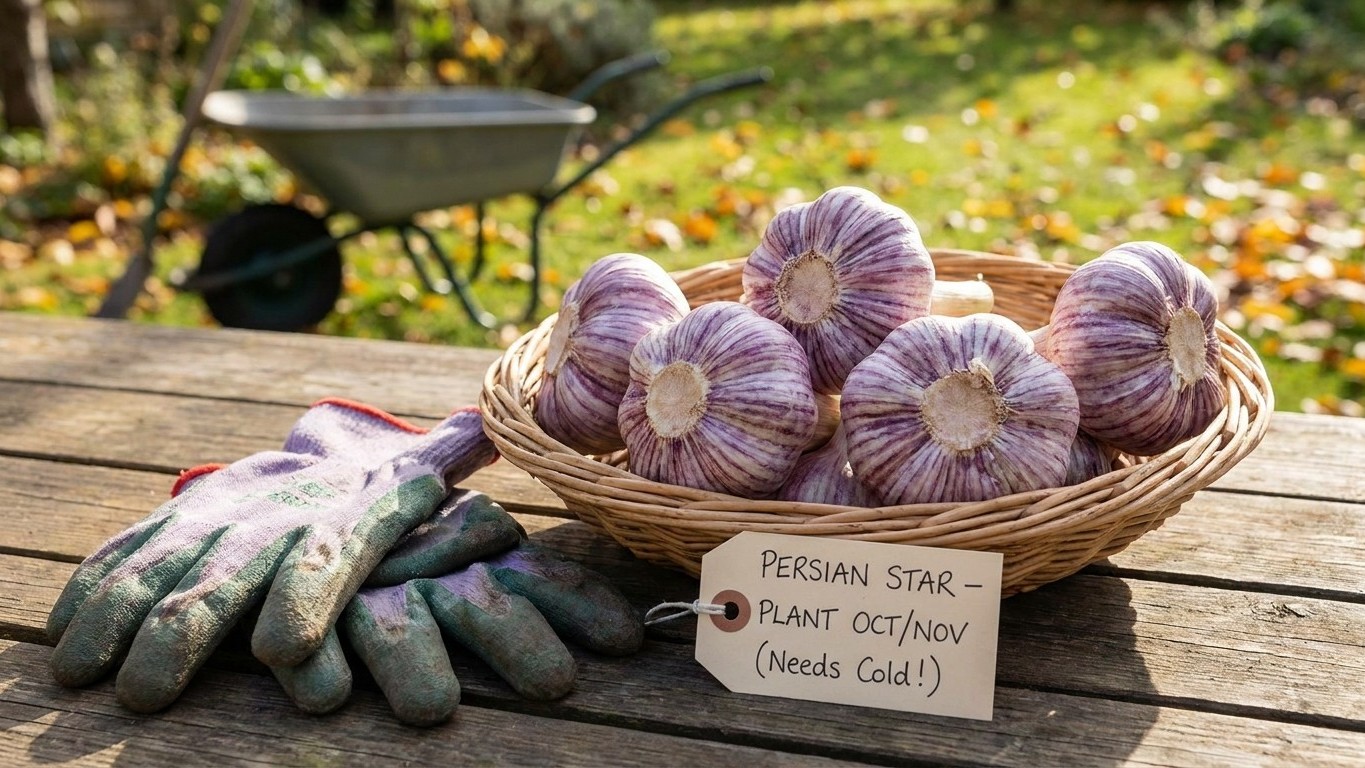

Persian Star is a hardneck garlic in the Purple Stripe family, with plump violet-streaked cloves and a delectable flavor with a mild spice. It goes into the ground in fall, timed off your first frost rather than a calendar date, so roots can establish before the ground locks up. It also needs a real, sustained cold winter or the clove never divides into a head at all. Check your USDA hardiness zone and your local first fall frost date before you order seed stock, because this variety is fussier about winter than most garlic on the shelf.
What Persian Star actually is

Persian Star sits in the Purple Stripe family of hardneck garlics, a group known for showy, marbled wrappers in shades of violet and cream. It is not the mildest garlic you can grow. Seed catalogs typically describe the raw flavor as hot and assertive, mellowing into a rich, almost sweet garlic once cooked, which is why it shows up on menus more often than in raw salsas. Each bulb generally produces a modest number of large, easy-to-peel cloves, a trait Purple Stripes are known for across the type.
Being a hardneck matters more than the color of the wrapper. Hardnecks send up a stiff central stalk, called a scape, that has to be cut off before the bulb finishes sizing. They also do not store as long as softneck garlic, typically holding for a few months in a cool, dry space rather than the better part of a year. If long storage is the priority over flavor, that trade-off is worth weighing before you commit a whole bed to it. For a broader look at how Persian Star compares with other types before you decide, the roundup of garlic varieties lays out the storage and flavor trade-offs side by side.
What Persian Star tastes like, and what to do with it
The heat that catalogs attribute to Persian Star lives mostly in the raw clove, on the first bite before any heat from a stove gets involved. Cooking is what changes that. Heat breaks down the compounds responsible for garlic’s raw sting, so a clove that reads as sharp minced into a dressing turns into something rounder and only mildly spiced once it hits a pan, and sweeter still if you let it roast. That arc is what makes this an all-round garlic with only mild spice: enough presence raw to matter, and enough restraint cooked that it doesn’t overwhelm a dish the way some hardnecks can.
That balance is why it has a reputation as a kitchen staple rather than a specialty clove reserved for one use. Mince it raw into a vinaigrette or salsa when you want the bite up front. Slow-roast a whole head and it softens into a spread with real depth but none of the sharpness, good on bread or worked into mashed potatoes or a pan sauce. Sauté it into the base of a soup or braise and the mild spice comes through as background warmth rather than a dominant note, which is part of why it works in more recipes than garlics bred purely for pungency.
Beyond that, the variety hasn’t been documented with the kind of granular tasting notes some growers publish, no claims about lingering aftertaste or pairing with particular dishes. What’s reliable is the shape of the flavor: assertive enough raw to notice, mild and rounded once cooked, and consistent enough across preparations that it earns a place as an everyday garlic rather than a novelty one.
Will it get the cold it needs where you are
The real test for Persian Star has nothing to do with how mild your average January feels. It comes down to how many weeks of genuinely cold weather, air temperatures under 40°F, the ground gets after planting. Persian Star, like every hardneck, needs roughly six weeks in that cold band to split each clove into a full head. Skip that stretch and you get one round, undivided bulb instead of a head, edible but useless for replanting or braiding.
Where the shortfall is total
In California, measured at the Los Angeles station, winter delivers zero weeks under 40°F against the six the variety needs, a complete six-week shortfall. Hawaii, measured at Honolulu, and Arizona, measured at Phoenix, log the same zero-week reading. In all three, a hardneck like Persian Star is a poor bet without intervention. The two real options are to refrigerate the cloves for several weeks before planting, mimicking the cold they will not get in the ground, or to plant a softneck type from the Artichoke or Silverskin groups instead, which asks far less of winter.
Louisiana, Texas, and Florida come out the same on paper. New Orleans, Houston, and Jacksonville all show zero weeks under 40°F, yet growers in these states do still plant and lift hardneck garlic, generally using pre-chilled cloves to stand in for the cold the climate will not provide on its own.
Where cold is plentiful but heat runs short
The opposite problem shows up at the far end of the range. Prince Edward Island, Alaska, Yukon, the Northwest Territories, and Alberta all get more than enough cold to satisfy vernalization, so the verdict there reads comfortable. But garlic also needs a season’s worth of accumulated heat to size the bulb up, and in Yukon, measured at Whitehorse, the year totals only around 600 degree-days, in Nunavut fewer still. That shortfall has nothing to do with the winter cold and everything to do with a short, cool growing season, which is why a greenhouse or high tunnel helps in these territories even though the cold requirement itself is never in doubt.
| Territory (reference station) | Weeks under 40°F | Verdict | What it means for Persian Star |
|---|---|---|---|
| California (Los Angeles) | 0 of 6 needed | Risky | Clove won’t divide without pre-chilling |
| Texas (Houston) | 0 of 6 needed | Risky | Same shortfall; growers use pre-chilled cloves |
| Prince Edward Island (Charlottetown) | Sufficient | Comfortable, tight on heat | 1,569 degree-days is a thin margin |
| Alaska (Anchorage) | Sufficient | Comfortable, short on heat | 917 degree-days; season extension helps |
| Yukon (Whitehorse) | Sufficient | Comfortable, short on heat | 600 degree-days; tunnel recommended |
When to put the cloves in
Garlic goes in during fall and comes out the following summer, and the exact window shifts by region because it is set by the first fall frost, not by the month on a calendar. The general rule holds everywhere: plant early enough for roots to establish in the still-warm soil, but late enough that the clove does not push much leafy top growth before winter shuts things down. Push too early and tender green growth gets caught by the first hard freeze. Wait too long and the clove goes into winter with no root system at all.
In cold-winter territories that root window sits well ahead of the ground freezing solid. In Prince Edward Island, measured at Charlottetown, cloves go in during late September for a harvest beginning in early June. Alaska, measured at Anchorage, plants in early September for a mid-May harvest, and Yukon, measured at Whitehorse, plants even earlier, in early August, for a mid-April lift. These earlier windows reflect how much sooner the ground locks up that far north.
In warm-winter states where the ground barely freezes, if at all, the window shifts to late in the year instead. Louisiana, measured at New Orleans, sets cloves out from late November to mid December for a harvest beginning late August. Texas, measured at Houston, and Florida, measured at Jacksonville, both plant from early to late November for an early August harvest. Note that these are the same regions flagged as risky for cold in the section above. The planting window exists, but the crop’s success there depends on getting that cold requirement satisfied some other way, not on timing alone. Extension guidance differs region to region on exactly how many weeks before the ground freezes to plant, so treat these ranges as a starting point and confirm the specific window with your own state or provincial extension service.
Hardneck or softneck: what this one asks of you
Persian Star is a hardneck through and through, and that fact shapes almost every decision you make with it after planting. A hardneck sends up a curling flower stalk called a scape partway through the growing season, and that scape has to be cut off once it curls, or the plant spends energy on it instead of the bulb. In exchange, hardnecks like Persian Star give you fewer, larger cloves that peel easily, which is part of why cooks like them.
The trade-off is storage life. Hardnecks generally keep for a few months in a cool, dark, dry space, while softnecks can hold for the better part of a year. Softnecks also lack a rigid central stalk, which is exactly why they can be braided and hardnecks cannot.
Hardnecks like Persian Star evolved to expect a real winter, and they perform best where that winter shows up reliably. If your winters run mild, a related choice worth comparing is Purple Glazer garlic, another hardneck with the same real-winter requirement, or you can sidestep the cold problem altogether with a softneck bred for it, like the one covered in Silver White garlic, which suits a mild winter by design rather than by workaround.
Growing and curing it without losing the crop
Persian Star grows the way most hardnecks do. Individual cloves, pointed end up, go a couple of inches deep and several inches apart, in a bed that drains well since sitting cloves stay wet through winter and rot before they ever root. A mulch layer over the row matters more here than with a spring-planted crop, because it buffers root-zone temperature swings through the coldest stretch and keeps a shallow freeze-thaw cycle from heaving young roots out of the ground.
Reading the plant, not the calendar
Water regularly through spring while the bulb is sizing, then stop watering a few weeks before you expect to lift, since wet soil at harvest time invites staining and rot in the wrapper. The signal to watch for is the lower leaves. When the bottom third to half of the leaves have browned while the upper leaves are still green, the bulb is ready. Pulling too early or too late is the single most common way growers lose an otherwise good crop, either sacrificing size by lifting too soon or losing the wrapper’s protective layers to rot by leaving it in too long.
- Lift by loosening soil first, never yank by the stalk
- Leave a few inches of stalk and the roots attached for curing
- Cure somewhere shaded, dry, and airy, never in direct sun
- Allow several weeks of curing before trimming and storing
Curing is where a lot of good crops go bad. Bulbs need real airflow and low humidity for that curing stretch, not a sunny windowsill, which can scorch the wrappers and shorten storage life before the garlic even reaches the pantry. Trim roots and stalks only once the outer wrappers are fully papery and dry.
Common questions
Can I just use a Persian Star bulb from the grocery store as seed?
You can, but it is a gamble. Grocery garlic is often treated to slow sprouting, and the specific variety is rarely labeled accurately, so you may not actually be planting Persian Star at all. Buying certified seed stock from a garlic grower is the more reliable route if you want the true variety and its purple-streaked wrapper.
My garlic came up as one big round bulb with no cloves. What happened?
That is the classic sign the clove never got enough sustained cold to divide, the exact problem described above for warm-winter regions. The bulb is still edible, but it will not braid, peel into separate cloves, or work as seed stock for next year. Next season, refrigerate your cloves for several weeks before planting or switch to a lower-chill softneck type.
Do I need to cut the scape or can I leave it for a bulbil crop?
Cut it if bulb size is your goal, since leaving the scape to mature diverts energy away from the bulb below ground. Some growers do leave a few scapes on purpose to collect the small bulbils at the top for slow, multi-year replanting, but that is a separate long-term project, not the standard approach for a kitchen crop.
How long will Persian Star actually keep once it’s cured?
Expect a shorter shelf life than softneck types, generally a few months in a cool, dark, well-ventilated spot rather than the six to ten months softnecks can manage. Plan to eat or cook with your Persian Star bulbs earlier in the year than you would a braided softneck variety.