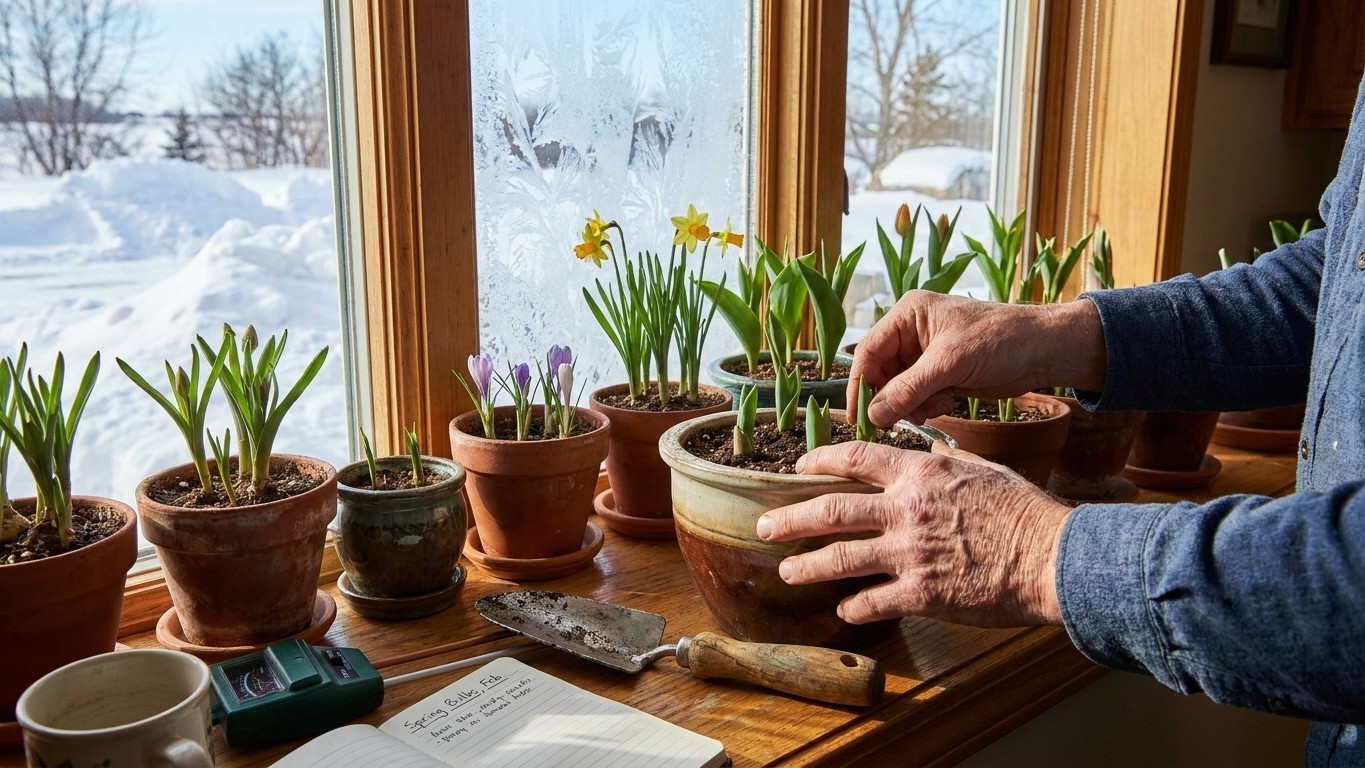

Forcing Spring Bulbs Indoors works reliably in North Dakota, and the reason has little to do with a shortage of winter. The coldest month here averages a low of 0.2°F, more cold than any spring bulb could ask for. The real risk isn’t finding enough chill. It’s a container freezing solid before that chill can do its job gently.
Why this matters in North Dakota

Zero point two degrees Fahrenheit. That’s the average daily minimum for the coldest month at the Fargo reference station, according to NOAA NCEI’s 1991-2020 climate normals. Compare that to the 45°F ceiling a spring bulb needs to start its chilling clock, and you can see the gap. North Dakota isn’t a place where winter fails to show up. It’s a place where winter overshoots by 40 or 50 degrees for weeks at a stretch.
That distinction matters because forcing bulbs indoors exists to solve two very different problems, depending on where you garden. In a mild climate, a gardener forces bulbs because outdoor winter never gets cold enough, long enough, so the chill has to be manufactured in a refrigerator. That’s not the North Dakota situation. The USDA Plant Hardiness Zone Map (2023 edition, built on the 1991-2020 normals) puts most of the state at 3a to 4b, some of the coldest ground in the Lower 48. There’s no shortage of cold to borrow from.
The problem here is the opposite kind, and it shows up specifically in Containers. Garden soil freezes from the top down. Even in a brutal Fargo January, the frost line advances gradually, and a bulb planted 6 inches deep is insulated by the earth above and around it. A pot has no such buffer. Surrounded by air on every side, a container left outdoors doesn’t freeze at the surface and stay workable underneath, it freezes straight through, roots and all, in a fraction of the time a garden bed would take. The same hardiness zone that keeps a tulip alive in a border can kill the identical bulb in a terra cotta pot on a porch.
So the situation this territory sits in is the container problem, not the missing-cold problem. Anyone forcing bulbs in North Dakota already has more chilling available than they can use. What they have to manage is exposure: giving a bulb the 35°F to 45°F range it needs without letting the temperature slide the extra 30 or 40 degrees down to what an unprotected pot will actually experience outside. That single fact, more than any calendar date, decides whether a forcing project succeeds or turns into a block of frozen mud by February.
How to do it here
Every spring bulb chosen for forcing needs roughly 12 to 14 weeks in that 35°F to 45°F window before it will bloom on schedule. The method below is built around finding and holding that window in a place where the outdoor air rarely cooperates.
- Pot the bulbs in fall, in a container with drainage holes, using ordinary potting mix. Set them close together, shoulders just below the surface, and water once thoroughly.
- Decide where the cold will come from. A refrigerator crisper drawer works and is the most predictable option, but keep it away from apples, pears, or any ripening fruit stored in the same fridge. Ripening fruit releases ethylene gas, and ethylene damages the flower bud forming inside the bulb before it ever gets the chance to open.
- If using an unheated space instead of a fridge, a three-season porch, insulated garage, or root cellar can work, but only if it holds steady in the mid-30s to low 40s. Given that the outdoor coldest-month average low here is 0.2°F, an uninsulated garage that simply tracks the outside temperature is not a safe substitute for a refrigerator; it can drop well below freezing on the coldest stretches.
- Check the storage spot with an actual thermometer at least once a week rather than trusting a guess. A space that reads 40°F in November can read 15°F by January once outdoor lows deepen.
- For containers wintering outside rather than in a fridge or porch, follow the two-zone rule: the pot needs a hardiness rating at least two zones tougher than the bulb inside it, or it needs to be brought closer to ground conditions artificially. In practice, that means burying the pot to its rim in a sheltered bed or cold frame and packing 4 to 6 inches of straw or leaf mulch around and over it, so the container behaves like buried soil instead of exposed clay.
- Keep the soil barely moist through the entire chilling period, checking every week or two. Bone-dry soil stalls root growth; soggy soil invites rot.
- Once you see roots at the drainage holes or an inch or two of pale shoot, move the pot to a cool, dim spot around 50°F to 60°F for one to two weeks. This step lets the stem start elongating before it meets full light.
- Move the pot into bright, indirect light at normal room temperature. Flowers typically open two to four weeks after that final move.
Which bulbs are worth it
Not every spring bulb repays the shelf space in a refrigerator. The ones that force well share a short chilling requirement and a stem that stays low enough to hold itself up indoors. The ones that disappoint usually fail on one of those two counts, or both.
- Paperwhite narcissus: needs no cold period at all and blooms in as little as three to four weeks from potting.
- Hyacinth: a shorter chill of 10 to 12 weeks and a thick, upright stem that rarely flops.
- Crocus: short chill requirement, low growth habit, well suited to a shallow bowl.
- Iris reticulata (dwarf iris): short chill, a 4- to 6-inch stem that never needs staking.
- Muscari (grape hyacinth): short chill and a compact, dense form.
- Tall Darwin hybrid and single late tulips: a 14-plus-week chill combined with a 20- to 28-inch stem that topples in a light pot without staking.
- Large trumpet and large-cupped daffodils: heavy blooms on tall stems, prone to leaning or snapping indoors.
- Allium: a chill period long enough to make the fridge commitment barely worth it, and hardy enough here that it’s better left in the ground.
- True lilies: a long chilling requirement and slow, unpredictable timing that rarely lines up with a target bloom date.
There’s also a cost argument specific to this climate. Many tulip varieties don’t reliably perennialize in the coldest pockets of a 3a to 4b range, so gardeners here often treat them as a one-season purchase whether they force them or plant them outside. If a bulb was never going to come back next spring anyway, forcing it indoors costs nothing extra in the long run, you get a bloom either way.
What goes wrong, and when you can still fix it
Leaves, but no flower
This means the chilling period ran short. The flower bud inside a spring bulb only finishes forming after the full 12 to 14 weeks below 45°F; cut that period short and the bulb has enough energy for leaves but never completes the bud. There’s no fix once this happens, the bulb has already spent its stored reserves on foliage. Note how many weeks it actually got, and give the next batch the full period without shortcuts.
A short, buried flower stem
When the bloom opens low, almost hidden in the leaves, the bulb was likely moved from cold to warm too abruptly, skipping the intermediate cool, dim stage. The flower opens before the stem has elongated to lift it clear of the foliage. Nothing rescues that particular bloom, but the next round can avoid it by holding the pot at 50°F to 60°F for a week or two before moving it into bright light and full room warmth.
Rot at the base of the bulb
Soft, discolored tissue at the base plate usually traces back to standing water, either a pot without drainage holes or soil kept wet through the cold weeks. Once rot sets in, the bulb is lost; there’s no reviving it this season. For the next attempt, confirm the container actually drains and let the soil dry slightly between waterings rather than keeping it saturated throughout the chilling period.
Related guides
- Growing Spring Bulbs in Containers in North Dakota
- Forcing Spring Bulbs Indoors in Northwest Territories