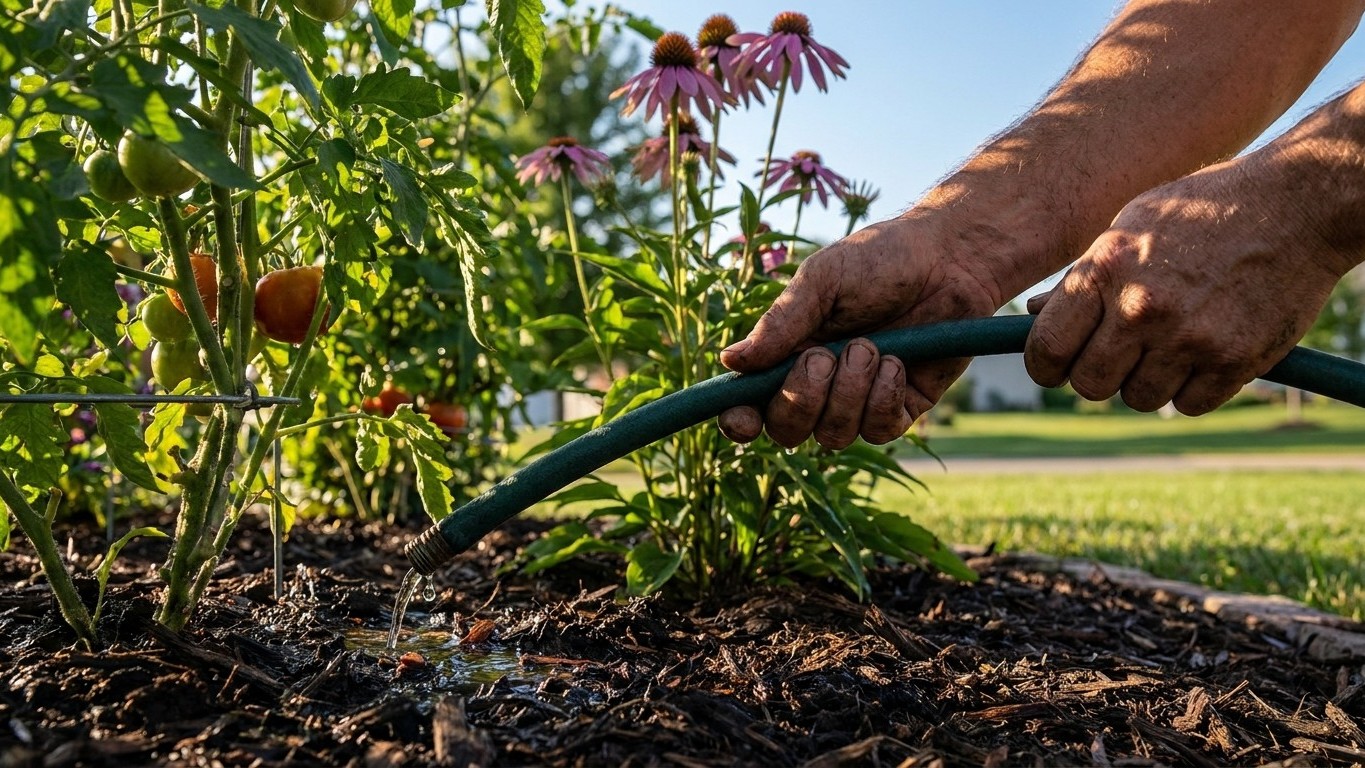

Wisconsin gardens face their driest stretch in July, when just 3.4 inches of rain falls across the month. Add in only 7.0 days a year that reach 90F, and the answer for watering through that dry patch is simple: supplement the sky’s shortfall with roughly a quarter-inch of extra water each week, delivered slowly at the roots, rather than trusting an occasional thunderstorm to keep a bed alive.
What changes here

Start with the two numbers that decide everything in this section: July, the driest month of a Wisconsin summer, brings just 3.4 inches of rain, and the region sees only 7.0 days a year that climb to 90F or higher. Put together, those figures tell a gardener something concrete: the shortage isn’t about a scorching climate, it’s about one dry month sitting inside an otherwise wet year, with just enough heat load to make that gap sting.
Run the arithmetic and the gap gets a number attached. A vegetable bed or a perennial border wants roughly an inch of water a week to keep growing without stress. Spread July’s 3.4 inches evenly across the month’s four-plus weeks, and the sky delivers about 0.8 inch a week on its own. That leaves a gardener carrying the rest, something close to a quarter-inch a week, through a hose or a can, to close the gap between what falls naturally and what the plant actually needs.
That quarter-inch sounds small until the ground gets involved. On sandy soil, water drains through within hours, so that quarter-inch has to be replaced almost as soon as it’s applied, and a single weekly top-up often isn’t frequent enough. On heavy clay, the same amount can sit in the top few inches for the better part of a week, which flips the risk toward overwatering rather than underwatering. Wisconsin gardens run the gamut between the two, from the sandy outwash plains left by glacial meltwater to the denser clay loams found across much of the southern and eastern parts of the state, so the number that matters most is less the statewide average and more what a trowel turns up in a specific yard.
The 7.0 days above 90F matters too, even though it’s a modest figure next to hotter states. Those days don’t spread evenly through the calendar, they tend to cluster in July, right on top of the driest month, which means the moment rainfall is scarcest is also the moment evaporation is working hardest against it. That overlap, more than either number alone, is what makes July the month a Wisconsin garden actually needs watching.
How to water when it matters
The method that works on Wisconsin ground is deep, infrequent watering at the base of the plant, done in the morning. Each part of that has a reason behind it. Deep watering pushes moisture down where roots can follow it, training them to grow downward rather than staying shallow near a surface that dries out fast. Infrequent watering gives roots time to use what’s there before more arrives, which matters most on clay that holds moisture for days at a stretch. Watering at the base, rather than overhead, keeps water where roots can use it instead of losing it to evaporation or leaving it sitting on foliage. Morning watering lets any splashed leaves dry out before nightfall, before disease-friendly damp darkness sets in.
Checking the soil matters more than checking the calendar. A finger pushed two inches into the ground, or a trowel lifted to that same depth, tells a gardener whether the root zone is actually dry. Surface soil can look pale and cracked while two inches down stays damp, and the reverse happens too after a light shower that never soaked past the first half-inch.
Adjusting for sand or clay
Texture changes the rhythm of all this. Sandy soil, common on Wisconsin’s old glacial outwash plains, holds water briefly and needs shorter, more frequent soakings, sometimes every two to three days during a dry July. Heavy clay, more common in the southern and eastern parts of the state, holds a week’s worth of water at once, and watering it again before it has dried invites root rot rather than drought stress.
A starting point, to test against a specific yard: about 1 inch of water a week, split into one or two sessions rather than a daily trickle, adjusted up in frequency on sandy ground and down in frequency on clay. That number is a beginning, not a rule, since slope, mulch, shade and the particular plants in a bed all shift it. This is the sequence to follow through a dry July:
- Check the soil two inches down with a finger or trowel before watering at all, rather than watering on a fixed schedule.
- Water early in the morning, before the heat of the day pulls moisture back out of the top layer of soil.
- Apply water slowly at the base of each plant, giving it time to soak in rather than run off.
- Aim for about 1 inch a week total, delivered in one deep session on clay or split into two on sandy ground.
- Recheck two inches down a day or two later, and adjust the next session’s timing based on what the soil actually shows.
What goes wrong
A quick sprinkle every day
A light daily watering wets only the top inch or so of soil, which trains roots to stay shallow, right where the sun bakes hardest during those 90F days. When the inevitable dry stretch hits, those shallow roots have nowhere deeper to draw from, and the plant wilts faster than one watered less often but more deeply would.
Watering the leaves in the evening
Wetting foliage instead of soil, especially after dinner, leaves it damp through the cool overnight hours. That combination of moisture and darkness is exactly what fungal disease needs to take hold, a problem that shows up on tomatoes and squash more than most other garden plants.
Trusting a rain shower that barely wet the surface
A passing thunderstorm can look like it solved the watering problem while only soaking the first half-inch of soil, especially when it falls hard and fast and runs off before it soaks in. The only way to know is to check with a finger two inches down rather than judge by how wet the ground looks right after the rain stops.
Skipping the mulch
Bare soil left uncovered through a Wisconsin summer gives back to the air much of what watering just put into the ground, especially on the state’s sandier stretches where drainage is already fast. A few inches of mulch slow that loss and stretch the interval between waterings.
Watering a bed that hasn’t dried
This is the mistake that costs more here than heat stress does, given how much of the state carries clay-heavy soil and a wetter year overall than the July dry spell suggests. Adding water to ground that’s still holding last week’s rain pushes air out of the soil and starves roots of oxygen, a slower but just as real way to lose a plant as letting it go dry.
Local help
The University of Wisconsin’s Division of Extension is the state’s land-grant resource for garden and lawn watering guidance suited to local conditions, from soil testing to season-specific advice. Watering restrictions aren’t uniform across Wisconsin; municipalities and water utilities set their own schedules, often tied to summer demand, and those rules can change year to year. Check directly with your local water provider or municipality for the current restrictions in your district before setting up a regular watering routine.
Common questions
How often should I water my Wisconsin garden during a dry July?
Start by checking the soil two inches down rather than watering on a fixed schedule. As a starting point, aim for about 1 inch of water a week, split into more frequent sessions on sandy soil and less frequent, deeper sessions on clay.
Does Wisconsin get hot enough to need constant watering?
Not by the numbers. The reference station averages only 7.0 days a year at or above 90F, a modest heat load. The bigger driver of watering need is July’s low rainfall, 3.4 inches, rather than extreme heat.
Is a heavy rain shower enough to skip watering that week?
Only if it soaked past the first couple inches of soil, which a quick summer thunderstorm often doesn’t do. Check with a finger or trowel before assuming a storm did the job.
Does soil type really change how I should water?
Yes. Sandy soil drains fast and needs shorter, more frequent watering, while clay holds moisture for up to a week and can drown roots if watered again before it dries. Wisconsin has stretches of both, so checking your own yard’s soil matters more than any statewide rule.