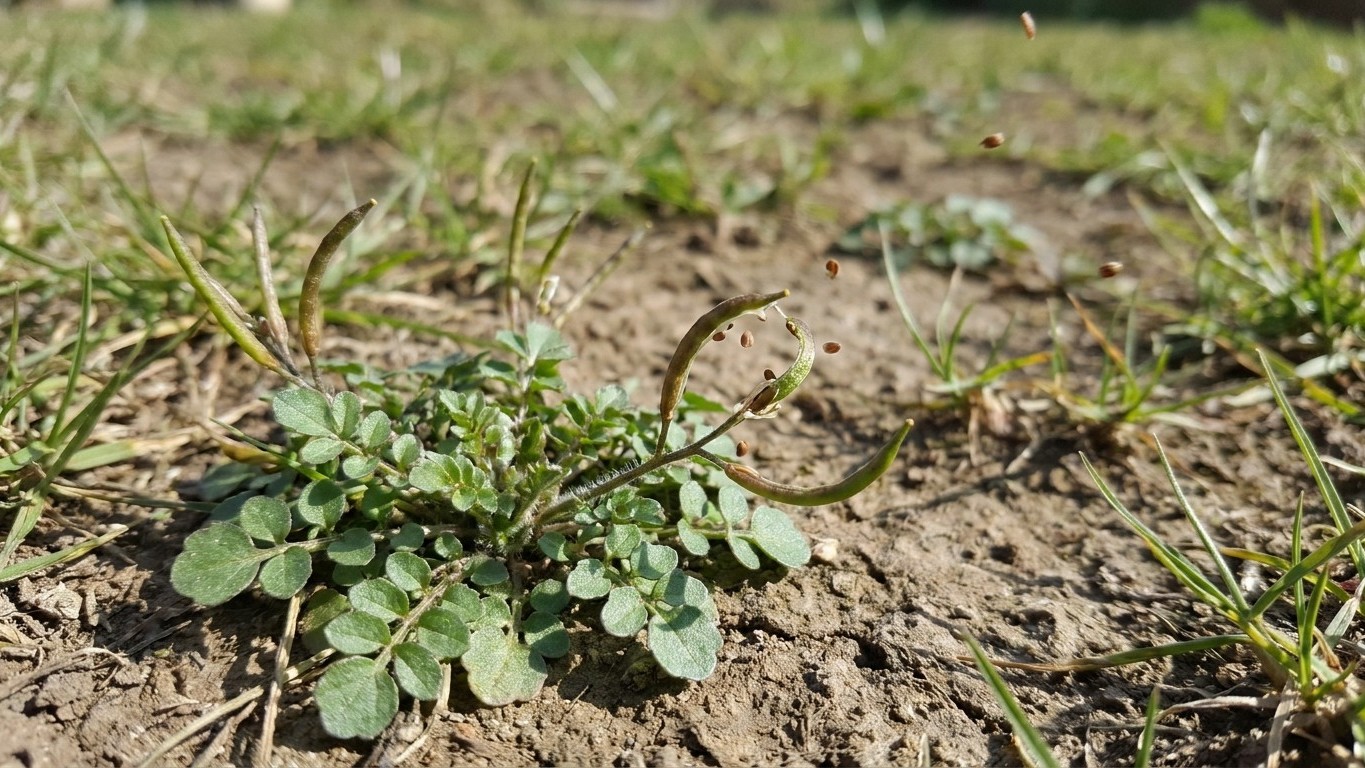

Hairy bittercress is a low, rosette-forming winter annual in the mustard family, easy to identify by its small round leaflets and the seed pods that snap open and sling seeds several feet when brushed or touched. It shows up in thin, compacted, or bare turf during cool weather, and the fastest fix is usually thicker grass, not a chemical spray.
How to be sure that is what you have

Hairy bittercress grows as a flat rosette close to the soil, made of pinnately compound leaves, meaning each leaf stem carries several small, rounded leaflets arranged like tiny paddles along a central stalk. The end leaflet is usually larger than the ones behind it. From that rosette rises a thin flower stalk topped with tiny white, four-petaled flowers, followed by narrow seed pods called siliques that curve upward. Touch a ripe pod and it curls back on itself, catapulting seeds well clear of the parent plant, which is exactly how the weed spreads through a lawn or garden bed in a single season without any help from wind or mowers.
This plant favors bare or thin soil: the edges of driveways, mulched beds, nursery pots, and patchy turf where sunlight reaches bare ground. It germinates in fall, stays low and green through winter (it tolerates a hard frost better than most lawn grasses), then bolts, flowers, and sets seed in late winter or early spring before summer heat arrives. By early summer the plant is usually gone, its life cycle finished.
Two lookalikes trip people up. Common chickweed (Stellaria media) has opposite leaves on sprawling, matted stems and star-shaped flowers with deeply notched petals, quite different from bittercress’s upright rosette and compound leaves. Shepherd’s purse (Capsella bursa-pastoris) shares the rosette habit and small white flowers, but its seed pods are flat and heart-shaped rather than long and narrow, and it doesn’t fling its seeds the way bittercress does. If the pods explode when you touch them, you’re not looking at either of those two.
Why it is in your lawn
A weed like this doesn’t invade healthy turf so much as move into the gaps healthy turf leaves behind. Hairy bittercress needs bare or thinly covered soil to germinate, so its presence is a fairly reliable sign that something in the lawn’s structure isn’t dense enough to compete with it in fall.
Compacted soil is a common culprit, especially along walkways, near gates, or anywhere foot traffic concentrates, because compaction squeezes out air and slows root growth in turfgrass while doing little to bother a shallow-rooted opportunist like bittercress. Mowing too short has a similar effect: cutting cool-season grass like tall fescue or Kentucky bluegrass below its ideal height in fall thins the canopy and opens sunlit gaps right when bittercress seeds are germinating. Poor drainage and shaded, damp corners also favor it, since those spots often carry thin, stressed turf for months at a time.
The practical takeaway is that treating the plant without treating the bare ground underneath it buys, at best, one clean season. If the same patch keeps producing bittercress every winter, the soil is telling you it’s compacted, too shaded, or mowed too aggressively, and pulling weeds without addressing that will turn into a yearly chore.
The window that decides everything
Timing separates an effective bittercress treatment from a wasted one, and the trigger isn’t a date on the calendar, it’s a condition in the soil. Extension services time herbicide applications to plant and soil cues rather than fixed months because those cues shift by weeks depending on where you live. Clemson Cooperative Extension’s HGIC 1219 factsheet, for example, ties pre-emergent applications for spring-germinating weeds like crabgrass to the bloom of forsythia and flowering dogwood, using those familiar landscape plants as a stand-in for the soil temperature crabgrass needs to sprout.
Hairy bittercress runs on the opposite calendar. It’s a winter annual, meaning it germinates as the weather cools in late summer and early fall, not in spring. A pre-emergent herbicide applied in spring, timed to forsythia bloom for crabgrass, will do nothing for bittercress because the seeds it’s meant to stop have already sprouted, flowered, and dropped their own seeds months earlier. For this weed, a pre-emergent needs to go down before fall germination begins, while a post-emergent works best on rosettes that are visible but haven’t yet sent up a flower stalk, since killing the plant before it sets seed is what actually reduces next year’s population.
Because fall’s cooling trend arrives at very different times across the country, the same lawn-care task can be weeks apart between a northern state and a southern one. Rather than guess, match any treatment to your own region’s fall weed-control window on your territory lawn calendar instead of copying a date meant for another climate.
Getting rid of it
Hand-pulling is genuinely effective against hairy bittercress, more so than against many lawn weeds, because it grows from a shallow taproot rather than spreading rhizomes or stolons. Pull it while the rosette is still flat and before any flower stalk appears, grasping low near the crown so the root comes with it; left-behind root fragments don’t resprout the way they would with a perennial like dandelion. The one real trick is timing the pull before seed pods form, since a plant that’s already flowering will fling viable seed the moment it’s disturbed, so bag anything with pods rather than tossing it on a mulch pile or open compost bin.
Where pulling isn’t practical across a larger area, post-emergent broadleaf herbicides containing 2,4-D, dicamba, MCPP, or triclopyr, typically sold as three-way combination products for home lawns, will control actively growing bittercress rosettes without harming most established cool-season or warm-season turfgrasses when used at labeled rates. Pre-emergent actives such as pendimethalin, dithiopyr, or isoxaben can prevent fall germination if applied before seeds sprout, but they won’t touch a rosette that’s already up and growing.
A few cautions matter here. Broadleaf herbicides that control bittercress can also injure or kill desirable groundcovers, vegetables, and some ornamental shrubs if drift reaches them, and dicamba in particular is known for vapor drift in warm weather. Several of these active ingredients carry state-specific use restrictions or require certification for certain formulations, so check your state department of agriculture’s rules before buying anything, and always read the label to confirm it’s labeled for your particular grass species before applying.
Keeping it out
Dense, healthy turf is the only control that holds up year after year, because bittercress simply can’t establish in soil it never reaches. What “thick” means depends on the grass. Cool-season lawns, tall fescue, Kentucky bluegrass, and perennial ryegrass among them, do best mowed at roughly 3 to 4 inches, a height that shades the soil surface and denies bittercress seeds the light they need to germinate in fall. Warm-season lawns like Bermuda or zoysia are typically kept shorter and thicken through lateral spread rather than mowing height, so their defense against winter annuals comes more from a tight, actively growing canopy during their growing season.
Fall feeding matters as much as mowing height for cool-season lawns, since a fall fertilizer application supports root growth and canopy density right as bittercress seeds are trying to sprout, giving the grass a head start on covering bare soil before the weed can. Overseeding thin or bare patches in early fall closes the same gaps bittercress relies on, and it’s usually far cheaper than a season of spot-treating with herbicide. None of this eliminates the weed overnight, but a lawn that carries full, even coverage through autumn rarely gives hairy bittercress the open ground it needs to get started.
Common questions
Is hairy bittercress the same weed that “explodes”? Yes. Its seed pods build up tension as they ripen, and touching a mature pod triggers it to curl and release seeds outward, often several feet, which is how a small patch can spread across a lawn or garden bed in one season.
Will hairy bittercress kill my grass? No. It’s an opportunist that fills bare or thin spots rather than a disease that damages turf directly. Thickening the lawn crowds it out; it doesn’t compete well against dense, healthy grass.
Is hairy bittercress edible? It’s a relative of watercress and arugula in the mustard family, and the young leaves carry a similar peppery bite. Anyone considering eating wild plants from a lawn should be certain no herbicides or pesticides have been applied to that area.
Does mulch stop hairy bittercress? A thick layer of mulch in garden beds blocks the light seeds need to germinate and is one of the more reliable non-chemical controls in those areas, though it isn’t a practical option for lawn turf itself.