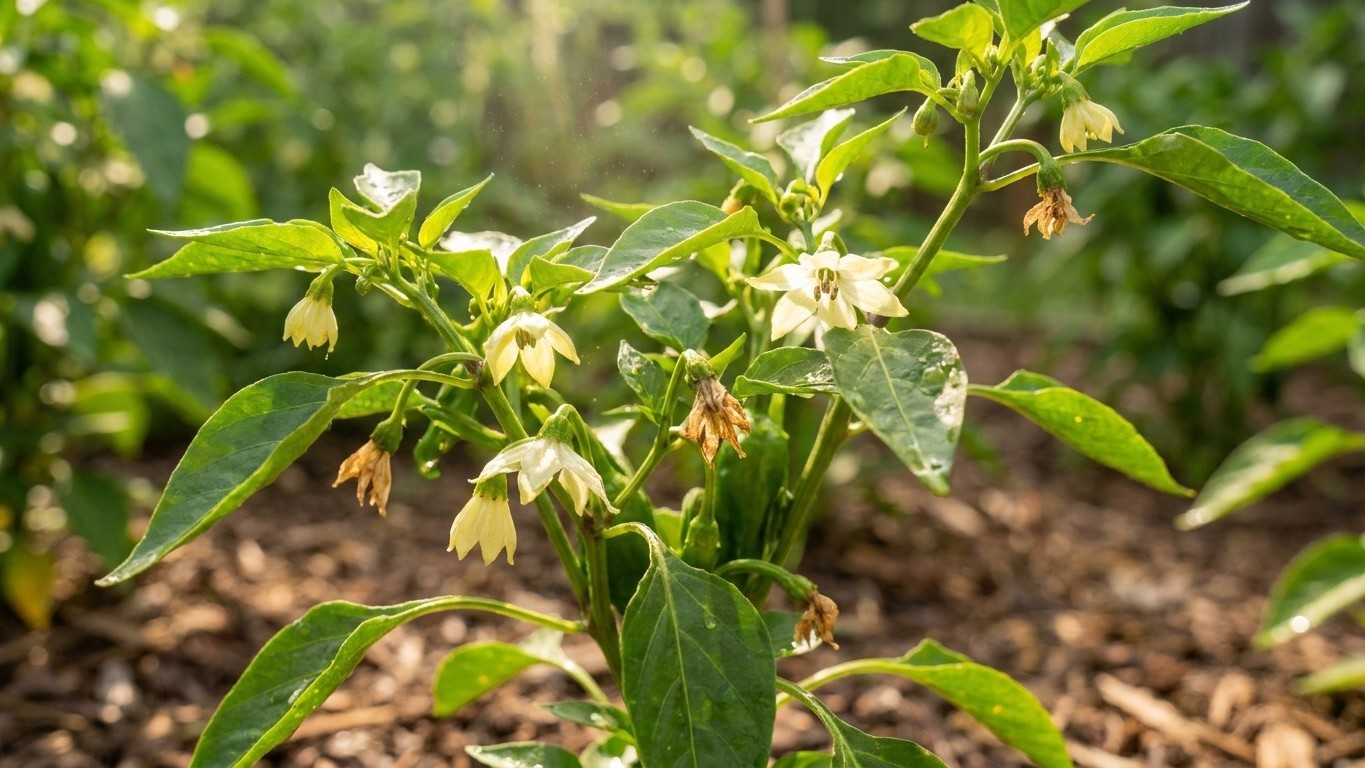

Why Peppers Fail to Set Fruit in Alabama comes down to trouble at the top end of the thermometer more than most gardeners expect: the reference station near Huntsville logs 58.5 days a year at 90°F or hotter, and pepper flowers stop setting fruit once daytime heat climbs that high. The fix is timing your transplant so flowering happens before the worst of that heat arrives, and watching your own nighttime lows the rest of the season.
The short answer

Start with the number that actually drives the problem: 58.5 days a year at or above 90°F, averaged over the 1991-2020 period at the Huntsville reference station, according to NOAA NCEI Climate Normals. That’s not a handful of scorching afternoons in late July. It’s nearly two full months, scattered across the growing season, where pepper flowers can abort before they ever become fruit. Pepper plants don’t fail outright in that heat. They just stop setting. Flowers open, look fine, then drop without pollinating, and the plant sits there looking healthy while producing nothing.
That’s the hot end of the fruit-set window. There’s a cold end too, and it matters just as much. According to Utah State University Extension, pepper fruit set also fails when nighttime temperatures drop below 55°F. Cool nights in spring, especially right after transplant, can hold a plant in vegetative limbo the same way a heat wave does later in summer. A pepper plant set out too early into a string of 50-degree nights won’t necessarily die. It just won’t fruit until conditions improve.
Here’s where this gets specific to your yard rather than the state as a whole: this site tracks days above 90°F by location, but it does not carry summer night minimum temperatures. That’s not a small gap. A garden in a low spot near a creek can run five degrees cooler at night than one on a ridge two miles away, and neither number shows up in a regional average. Don’t guess at your night lows based on how far south you are on the map, and don’t assume the coldest month of the year tells you anything about a June or July night. Latitude is a poor stand-in for a thermometer.
The practical takeaway: track your own overnight lows with a simple min-max thermometer in the bed itself, at least through the first month after transplant. Pair that with the 90°F day count for your area, and you have both halves of the fruit-set equation instead of just the one this page can hand you directly. For a rundown of which cultivars actually have time to mature under these conditions, see Pepper Varieties That Ripen in a Alabama Season.
When to start seed here
Work backward from two fixed points and one soil reading, and the seed-starting date follows, as detailed in When to Start Pepper Seed in Alabama, falls out of the arithmetic rather than a guess. Utah State University Extension puts pepper transplants at 8 to 10 weeks of indoor growing before they go in the ground, and that move outdoors should happen only after frost has passed and soil has warmed to 60°F.
- Find your local last-frost window. At the Huntsville-area reference station, NOAA’s 1991-2020 climate normals put the last spring freeze (32°F) in the March 19 to April 3 range, based on the 30-70% probability band. That’s a reference-city figure tied to one airport weather station, not a statewide guarantee, and it skews early for most home gardens.
- Push that date later for a real yard. Suburban and rural gardens typically see their last frost one to two weeks after the airport station clears, sometimes more at higher elevation, because open fields at airports warm faster than shaded or low-lying residential lots.
- Wait on the soil, not just the calendar. Even after the air stops freezing, soil at 60°F might still be days away. A basic soil thermometer pushed 4 inches deep, checked in the morning, tells you more than any date on a chart.
- Count back 8 to 10 weeks from your adjusted transplant date. If your realistic frost-free, soil-warm date lands in mid-April once you’ve added a buffer to the airport figure, seed starting indoors begins roughly in mid to late February.
- Build in slack for a cold snap. Since transplanting into nights below 55°F stalls fruit set just as surely as a late frost kills the plant outright, treat your calculated date as a floor, not a target to beat.
The math holds regardless of where in the state you garden. Only the frost-window inputs change, and only your own extension office or a home thermometer can supply the local version of that number with any confidence.
What goes wrong here
- Blossom drop from a heat spell. Once daytime temperatures push past 90°F, and Alabama sees that on average 58.5 days a year, open flowers can abort before pollination happens. Peppers don’t recover the lost flowers; they simply set the next flush once temperatures ease. Give plants afternoon shade cloth during the worst stretches and keep soil moisture even, since drought stress on top of heat stress compounds the drop.
- Blossom drop from a cool night. The same failure shows up from the opposite direction: nights under 55°F, particularly in the weeks right after transplant, stall fruit set. Since this site doesn’t track summer night minima, run your own min-max thermometer in the bed and hold off expecting fruit until nights consistently clear that mark.
- Sunscald on exposed fruit. Alabama’s strong summer sun can scorch pepper fruit that loses its leaf cover, especially on plants pruned hard or thinned of foliage to “let more light in.” The fruit develops a pale, papery patch that turns leathery. Leave foliage in place to shade developing peppers, and avoid heavy pruning once fruit starts to size up.
- Blossom-end rot. A dark, sunken patch on the fruit’s blossom end usually traces back to inconsistent watering rather than a soil calcium shortage outright, since uneven moisture interrupts the plant’s ability to move calcium to the fruit. Mulch to buffer soil moisture swings and water on a steady schedule rather than letting the bed dry out between heavy soakings.
Checking this against your own county
Everything above comes from a single reference station and a set of general extension guidelines, not a survey of every county in Alabama. Soil type, elevation, tree cover and even which side of a hill your garden sits on can shift both frost timing and heat load enough to matter. Before you lock in a transplant date, run it past the Alabama Cooperative Extension System at aces.edu, where county-level frost data and heat guidance reflect your actual growing conditions rather than an airport several counties away. That single check can save a whole flat of pepper seedlings from going out two weeks too early or too late.
Common questions
Can I still transplant peppers if my soil hasn’t hit 60°F yet?
Holding off is worth it. Soil below 60°F slows root establishment and can stall a pepper plant for weeks even after the air warms up, so a short wait usually costs less time than a stunted start.
Does Alabama’s heat mean I should skip peppers entirely in midsummer?
No, but expect a lull. Plants that set fruit before the hottest stretch, then coast through the 90°F days without setting new flowers, typically resume once nights and days both moderate later in the season.
How do I know if it’s heat or cold causing my blossom drop?
Check the calendar and a thermometer. Early-season drop right after transplant points to cool nights under 55°F, while drop during a summer heat spell above 90°F points the other way. Since this site doesn’t track night minima, a simple bedside thermometer settles the question.
Is blossom-end rot a sign I need to add calcium to my soil?
Usually not. Most home gardens have enough calcium already; the rot comes from uneven watering interrupting how the plant delivers that calcium to the fruit. Consistent watering and mulch solve it more often than a soil amendment does.