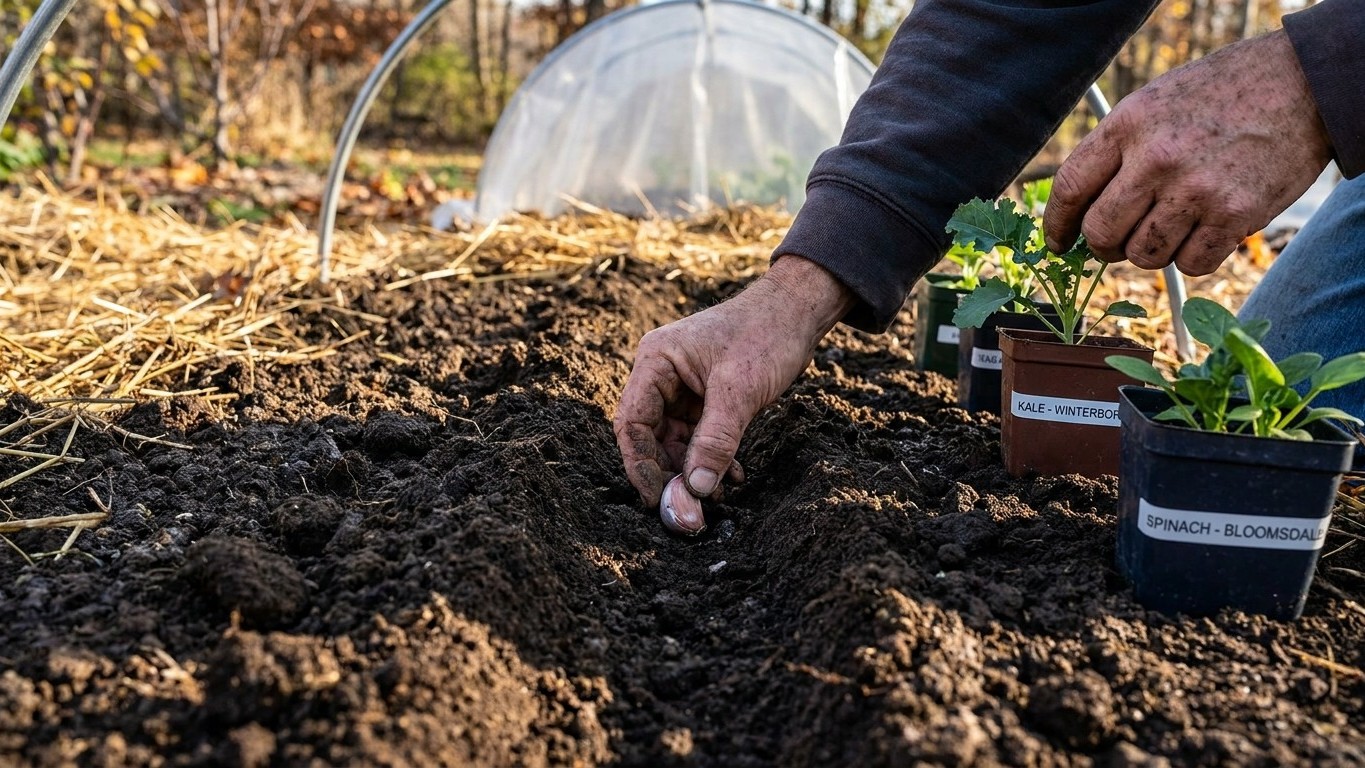

Garlic and shallot cloves are the headline task this month in Maine, going into the ground while the soil still turns easily. Behind that, cold-hardy greens tucked under a low tunnel, a broadcast of winter rye over a cleared bed, and bare-root fruit stock going in dormant. Everything outdoors is racing the first fall frost, which lands anywhere from October 9 to October 21 depending on where you garden in the state.
What goes in the ground in October

Soil temperature decides what makes it through this month, not the date on the calendar. In coastal Portland, NOAA’s 1991-2020 climate normals put the first fall freeze between October 9 and October 21. That’s the mild end of Maine. Inland valleys and the northern counties routinely see their first hard freeze earlier, sometimes by two or three weeks, so a gardener in Aroostook County is working on a different clock than one in Cumberland County.
Garlic and shallots are the safest bet of the month. Cloves want roughly four to six weeks of soil contact before the ground locks up solid, which lines up well with October for most of the state. Push individual cloves root-down, two inches deep, and cover the bed with a few inches of straw once the top layer has cooled. They’ll send up a few inches of green before frost, then sit quiet until spring.
Cold-hardy greens still have a window if sown early in the month. Spinach, mache, and claytonia tolerate light frost and keep growing slowly under a cold frame or row cover well past the point where an unprotected planting would quit. Sown after the middle of the month in most of Maine, though, germination slows in cooling soil and seedlings often don’t gain enough size to survive the winter, so treat late sowings as a gamble rather than a plan.
Cover crops belong on any bed you’ve already cleared. Winter rye or hairy vetch broadcast over bare soil germinates in cool conditions, holds the ground against erosion, and adds organic matter back in the spring when it’s turned under.
Bare-root and dormant stock, fruit trees, cane fruit, asparagus and rhubarb crowns, can still go in while the ground is workable. None of it will show top growth before winter, but the roots get a head start establishing before the freeze sets in for good.
What to start under cover
Counting backward from the frost window tells you whether a sowing under cover is still worth the seed. Mache, spinach, and claytonia need roughly 30 to 45 days to reach a workable size. Measure back from that October 9 to October 21 window and the sowing date lands right at the start of the month for most of Maine, earlier still if you’re inland or north. Miss that window and the plants stall out small, which is fine for mache, which overwinters happily as a tiny rosette, but a loss for anything you actually wanted to eat before spring.
Two mistakes show up every year. Sow too early, while daytime heat is still lingering from summer, and quick greens like spinach bolt to seed instead of forming leaves. Sow too late, once soil temperatures have dropped hard, and germination simply stalls, leaving bare cells or bare soil under the row cover with nothing to show for it once the light shortens further.
Indoor options don’t answer to the frost clock at all. Microgreens and sprouts can run under lights on a kitchen counter regardless of what the ground outside is doing, and they fill the gap left by the outdoor garden’s slowdown. Amaryllis and paperwhite bulbs potted up now, timed against their own six-to-eight week bloom cycle, are the closest thing to a guaranteed payoff this month offers indoors. None of it replaces a vegetable harvest, but it keeps something growing while the beds outside go quiet.
What is ready to pick
October is a genuine harvest month in Maine before frost tightens its grip, and a handful of crops actually improve once that frost arrives. Winter squash and pumpkins, maincrop potatoes, leeks, carrots, beets, parsnips, and the brassica family are all either at their peak or getting better by the week.
| Crop | Sign it’s ready | What to do |
|---|---|---|
| Winter squash and pumpkins | Stem is dry and corky, skin resists a thumbnail | Cut with 2 to 3 inches of stem attached, cure a week or two in a warm, airy spot before storing |
| Potatoes | Foliage has fully died back | Dig on a dry day, cure in a dark, cool spot for a week or two before bagging |
| Leeks, carrots, parsnips | Full size, tops still green | Can stay in the ground under heavy mulch and be dug as needed through fall |
| Brussels sprouts, kale | Sprouts firm, leaves have darkened | Leave through a light frost or two; the cold sweetens the flavor |
Anything already in storage from earlier picks needs a weekly look. Squash and pumpkins that develop a soft, sunken spot near the stem are on their way to rot and should be used first, not left to spread trouble to the rest of the bin. Onions and potatoes want a check for sprouting eyes or soft necks, both early warnings that storage conditions are running too warm or too damp.
The jobs that matter this month
Soil and cleanup
Fall is the right season for a soil test and any lime application it calls for, since lime needs months to shift pH before spring planting starts. Work compost or aged manure into beds while the soil is still soft enough to turn easily, rather than fighting frozen ground later. Pull and dispose of diseased plant debris, especially old tomato and squash vines, instead of composting it. Leaving that material in the bed gives fungal spores and overwintering pests a place to sit out the cold and reappear.
Tools, seed orders and storage checks
Drain hoses and irrigation lines before a hard freeze splits them. Clean and oil hand tools before they go into winter storage, since rust set in over a damp winter costs more time in spring than the ten minutes it takes now. Seed catalogs start circulating this month, and the varieties that sell out first tend to be the ones worth having, so an early order beats a spring scramble. Keep checking stored squash, onions, and potatoes on a weekly rhythm rather than assuming the bin is fine until something smells wrong. A rotation plan for next season, sketched out now while this year’s results are fresh, saves a repeat of whatever pest or disease pressure showed up in a given bed.
What not to do in October
Tender crops still standing in the garden, tomatoes, peppers, basil, and squash vines, are the classic trap. Hoping for one more warm stretch usually ends with a frost that turns the whole planting to mush overnight. Pick green tomatoes before that first freeze; they’ll ripen indoors on a windowsill, which beats losing the crop entirely.
Mulching too early does more harm than good. Piling straw or leaves over strawberry crowns or other tender perennials before the ground has had a couple of real frosts traps residual warmth in the soil, which is exactly the condition rodents look for when picking a spot to nest for the winter. Wait until the soil surface is consistently cold before covering it.
Pruning fruit trees now is another common misstep. Cuts made before the tree is fully dormant heal slowly and leave an open door for disease and insects heading into winter. That job belongs later, once true dormancy has set in.
Nitrogen fertilizer applied this late pushes soft new growth on shrubs and perennials that has no time to harden off before frost, which weakens the plant’s winter survival rather than helping it. And winter squash cut with a damaged or missing stem, or harvested before the skin has fully hardened, tends to rot in storage within weeks instead of lasting through winter.
Checking this against your own county
A state-wide frost window is a starting point, not a fixed instruction. Elevation, distance from the coast, and the usual north-south divide in Maine can shift these dates by weeks in either direction. A garden in the Rangeley Lakes region or up in Aroostook County is playing by a different calendar than one along Casco Bay. For a planting calendar built around your specific county, and for local recommendations that account for elevation and microclimate, the University of Maine Cooperative Extension is the reference worth checking before committing seed or cloves to the ground.
Common questions
When should I plant garlic in Maine?
Cloves want four to six weeks of soil contact before the ground freezes solid, which generally puts planting in early to mid-October for most of the state, earlier for inland and northern counties.
Can I still start seeds outdoors in Maine in October?
Only a narrow set: quick, cold-hardy greens like mache and spinach sown early in the month under cover, and garlic or shallot cloves. Anything else direct-sown this late is unlikely to establish before the first fall frost.
What USDA hardiness zone is Maine?
Maine spans USDA Plant Hardiness Zones 3b to 6a on the current map, built from average annual extreme minimum temperatures. Coastal Portland sits on the milder end of that range; inland and northern areas run colder.
Where can I find a planting calendar specific to my Maine county?
The University of Maine Cooperative Extension publishes county-level guidance that adjusts for local elevation and microclimate, a better source than a single state-wide date.
Gardeners who plant by the Moon can check the October 2026 moon planting calendar, a tradition rather than a proven method.
Related guides
- What to Plant in Maine in April
- What to Plant in Maine in March
- What to Plant in Maine in June
- What to Plant in Maine in September
- What to Plant in Maine in November
Elsewhere? See what to plant in October in every state and province.