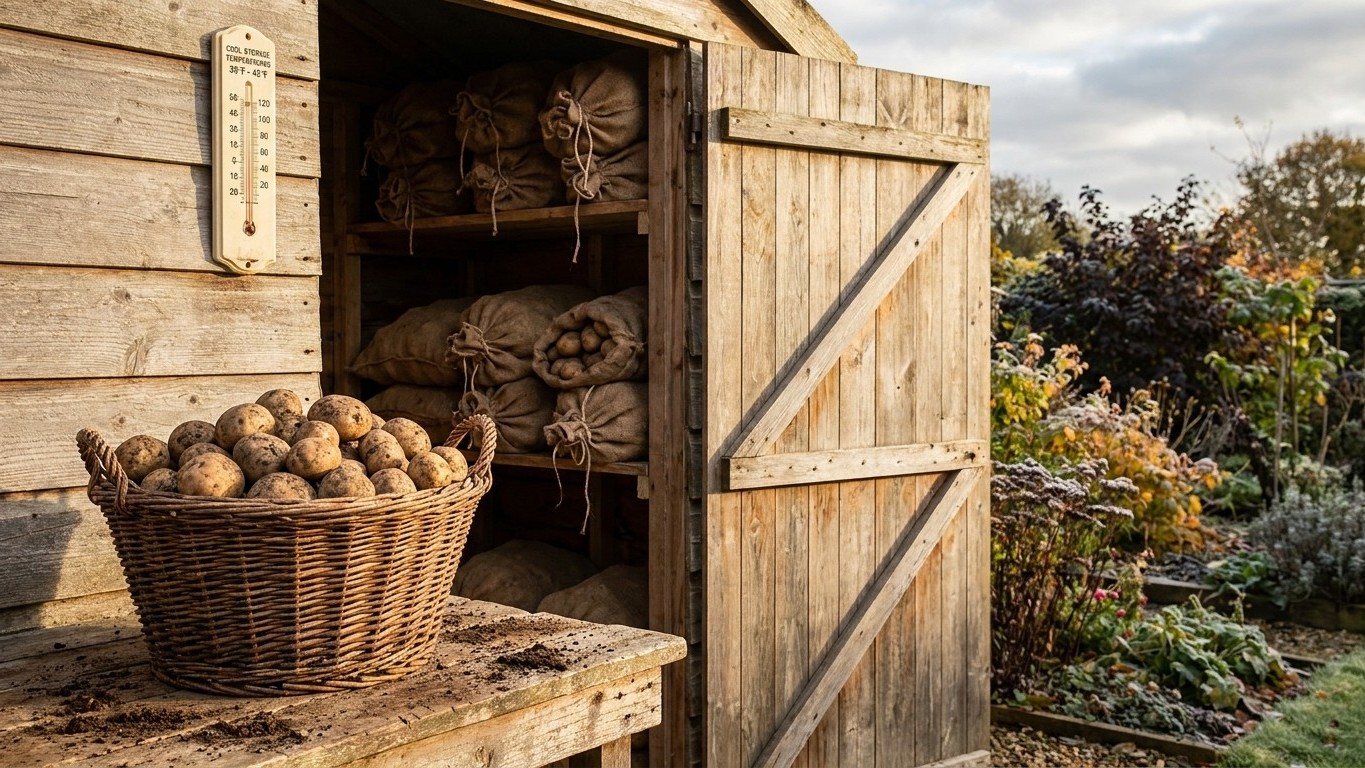

Massachusetts growers get one clear signal for the potato calendar: the first fall frost lands November 3 to November 14 across the state’s mildest coastal reference point, and the coldest month averages a nightly low of 23.1°F. That second number matters more than most gardeners realize, because it tells you flatly that an unheated garage or shed will not hold the 40-45°F a stored potato needs. It will freeze.
The short answer
Start with the frost window: November 3 to November 14, per NOAA’s 1991-2020 climate normals for the Boston-area reference station. That’s the mildest, most waterfront-influenced spot in the state, so treat it as the late end of the range, not the rule. Gardens in the inland suburbs, the Connecticut River Valley, and especially the Berkshires see their first freeze noticeably earlier, sometimes weeks earlier. If you’re gardening west of Worcester or at any elevation, don’t wait for a Boston-area date to tell you it’s time.
Potato foliage dies back at first frost, and that’s your practical harvest trigger statewide: get the tubers out of the ground once the vines have blackened, or once you’ve cut them down deliberately about two to three weeks ahead of the frost date to let the skins set. For most of Massachusetts, that puts digging squarely in October, with the Berkshires and higher inland towns pushing into late September some years.
The second figure, that 23.1°F mean minimum for the coldest month, is the one that decides where those potatoes live for the next five months. Storage wants a steady 40-45°F in the dark (Utah State University Extension), or as low as 38°F at 95% humidity for longer keeping (University of Maine Cooperative Extension). An open, unheated structure in Massachusetts spends its coldest month averaging well below that range on any given night. A detached garage, a three-season porch, an uninsulated shed: none of them hold 40°F reliably once January arrives. They swing from freezing to well above the target depending on the day, which is worse than steady cold, because it triggers rot and sprouting in turns.
What does hold that range is a basement, a root cellar, or an insulated crawlspace, ideally one built into or against the ground where the earth itself buffers the swings. If you don’t have one of those, an interior closet against an uninsulated exterior wall, checked with a thermometer over a few weeks, can sometimes get close. But guessing is how a winter’s worth of potatoes turns to mush by February. Measure first, store second.
Curing, and where
Before storage even starts, cured potatoes keep dramatically better than uncured ones, and Massachusetts’ harvest-season weather makes finding the right spot for that curing step a genuine puzzle. Utah State University Extension specifies 55-60°F with high humidity, held for two to three weeks, to let cuts and nicks heal over and skins thicken. In an Massachusetts October, outdoor air temperatures swing from warm afternoons well above that range to nights already dropping toward frost, so nowhere outside stays in that window on its own.
- Dig on a dry day and skip the wash. Brush off loose soil by hand; water invites rot before curing even starts.
- Move tubers straight to a shaded, sheltered spot out of direct sun. A covered porch, an open garage bay, or a barn aisle works if daytime highs are running close to 55-60°F, which is common through most of an Massachusetts October before the month’s later cold snaps set in.
- Once night temperatures start dropping into the 30s and 40s, shift the operation indoors. A basement near a furnace, a mudroom, or an unheated-but-insulated back room can hold 55-60°F more consistently than any porch once fall progresses.
- Boost the humidity around the pile. Loosely covering bins with damp burlap, or curing in a basement that already runs humid, gets closer to the target than a dry heated room does.
- Give it the full two to three weeks before checking storage temperature. Cutting curing short is one of the most common reasons stored potatoes rot early.
The practical takeaway for this state: expect to start curing outdoors in a shaded, covered spot and finish indoors as the season turns, because no single location holds 55-60°F for the entire curing window once frost season approaches. Basements again do the heaviest lifting here, the same way they do for storage afterward.
Storing through this winter
Once cured, the storage target splits depending on how long you want the crop to last. Utah State University Extension’s baseline is 40-45°F in a dark space; the University of Maine Cooperative Extension gives a colder, more humid benchmark of 38°F at 95% humidity for potatoes meant to keep well into the following season. Both numbers sit far below what an unheated Massachusetts outbuilding delivers in midwinter and, just as often, far above what that same space drops to on the coldest nights.
Run the 23.1°F coldest-month mean minimum against those targets and the mismatch is obvious. A detached shed or garage in this state isn’t hovering near 40°F through January, it’s swinging below freezing on an average night and warming unpredictably on milder days tied to whatever weather system passed through. That instability is harder on stored potatoes than a steady cold snap would be, because repeated freeze-thaw cycles break down cell walls and turn tubers soft and sweet-tasting well before spring.
A basement heated only incidentally by the house above it, or a true root cellar dug into a bank or foundation, is the realistic match for both storage targets in this climate. These spaces track ground temperature more than air temperature, so they resist the wild day-to-night, week-to-week temperature swings that punish an aboveground structure through a Massachusetts winter. Keep the storage area dark, since light greens the skins and builds up solanine, and keep the tubers loosely packed in perforated crates or breathable bags rather than sealed containers, so trapped moisture doesn’t accelerate rot.
Check on the stored crop every few weeks rather than assuming it’s fine once it’s tucked away. Pull out anything that’s gone soft or moldy immediately, since one rotting potato spreads quickly to its neighbors in a crate. If your basement runs on the warmer side, closer to 50-55°F, expect earlier sprouting and plan to use that batch sooner rather than counting on it to last through a full New England winter.
What goes wrong here
- Waiting for a hard frost before digging. By the time frost actually blackens the vines in the Berkshires or the inland suburbs, ground temperatures have already dropped and tubers risk chilling injury underground. Cut the vines back two to three weeks ahead of your local frost expectation instead, and dig on the earlier side rather than the later one.
- Curing in a heated room. A warm kitchen or heated basement corner runs well above the 55-60°F Utah State University Extension recommends, and dry indoor winter air adds low humidity on top of it. Both push tubers toward shriveling instead of proper healing.
- Storing in an unheated garage through a Massachusetts winter. With the coldest month averaging a 23.1°F nightly low, garage-stored potatoes freeze solid on the hardest nights and turn to mush once they thaw. This is the single most common Massachusetts storage failure, and it’s avoidable simply by moving the crop indoors before the first hard cold snap.
- Storing in a heated basement near ductwork or a furnace. That spot easily runs above 50°F, well past both the Utah State University Extension and University of Maine Cooperative Extension targets, and sprouting shows up far earlier than it should.
- Skipping a fungicide or insecticide check before storage. Tubers with unaddressed pest damage or disease pressure from the growing season carry that damage into storage, where it spreads. Utah State University Extension’s guidance is to apply an appropriate fungicide or appropriate insecticide during the growing season as needed, rather than trying to sort out damaged tubers after the fact.
- Storing in light. A basement with a bare window or a bright bulb left on greens the potato skins over weeks of storage, a straightforward fix by moving crates to the darkest corner available.
Common questions
When should I dig potatoes in Massachusetts?
Plan around your local first frost, which falls November 3 to November 14 near Boston and earlier inland and in the Berkshires. Cut the vines two to three weeks before that date and dig once they’ve died back, generally putting harvest in October for most of the state.
Will an unheated garage work for winter potato storage?
Not reliably. With the coldest month averaging a 23.1°F nightly low, an unheated garage swings well below the 40-45°F Utah State University Extension recommends, freezing the crop on cold nights and warming unevenly the rest of the time.
How long does curing take before storage?
Utah State University Extension calls for two to three weeks at 55-60°F with high humidity. In Massachusetts, that usually means starting outdoors in a shaded, sheltered spot and finishing indoors, since night temperatures drop out of that range as October progresses.
What temperature keeps stored potatoes longest?
Utah State University Extension sets a baseline of 40-45°F in the dark. The University of Maine Cooperative Extension gives a colder benchmark, 38°F at 95% humidity, for potatoes meant to keep longer into the following season. A basement or root cellar is the space in this climate most likely to hold either target through a full winter.