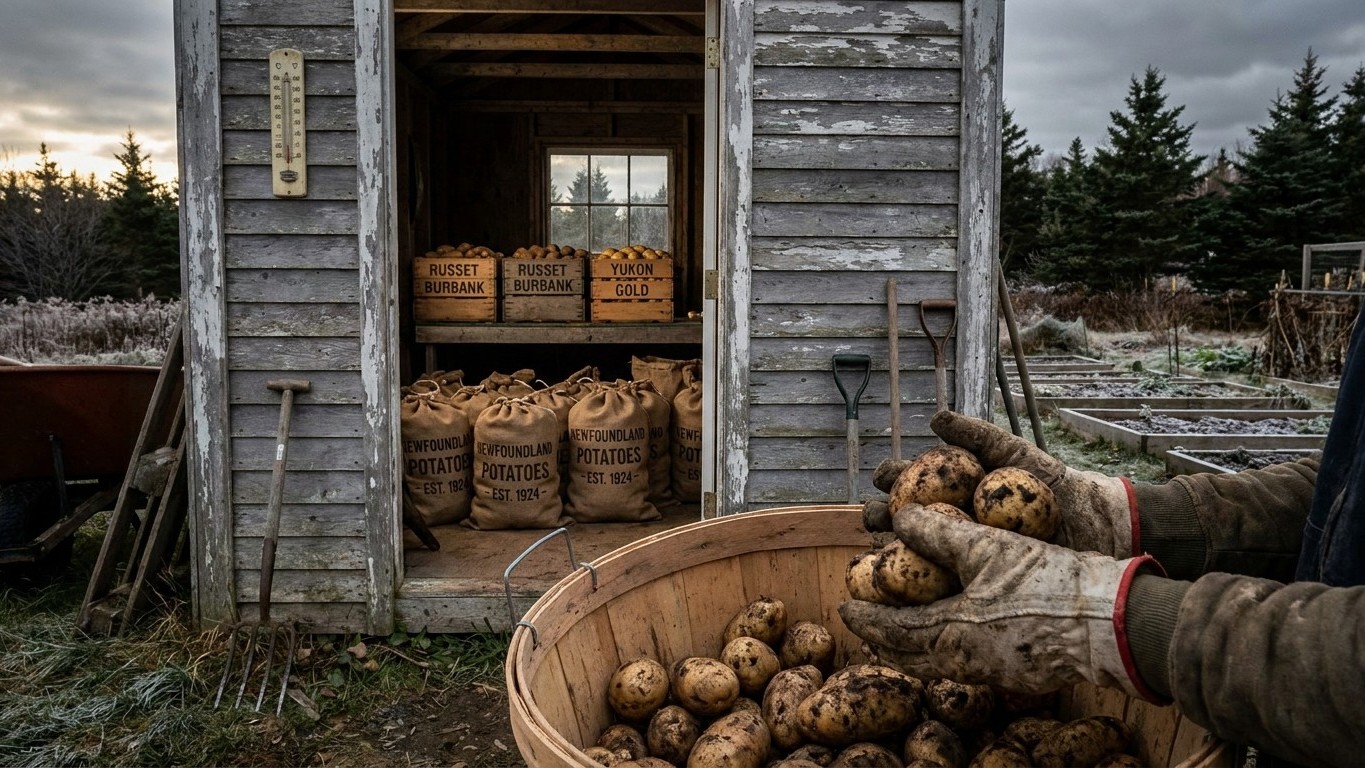

Frost at St. John’s arrives on average October 17, and the coldest month’s mean minimum sits at 16.4 F (Environment and Climate Change Canada, Canadian Climate Normals 1981-2010). That combination means the harvest window closes early and hard, and it also means no unheated shed, porch, or garage in this province holds the 40-45 F storage range once real winter arrives. Anyone growing potatoes here needs a plan for both ends: getting the crop out before the ground freezes, and finding a space that stays above freezing but well below room temperature for months afterward.
The short answer
Two numbers govern everything about growing and keeping potatoes in Newfoundland and Labrador. The first is the average first fall frost at St. John’s, October 17. The second is the mean daily minimum of the coldest month, 16.4 F. Neither number is a guarantee, but together they tell you what kind of season and what kind of storage space you’re working with.
October 17 is a mean date pulled from thirty years of records at the ST JOHN’S A station, not a promise. In one year out of two, the frost lands later than that date, and in the other half it lands earlier, sometimes by a couple of weeks. Treat it as the midpoint of a window rather than a line you can plan against exactly. It also reflects conditions around St. John’s specifically. A province this size is not one climate: gardens on the Avalon Peninsula near the coast often see frost show up later than inland or upland districts, and parts of Labrador run well behind that October date, sometimes by several weeks. Anyone gardening outside the immediate St. John’s area should watch local conditions rather than lean on this single figure.
The 16.4 F figure matters just as much, maybe more, because it decides what happens after the crop is dug. That’s the average low during the coldest month, not the record low and not the daily average, just the typical overnight minimum. A shed, an unheated porch, or a detached garage in this province will regularly sit at or below freezing for weeks at a stretch once that coldest month sets in. Potatoes stored in a space like that don’t just get chilly, they freeze solid, and a frozen potato turns soft, sweet, and unusable once it thaws. So the practical answer is this: dig the crop before mid-October in most areas of the island, earlier in Labrador and upland districts, and plan on a basement, an insulated room, or another space with some heat retention for storage, because nothing left unheated through a Newfoundland winter will hold the 40-45 F range on its own.
Curing, and where
Utah State University Extension recommends curing freshly dug potatoes at 55-60 F with high humidity for two to three weeks before they go into long-term storage. That step heals small cuts and bruises from digging and toughens the skin, and skipping it leads to rot later on. The trouble in Newfoundland and Labrador is timing: the crop typically comes out of the ground in the weeks leading up to that mid-October frost date, and by then, outdoor air on the island is often already running cooler than 55 F, especially overnight. Finding a spot that holds steady in that range takes some searching rather than just setting bins on a back step.
- Dig on a dry day, ahead of frost. Choose a stretch of dry weather before the average October 17 frost date arrives, remembering that in half of all years frost comes later and in half it comes sooner, so don’t wait for a hard freeze to force the issue.
- Brush off soil without washing. Wet skins slow curing and encourage rot, so let excess dirt fall away and leave the potatoes dry.
- Move them indoors quickly if evenings are already cool. Once outdoor lows start dropping past the 55-60 F range, which happens early in this climate, an unheated porch or shed will run too cold. A heated basement corner, a mudroom near the house’s heat source, or an insulated garage with a small space heater tends to work better than anything left to outdoor air.
- Keep the space dim and humid. Cover bins loosely with burlap or breathable cloth to hold moisture around the tubers without trapping condensation directly on the skins.
- Hold for two to three weeks before moving to cold storage. Check periodically for soft spots, and pull out any potato that starts to break down before it spreads to the rest of the bin.
Storing through this winter
Once curing is done, the target shifts. Utah State University Extension puts long-term storage at 40-45 F in the dark, and the University of Maine Cooperative Extension gives a slightly different benchmark, 38 F at 95 percent humidity. Both point the same direction: cold, dark, and humid, well above freezing but well below a heated living space. The question in Newfoundland and Labrador is where that range actually exists once the coldest month sets in with a mean minimum of 16.4 F.
An unheated garage or shed will not do it. At 16.4 F average overnight lows, those spaces spend the coldest stretch of the year well under freezing, and a batch of potatoes left there won’t just chill, it will freeze through repeatedly, turning soft and sweet-tasting as the starches convert to sugar, and eventually breaking down into mush once it thaws. A root cellar dug into the ground, or a basement room against the foundation, holds heat from the earth around it and from the house above, which tends to keep it closer to that 38-45 F band even when outdoor temperatures fall well below freezing for weeks at a time. An insulated closet on an unheated but attached section of the house, or a corner near a chimney or heating duct that isn’t in a fully conditioned space, can sometimes split the difference too, though it takes some trial and error with a thermometer to confirm it stays in range rather than drifting warm on a mild day or cold during a hard snap.
The practical move is to check the space with an actual thermometer through the coldest weeks rather than assume. A basement corner that reads 42 F in November can still drop into the 30s during a deep cold snap in January or February if it’s not well insulated from an exterior wall, and that’s enough to damage the crop. Consistency matters as much as hitting the exact number.
What goes wrong here
- Digging too late and hitting frozen ground. Waiting past the average October 17 date without a backup plan means a cold snap can freeze the soil before the crop is out. Dig on the first good dry stretch once the season turns, and don’t assume the average date buys extra time.
- Curing in a space that’s already too cold. Outdoor evenings in this province often drop below the 55-60 F curing range well before harvest wraps up. Move bins indoors to a heated room or insulated space rather than leaving them on a porch or in a shed once nights turn cool.
- Storing in an unheated outbuilding through the coldest month. With a mean minimum of 16.4 F, sheds and detached garages freeze solid for extended stretches. A frozen and thawed potato turns soft and sweet and won’t keep. Move storage into a basement, root cellar, or another space with some retained heat.
- Storing somewhere too warm instead. A heated basement room that runs above 45 F encourages sprouting and shrivels the skins over the winter. Aim for the 38-45 F range described by Utah State University Extension and the University of Maine Cooperative Extension, and check with a thermometer rather than guessing by feel.
- Skipping pest and disease checks before storage. Damaged or diseased tubers spread rot through an entire bin over a long winter. Sort carefully after curing, treat problem plants in the field with an appropriate fungicide or appropriate insecticide as needed during the growing season, and store only sound, dry tubers.
Common questions
Can potatoes stay in the ground past the average frost date?
Leaving them past October 17 is possible in a mild year, since that date is only a mean and frost arrives later about half the time. But it’s a gamble, and a hard freeze in the soil can damage tubers before they’re dug, so most gardeners are better off digging on the first dry stretch once the season turns rather than waiting on the average to hold.
Is a root cellar necessary, or will a basement work?
A basement room, especially one against an exterior foundation wall away from heating ducts, often gets close enough to the 40-45 F range that Utah State University Extension recommends. A dedicated root cellar makes hitting that range easier and more consistent, but it isn’t the only option if the space is checked with a thermometer through the coldest weeks.
Why do stored potatoes taste sweet after a cold winter?
That sweetness signals the tubers have been exposed to temperatures near or below freezing, which converts stored starch into sugar. It’s a sign the storage space dropped too cold at some point, consistent with what happens in an unheated space during a month with a 16.4 F mean minimum.
Does humidity matter as much as temperature in storage?
Yes. The University of Maine Cooperative Extension pairs its 38 F target with 95 percent humidity, and Utah State University Extension also calls for high humidity during curing. Dry storage air shrivels the skins and shortens how long the crop keeps, even if the temperature itself is right.